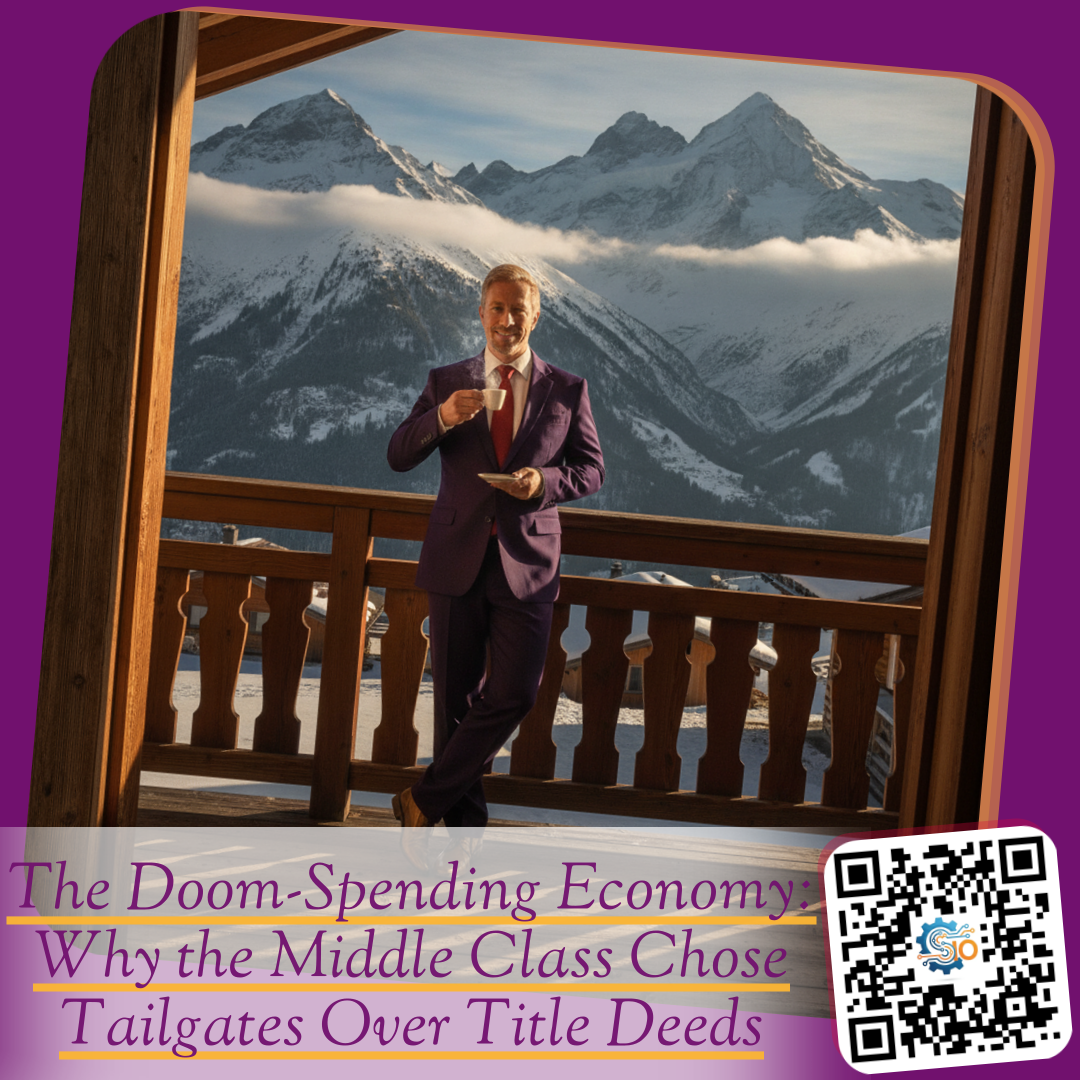
Sitting here by the hearth in my Swiss Alps chalet, watching the autumn mist settle over the jagged peaks of Valais, I cannot help but smile at the latest forecasts rolling out of Wall Street and academic think tanks. For the past two years, conventional economists have promised us an imminent season of agonizing consumer austerity. They pointed to the suffocating math of the suburban mortgage, volatile interest rates, and an unrelenting drip of local crime statistics as proof that families would soon lock their doors, cancel their credit cards, and subsist on canned beans while hoarding cash in high-yield certificates of deposit.
Yet if you look at the departure screens at Miami International Airport this weekend, you will not find an anxious public quietly retreating into financial bunkers. You will find crowds packing gate lounges, clutching boarding passes to Bali or booking last-minute regional flights to college towns across America. The pundits completely miscalculated the psychological reality of our era. When the dream of acquiring a deed to an overpriced split-level home dies, people do not suddenly become monastic savers. Instead, they pivot straight into what cultural observers call the doom-spending cycle, converting theoretical long-term security into immediate, high-velocity experiences.
The Broken Ladder and the Death of Generational Thrift
For three generations, middle-class existence ran on a simple social contract. You sacrificed youthful indulgence, accepted corporate friction, and funneled your monthly surplus toward a thirty-year mortgage and an indexed retirement portfolio. That calculation collapsed when the median home price disconnected entirely from median wages. When the cost of entry into modest homeownership requires two decades of deprivation in a market plagued by rising property taxes, high insurance premiums, and urban anxiety, people simply walk away from the table.
We saw the preliminary warnings of this shift when I wrote about The Great Capital Flight: From Shiplap Fantasies to Geopolitical Chokepoints. The illusion that domestic real estate represents an untouchable sovereign sanctuary has steadily dissolved. Add in the chronic unease that urban centers cannot guarantee basic safety, and you get a collective psychological surrender. Instead of striving for an unattainable asset, the consumer asks a much more visceral question: why hoard depreciating currency for a hypothetical retirement when the world feels deeply fragile right now?
As I noted in The 125-Year Sandwich and the Ten Percent Doom Clock, human behavior changes dramatically whenever the collective time horizon shrinks. When long-term promises look increasingly fictitious, people liquidate their future to finance the present. This is not reckless ignorance. It is an intentional reallocation of utility.
The Geography of Pure Utility: Bali Cliffs and Isle Royale Silence
Where does that unspent down payment go? It goes directly into high-octane escapism and unforgettable geography. Consider the sudden surge of travelers braving the treacherous limestone spine above Kelingking Beach on the island of Nusa Penida. A decade ago, that remote Indonesian viewpoint attracted only intrepid backpackers. Today, it is teeming with young professionals who spent five thousand dollars on flights, villas, and private drivers because they decided a seaside memory carries infinitely more tangible value than an escrow account.
For those seeking solitude rather than tropical spectacle, the reaction is equally intense. Travelers look to remote sanctuaries like the rugged northern wilderness described by ranger Craig Berg Isle Royale reports, where untouched lake water and dense boreal forest offer a complete psychological detox from algorithmic pressure and modern malaise. Whether it is an overcrowded cliff overlooking the Indian Ocean or a remote trail in Lake Superior, the motivation remains identical: buying peace, status, and raw vitality today because tomorrow feels deeply uncertain.
The Sacred Ritual of Autumn Saturdays
If international air travel represents one side of this spending coin, the other side is unmistakably domestic, tribal, and played out on Saturday afternoons. College football has become the ultimate beneficiary of the doom-spending impulse. There is an electric, almost religious urgency to the gridiron calendar that no financial spreadsheet can diminish.
Consider the sheer logistical capital fans poured into rivalry weekend and early-season matchups. Enthusiasts spent thousands to watch Iowa State vs Iowa in the classic battle for state bragging rights, knowing full well that fuel, hotel surcharges, and secondary-market tickets erased six months of disciplined budgeting. They showed up in force for Memphis vs Boise State, seeking the chaotic thrill of two non-traditional powerhouses trading punches under stadium lights.
You see the exact same unrestrained devotion across every tier of the sport. Fans emptied their weekend accounts to travel for Middle Tenn. vs Marshall, Jax State vs Ohio, and Southern Miss vs Auburn. Supporters rallied behind UTSA football as the Roadrunners continued to capture local pride, while Syracuse football faithful packed the JMA Wireless Dome to witness the dawn of a new offensive era. Loyalists journeyed to watch Towson vs South Carolina and Ga Southern vs Clemson, celebrating the pageantry even when the odds were decisively stacked against them. Even long-suffering Vanderbilt football enthusiasts found themselves booking flights and luxury tailgate packages, savoring an unexpected burst of competitive fire in the brutal Southeastern Conference.
To an institutional banker, paying hundreds of dollars for parking and thousands for club-level seats to watch an unranked non-conference clash looks like fiscal madness. But to a generation that has abandoned the hope of owning real estate, that Saturday tailgate represents the highest possible return on investment: deep camaraderie, intense drama, and genuine communal joy that cannot be repossessed or taxed away.
Building True Independence in an Unstable World
While I thoroughly understand why people choose tailgates and Balinese beaches over phantom mortgages, pure doom-spending carries its own trap. Trading away your future for instant dopamine may feel liberating in your twenties and thirties, but it leaves you structurally vulnerable to economic shocks. The real art of modern living is not choosing between joyless austerity and nihilistic indulgence. The real secret lies in creating automated, sovereign business systems that fund high-velocity living while simultaneously building genuine financial freedom.
That is why I have spent the last decade preaching operational autonomy. You do not need a bloated corporate infrastructure or a massive staff to create substantial recurring income. By leveraging an all-in-one platform like Systeme.io, you can construct an entire digital enterprise, automate sales funnels, manage memberships, and distribute high-value knowledge products from a single dashboard. Whether you are running campaigns while relaxing on a sun lounger in Nusa Penida or checking your metrics between quarters at a stadium, clean operational architecture gives you the liberty to experience life fully without liquidating your future.
True sovereignty means you never have to choose between enjoying the moment and securing your family. When your business operates seamlessly in the background, life ceases to be an agonizing trade-off between boring frugality and reckless consumerism.
The New Rules of Middle-Class Survival
The pundits waiting for consumer austerity will continue to be bewildered by airport foot traffic and sold-out stadiums. They are reading an economic playbook written for an era that no longer exists. When institutions break the standard path to prosperity, individuals will invent their own definitions of success, prioritizing vivid memories over real estate deeds.
If you find yourself caught in the turbulence of this transition, remember that you control your own perimeter. Do not let outdated societal expectations dictate your life choices, but do not let collective cynicism rob you of your independence either. Build assets you control, design cash-flowing systems, and savor every single Saturday along the way.
Have you felt the temptation to trade long-term financial milestones for immediate, vibrant life experiences? Where do you draw the line between living authentically and protecting your future freedom?
May your autumn days be full of brilliant clarity, great games, and genuine prosperity. Connect with me across my social networks to share your thoughts, and let us keep navigating this wild landscape together with purpose and style.