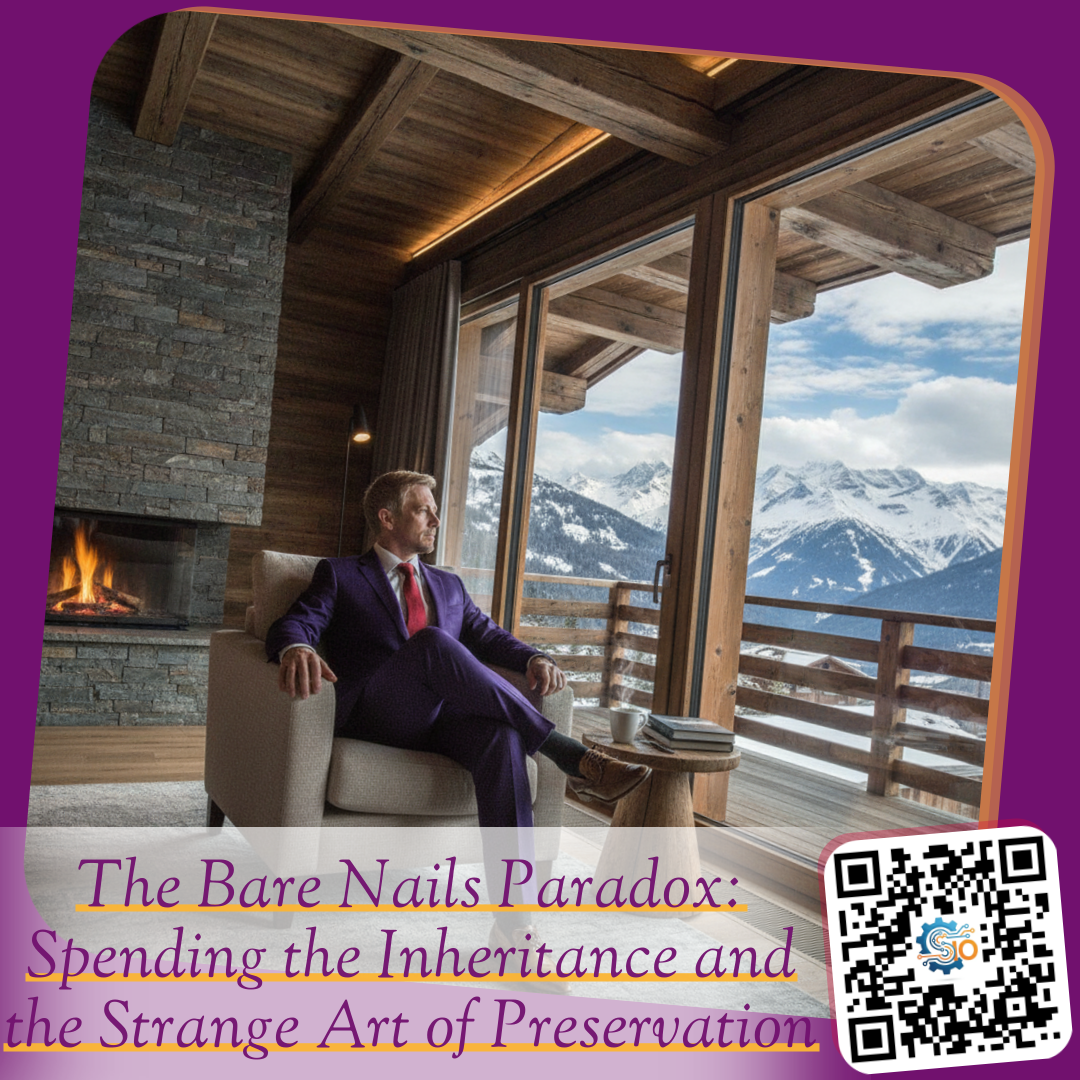
The morning light across the Swiss peaks has a way of stripping away illusions. Sitting here on my balcony with a fresh espresso, wearing a crisp purple suit and my favorite golden shoes, I often reflect on how our perception of wealth changes with the seasons. We are living through a rather fascinating cultural turning point. On one side of the ledger, a growing generation of retirees proudly announces that they would rather spend their children’s inheritance on first-class world tours, five-star cruises, and bespoke vacations. On the other side, the cultural elite embraces the bare nails aesthetic, turning minimalist grooming into a quiet luxury status symbol that whispers pedigree without shouting logo prints.
It creates an extraordinary paradox. We are simultaneously consuming our accumulated family capital at record velocity while adopting an aesthetic that feigns utter detachment from material excess. If you strip away the polished surfaces, you arrive at an uncomfortable question. When our grandchildren sift through the remnants of our lives fifty years from now, what will actually remain?
The SKI Phenomenon and the Vanishing Family Estate
The concept of spending the kids’ inheritance, often shortened by financial planners to the SKI lifestyle, is no longer a whispered confession. It is celebrated openly. Retirees who worked decades inside corporate machines are deciding that leaving a fat portfolio or prime real estate to adult children is outdated. Why leave a house when you can buy memories across seven continents? While I am a lifelong believer in celebrating personal freedom and savoring the fruits of your labor, this trend marks a radical shift in how human beings view dynastic continuity.
For centuries, the primary instinct of human families was generational accumulation. You worked so your children started five paces ahead of where you began. Today, that pact is dissolving into high-end airline tickets, Michelin-starred tasting menus, and luxury camper vans. We explored this shifting landscape of legacy and endurance recently in Will Your Family Name Endure Until 2076? Richard Ayoade, Systemic Poison, and Modern Reputational Risk. When the material fruits of a lifetime evaporate into experiential consumption, the estate effectively flatlines upon departure.
The irony is that this liquidation happens alongside an aesthetic movement that fetishizes plainness. Consider the obsession with manicured bare nails. What used to be the default state of having unpainted hands has morphed into an expensive salon ritual. Achieving the perfect natural look now requires high-end buffing, subtle translucent treatments, and regular salon maintenance. It signals that you have the time and capital to look entirely untouched by manual labor, converting biological simplicity into an elite class marker.
Accidental Relics in an Era of Demolition
If our wealth is spent on holidays and our personal presentation mimics unadorned neutrality, what survives physical time? History shows us that human beings are notoriously terrible at predicting what lasts. Consider the recent discovery of a movie prop key signed by the original cinematic Superman, found completely unbothered and hiding in plain sight inside an old household drawer. Nobody set out to construct a temple around it. It survived simply because an everyday object slipped through the cracks of domestic turnover.
At the very same time, we see real history slipping away because maintenance is deemed too expensive. Historic architecture, battered by seasonal gales, is routinely cleared for demolition because owners find repair costs economically unviable. When a storm-damaged landmark loses its battle with municipal code, it reminds us that physical preservation requires relentless discipline. Without active intervention, the tangible artifacts of our civilization rot, wash away, or end up buried beneath modern drywall.
Compare our disposable approach with the work happening on ancient sites across northern Europe. Archaeologists and masonry experts are currently working to repair a 5,000-year-old tomb, carefully restoring drystone chambers built during the Neolithic era. Think about that for a moment. Five thousand years ago, humans without steel cranes or computer models laid down stones with such profound architectural intent that their funeral chambers outlasted every empire that followed them. Those ancient builders possessed a serious understanding of preservation that makes our modern throwaway culture look painfully short-sighted.
The Illusion of Ephemeral Living and Building What Lasts
There is nothing wrong with luxury travel or pristine, understated aesthetics. I enjoy the finest things in life, from tailor-made tailoring to secluded chalets. However, there is a massive difference between enjoying cash flow and gutting the foundation of your family lineage. Living strictly for the immediate moment often disguises a deeper anxiety about the future.
True sovereignty is not about running your bank account down to zero on a tropical beach simply because the modern world feels chaotic. We touched upon this exact balance between immediate comfort and lasting security in From Pink Clouding to Real Sovereignty: Surviving the Storm and Building What Lasts. If you burn every bridge behind you, you leave the next generation vulnerable to an economic machine that shows zero mercy to those without assets.
To avoid this trap, modern wealth creators must shift their mindset from passive consumption to automated longevity. You do not need to choose between drinking vintage champagne in your golden years and leaving lasting security for your descendants. By building digital infrastructure, automated revenue funnels, and sovereign assets, your business can run seamlessly without demanding your daily physical presence. When I set up automated marketing systems, using intuitive platforms like Systeme.io makes the entire process effortless, allowing entrepreneurs to protect their personal time while establishing an enterprise that pays dividends long into the future.
What Will They Dig Up in Fifty Years?
Imagine archaeologists in 2076 dusting off the remains of our present day. They will not uncover the first-class boarding passes you redeemed in 2026. They will not dig up the minimalist salon treatments that defined our quiet luxury trends. Those things vanish into the ether the moment they are consumed.
Instead, our descendants will discover our accidental survivors. They will uncover forgotten hard drives, curious movie props stuffed behind garage shelves, and fragmented digital footprints. If we are lucky, they might find a few sturdy stone buildings that escaped the wrecking ball. The ancient tomb builders understood that if you want a memory to endure, you must build with materials that defy decay. They committed their time, energy, and resources into structures that defied the centuries.
If you choose to liquidate everything on personal holidays, do so with clear eyes. Understand that bare simplicity can easily tip over into complete cultural erasure. Real freedom means having the financial abundance to travel the globe in style today while preserving a durable lineage of knowledge, values, and tangible assets for tomorrow.
Take a long look at your own balance sheet and your daily habits. Are you building monuments that endure, or are you quietly consuming your foundation under the cover of minimalist sophistication? If you disappeared tomorrow, would your family inherit an enduring legacy, or just a drawer of forgotten trinkets and empty photo albums?
I wish you clarity, elegance, and unshakeable financial freedom as you navigate your own journey. Share your thoughts on my social media channels and let me know how you plan to balance immediate adventure with lasting preservation.