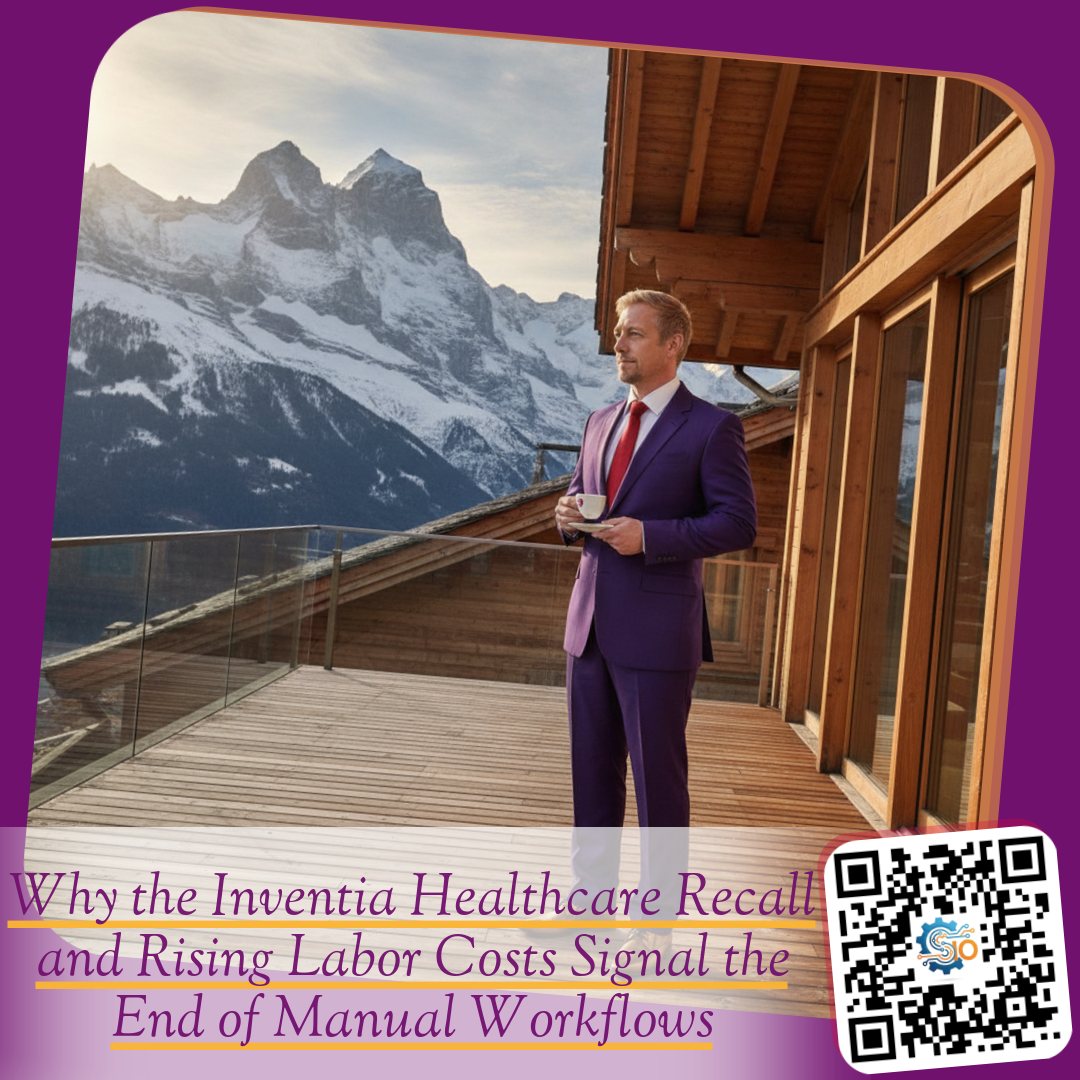
The morning sun in the Swiss Alps has a way of cutting through the fog with ruthless clarity. Sitting out on the terrace of my chalet, dressed in my favorite purple suit with a crisp white shirt, watching the peaks catch the golden light, I find myself thinking about precision. In life, business, and love, precision is everything. When you rely on fragile, haphazard systems, reality always catches up with you.
Just this week, news broke across the medical world about the massive Inventia Healthcare chlorthalidone tablet recall. When a pharmaceutical manufacturer recalls essential blood pressure medication due to cross-contamination and manual packaging errors, everyone pauses. Blood pressure tablets are not novelty keychains. They are matters of life and death. Yet, behind that crisis lies a familiar culprit: human-managed operational failure. When human hands handle every pivot of a delicate chain, disaster is not a question of if, but when.
At the very same moment, small business owners, service providers, and everyday founders are wrestling with fresh macroeconomic shocks. With another wave of statutory minimum wage increases taking effect and Personal Consumption Expenditures (PCE) price index numbers refusing to cool down, the squeeze on physical, manual operations has reached a breaking point. If your entire workflow depends on manual human coordination, you are standing on quicksand.
The Lesson of the Inventia Healthcare Chlorthalidone Recall
Let us look closely at what happened with the Inventia Healthcare chlorthalidone recall. Chlorthalidone is a frontline diuretic used by millions to manage hypertension. It requires strict chemical precision, disciplined dosage calibration, and uncompromising packaging integrity. Yet, human oversight slip-ups permitted mislabeled dosages and cross-contamination to slip into distribution channels.
I wrote about this systemic fragility earlier in Biological Sovereignty and the Collapse of Synthetic Cardiovascular Security, where we explored how synthetic safety nets fail when centralized oversight rots from within. The tragedy is that Inventia Healthcare did not intend to fail. Nobody wakes up planning a nationwide recall. Rather, their operational architecture relied on human checks where automated verification should have been sovereign.
Manual data entry, manual sorting, manual spot-checking, these are relics of the twentieth century masquerading as modern industry standards. If high-stakes pharmaceutical facilities cannot keep human error from tainting critical medicine, what makes you think your three-person customer service desk or manual spreadsheet invoicing will remain spotless?
The Inflationary Pinch: Minimum Wage, PCE, and the Crushed Business Owner
While product recalls show the physical dangers of manual operations, macroeconomic metrics show the financial impossibility of maintaining them. Recent updates to the PCE price index demonstrate that core inflation continues to eat into real business margins. At the same time, regional and national legislation keeps pushing the minimum wage higher to help workers cope with daily survival costs.
Consider the typical commercial tenant today. Your landlord raises your commercial lease because property taxes and facility maintenance have doubled. Your junior staff asks for a mandated minimum wage hike just to afford their grocery bills. Meanwhile, supplier costs escalate every quarter. The business owner caught in the middle is running on fumes.
If you are paying rising hourly wages for tasks that a machine can execute in milliseconds, you are subsidizing operational friction. Paying a human being twenty-five dollars an hour to copy data between forms, send manual confirmation emails, and manually reconcile invoices is economic suicide. It drains human morale and bleeds cash reserves that should be directed toward strategic growth, luxury, and true financial freedom.
Paper Empires and the Illusion of Control
Many entrepreneurs cling to manual processes because of an illusion of control. They believe that watching an employee type on a keyboard gives them certainty. In reality, it gives them nothing more than a front-row seat to inevitable mistakes. I touched on this fundamental deception in The Fall of Sham Contracts: Why Real Value Destroys Paper Empires. You can sign all the non-disclosure agreements, work orders, and compliance checklists you want, but paper cannot fix a flawed workflow.
Manual processes create silent operational bottlenecks. An employee catches the flu, a package gets labeled with the wrong dosage, an invoice goes out with an extra zero, or an inquiry from a high-ticket client sits unread in an inbox over a long weekend. In a world moving at digital speed, friction equals irrelevance.
Furthermore, human-dependent overhead turns every external shock into an existential emergency. When your operations are bound to physical headcount for routine repetitive tasks, every minimum wage hike and every spike in PCE statistics directly threatens your business solvency. You cannot scale peace of mind on top of manual friction.
The Shift Toward Sovereign Automation
True resilience requires you to dismantle fragile chains before they break. We are living through a massive structural transition, an evolution I detailed in The Liquidation of Physical Legacy and the 2035 Digital Architecture Shift. In that piece, we examined how physical encumbrances are dissolving in favor of nimble, digital sovereignty. The same logic applies directly to your daily business operations.
Automation is not about stripping human warmth from the world. It is about protecting human energy for things that actually matter: creative vision, personal connection, strategic negotiations, and enjoying the finer things in life. Repetitive tasks, such as lead nurturing, cart follow-ups, affiliate tracking, and membership administration, belong to autonomous digital systems.
This is where building an integrated digital infrastructure becomes mandatory. Instead of juggling six disconnected software subscriptions held together by manual copy-pasting, forward-thinking operators use unified platforms. With an all-in-one ecosystem like Systeme.io, your funnels, email sequences, customer management, and digital course delivery talk to each other without human intervention. When a transaction occurs, the system triggers the access, issues the receipt, and tags the customer instantly, eliminating the exact types of human oversight that lead to catastrophic failures like the Inventia recall.
Building Your Bulletproof Operational Engine
If you want to secure your enterprise against labor market volatility and operational hazards, you must audit your daily routine today. Here is the blueprint I recommend to anyone seeking genuine autonomy:
- Identify Every Manual Hand-off: Map out every step in your sales, fulfillment, and customer care pipelines where human hands must touch the data. Each touchpoint is a vulnerability waiting to fail.
- Automate the Monotonous: Set up triggers for customer onboarding, recurring billing, and service follow-ups. Let machines do the heavy lifting while you focus on high-level strategy.
- Shield Your Margins from Regulatory Shocks: By minimizing your reliance on low-skill manual hours, you insulate your bottom line from statutory wage spikes and landlord rent increases.
- Demand Absolute Traceability: Automated audit trails do not get tired, distracted, or forgetful. They deliver exact verification for every single event in your ecosystem.
Sitting here adjusting my red tie and catching my reflection in the glass of this mountain retreat, I know one thing with complete certainty: freedom is the byproduct of immaculate structure. You cannot live a life of beauty, romance, and financial independence if you are constantly putting out fires ignited by manual blunders.
The Inventia Healthcare recall and the rising minimum wage are not random, isolated events. They are the flashing red warning lights of an economic paradigm that has run out of road. You can choose to listen to the signal now, or you can wait for your manual systems to deliver their own costly reckoning.
Reflections for the Road Ahead
How many manual touchpoints in your business are currently one bad day away from a catastrophic error? If regulatory labor costs were to jump another twenty percent tomorrow, would your current business model thrive or collapse under the weight of human overhead?
I wish you clarity, courage, and unshakeable prosperity in your pursuits. Let us continue this conversation across my social networks, and let me know how you are restructuring your systems for true autonomy.