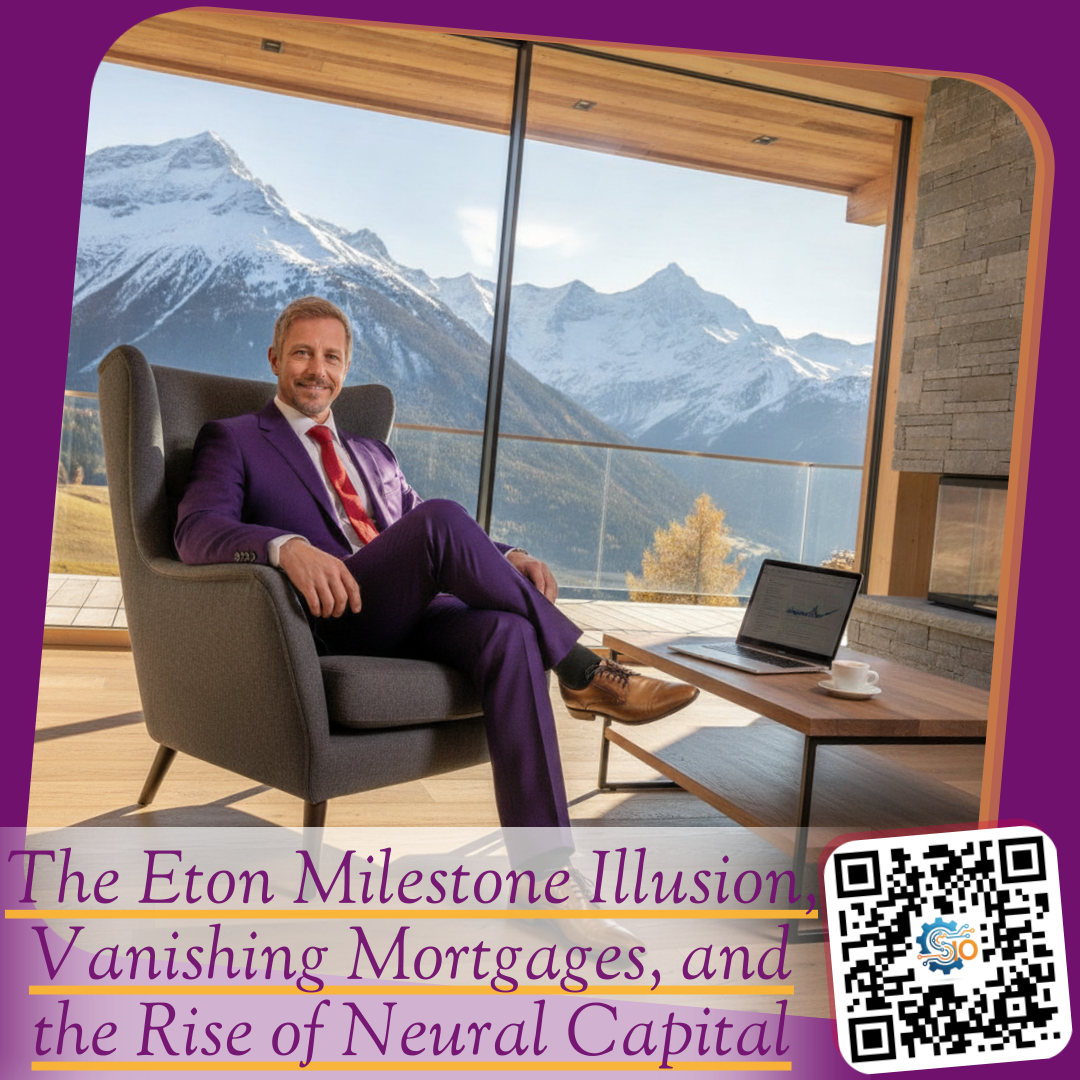
Good morning from the Swiss Alps, my friends. The autumn air up here is crisp, the espresso is hot, and the morning light catches the gold on my shoes just right as I look out over the jagged peaks. October always brings a peculiar kind of clarity. While the rest of the world gets swept up in grand media pageantry, I prefer to sit by the fire in my purple suit and examine what is actually happening beneath the polished veneer of modern society.
If you opened any major publication this week, you could not miss the royal headlines. The British establishment is swooning over Prince George and his upcoming Eton College milestone. We see photographs of ancient Gothic chapels, immaculate cricket lawns, and centuries of inherited prestige wrapped in tails and waistcoats. The narrative is clear: tradition is alive, continuity is guaranteed, and the British royal family remains an eternal fixture of global stability.
Yet, if you look away from the grand gates of Eton for just a second, the rest of the economic landscape tells a completely different story. Behind the royal fanfare lies an inescapable reality: the old structures of hereditary security and state-backed middle-class prosperity are crumbling in real time.
The Broken Ladder of Help to Buy
Consider the stark contrast between Windsor splendor and the everyday reality of ordinary citizens trying to secure a home. For over a decade, British citizens were sold the dream of state-sponsored property ownership through the Help to Buy equity loan scheme. It was marketed as a benevolent bridge to financial independence, a way for hard-working families to claim their own little piece of the realm.
Today, that bridge has effectively turned into a trap. With interest-free grace periods expiring and mortgage rates remaining painfully elevated, thousands of homeowners face ballooning fees on loans they can neither remortgage nor pay off. Properties bought at artificial premiums during the peak of government incentives are now underwater. The very mechanism designed to simulate old-fashioned security has left participants vulnerable to institutional repossession.
We saw the early warnings of this institutional collapse in our previous discussion, The Spanish Housing Revolt and the Illusion of State Shelter. When central authorities promise to engineer affordable living while propping up inflated assets, the outcome is always systemic fragility. As I wrote in The Fall of Fragile Systems: Madrid Evictions, Snap Elections, and Building True Financial Sanctuary, relying on bureaucratic benevolence for your foundational safety is a strategy destined for heartbreak. The Help to Buy model has failed because physical property within legacy jurisdictions is no longer designed to build sovereign independence for the middle class; it is designed to extract steady yields for institutional creditors.
The Era of the Ghost Seed Round
If ancestral land and state-backed housing are no longer viable engines of social mobility, where has the capital gone? It has not vanished. Instead, it has migrated into the ethereal world of modern venture finance, giving birth to a fascinating phenomenon: the ghost seed round.
In tech corridors from London to San Francisco, ambitious entrepreneurs are no longer building businesses that produce tangible goods or generate predictable cash flows. Instead, we see millions of dollars flowing into stealth projects with zero revenue, zero customer traction, and often no demonstrable product at all. These are the ghost seed rounds: funding cycles built entirely on phantom valuations, esoteric whitepapers, and breathless promises of generative dominance.
Capital is desperate. Traditional bonds offer negative real returns when accounting for persistent inflation, and traditional brick-and-mortar investments are choked by regulatory inertia. As a result, allocators pour wealth into speculative phantoms. The ghost seed round is not an investment in productive enterprise; it is a financialized lottery ticket. It reflects a world where ancestral prestige and tangible manufacturing have been liquidated in favor of purely abstract narrative arbitrage.
Karl Deisseroth and the Neural Capital Frontier
This massive shift goes far deeper than venture speculation. What we are witnessing is the dawn of what neuroscientist Karl Deisseroth pioneered through the tools of optogenetics: the ability to control, map, and monetize the fundamental wiring of human biological consciousness. We explored this quiet revolution recently in The $5,000 Check Illusion: Karl Deisseroth, Aunt Bessie, and the Rise of Synaptic Stasis.
The traditional economy was based on land, physical labor, and hereditary property rights. The prince inherited land; the commoner worked the soil or took out a mortgage to buy a suburban terrace. But Karl Deisseroth showed the world that biological circuits can be targeted with light and precision code. In the modern economy, the most valuable real estate on earth is no longer the acres surrounding Eton College; it is the neural real estate inside your skull.
Neural-driven capital does not care about family crests or hundred-year leaseholds. It cares about dopamine loops, biometric data extraction, cognitive attention spans, and synthetic synaptic mapping. Tech giants and algorithmic funds understand that whoever controls human attention controls total economic velocity. Ancestral prestige is an elaborate theatrical display designed to keep the public focused on yesterday, while neural architects harvest the value of tomorrow.
Building Your Own Sovereign Castle
Watching Prince George take his steps toward Eton College while Help to Buy borrowers struggle with negative equity might feel discouraging if you still believe in the old rules. But for those of us who observe the world with clear eyes, it is simply a call to action. You cannot play a nineteenth-century game in a twenty-first-century digital environment.
True sovereignty today does not come from waiting for an inheritance, nor does it come from begging a bank for an equity loan. It comes from owning your distribution, your cash flow, and your direct connection to the global market. You do not need a ghost seed round of twenty million dollars to build genuine security. You only need lean, automated infrastructure that solves real problems for real human beings.
This is why I constantly remind my inner circle to build independent online platforms. Using an all-in-one platform like Systeme.io allows you to create marketing funnels, manage email communities, host digital products, and automate sales without paying exorbitant enterprise fees or waiting for venture capital approval. When you build with Systeme.io, you create a private digital fortress that generates independent cash flow regardless of what central banks or property markets decide to do.
The Real Lesson of Windsor Theater
There is nothing wrong with admiring tradition. Eton College has produced prime ministers, scholars, and monarchs for centuries, and Prince George will undoubtedly carry that banner with poise. But we must never confuse ceremonial theater with economic reality.
The British royal family can afford centuries of symbolic continuity because their foundation was established in a completely different era of wealth accumulation. If you attempt to replicate that model by clinging to dying state assistance schemes or chasing speculative financial ghosts, you will find yourself locked out of the future. The real power today belongs to those who understand neural attention, master automated digital systems, and protect their personal autonomy at all costs.
Are you still placing your faith in the old institutions of land and pedigree, or have you begun building your own digital citadel? What steps are you taking this week to ensure your financial sanctuary remains untouched by bureaucratic collapse?
I wish you all sharp vision, steady discipline, and a wonderful autumn week ahead. Drop by my social media channels to share your perspectives on these changing tides, and let us keep building true sovereignty together.