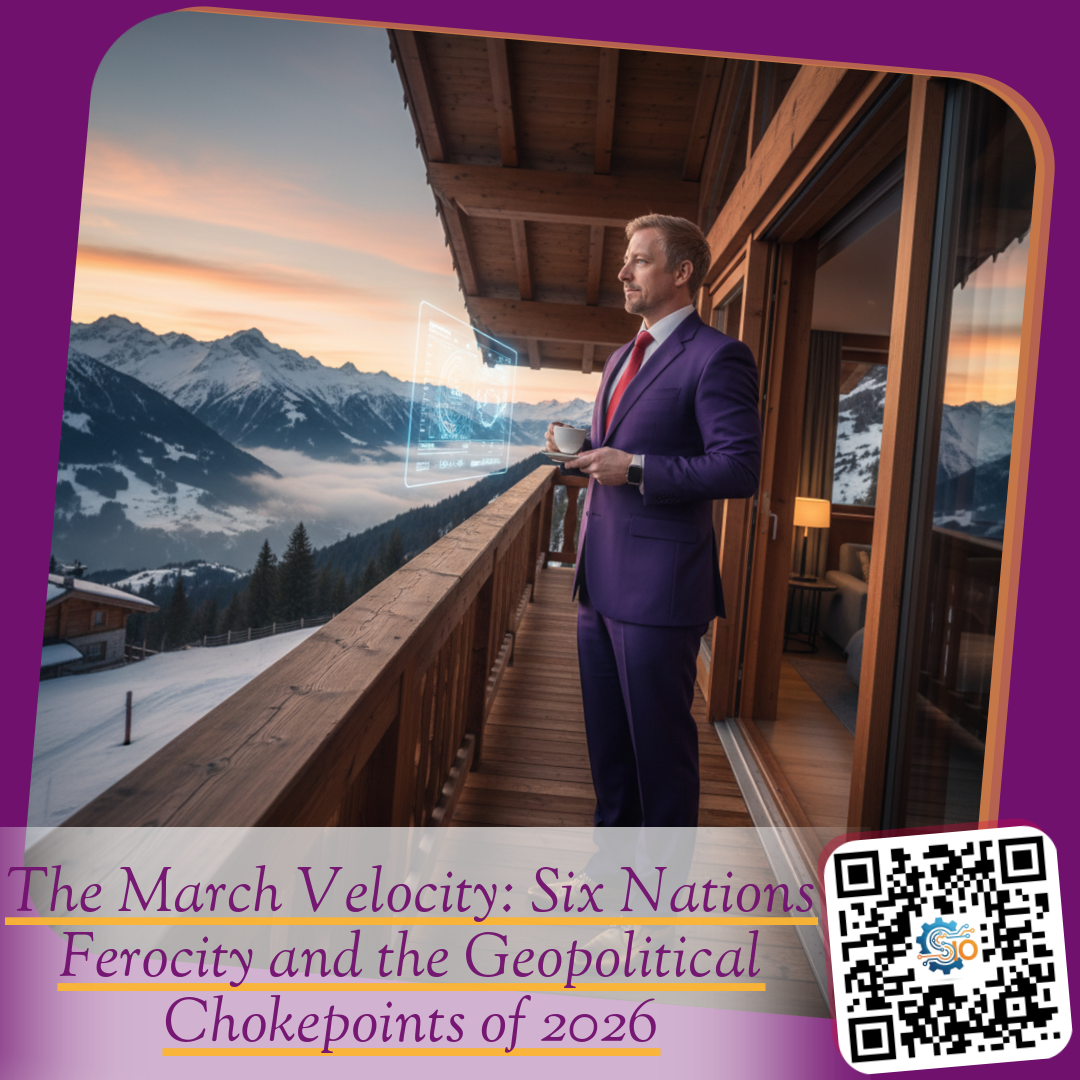
There is a specific kind of stillness that only exists in the Swiss Alps at half-past five in the morning. Looking out from the balcony of my chalet, the peaks are currently bathed in a pre-dawn indigo. It is Sunday, 15 March 2026, and while the air here is crisp and silent, the rest of the world is vibrating with an intensity that feels almost tectonic. I am sitting here in my favorite purple suit, a fresh espresso on the table, watching the digital tickers flicker with news that would have seemed like a fever dream just a few years ago.
We have officially entered what I described in a previous post as Pi Day Chaos and the 2026 March Velocity: From Madrid to March Madness. The sheer speed of events is staggering. From the rugby pitches of Europe to the volatile waters of the Persian Gulf, the friction of our era is reaching a boiling point. It is a time where luxury and survival are intertwined, and where the ability to remain calm in the eye of the storm is the ultimate currency.
The Ferocity of the Six Nations Finale
Yesterday was a day for the history books in the world of rugby. If you follow the sport with the same passion I do, you know that the Six Nations is more than just a tournament; it is a seasonal ritual of grit and national identity. This year, the drama reached a fever pitch. We saw Ireland display a ferocity that was almost frightening, shattering Scottish hopes in a match that will be studied for years. As the headlines noted, a shot at history passed Scotland by amid that Irish green wall.
But the real story for many was Wales. After a long, agonizing drought, they finally stunned Italy to end their losing streak. Even Prince William was spotted watching the Welsh win their first game in three years. It was a moment of pure, unadulterated emotion. However, the ultimate glory belonged to France, who took the title with a thrilling last-gasp win over England. It was a finale worthy of the greatest Six Nations ever, providing a much-needed distraction from the heavier clouds gathering over the Middle East.
Geopolitical Friction and the Black Rain
While we celebrate the grace of an oval ball, the reality of the Iran war is casting a long, dark shadow over global stability. The headlines today are dominated by the aftermath of strikes on Tehran oil facilities, which have led to reports of a disturbing phenomenon: black rain. This is not just a meteorological anomaly; it is a physical manifestation of what I called The Black Rain and the Oxidization of Our Bespoke Reality. Our world is literally changing color under the pressure of kinetic conflict.
The US military has released video of strikes on Iranian vessels near the Strait of Hormuz, a move that has sent shockwaves through the global energy market. The targeting of Kharg Island has laid bare the world’s reliance on Gulf oil and gas. We are seeing a massive spike in prices at the pump, and in places like Northern Ireland, drivers are bracing for a period of extreme uncertainty. This is the reality of Kharg Island Anxiety and the Costco Recall: Navigating the Defensive Consumer of 2026. When the chokepoints of the world are squeezed, the effects ripple into every supermarket aisle and petrol station on the planet.
The Economic Pivot and the Trump Factor
Adding to this complexity is the shifting stance of the United States. President Trump is seeking to close a 1.6 trillion dollar revenue gap with a raft of new tariffs, while simultaneously easing some sanctions on Russian oil. It is a high-stakes game of economic chess. Many are asking if Putin will ultimately benefit from the Iran war, or if the US can successfully navigate this without plunging the global economy into a tailspin. Meanwhile, the move to resume diplomatic ties with Venezuela after the capture of Maduro suggests a frantic search for alternative energy sources.
In the midst of this, the F1 has cancelled the Bahrain and Saudi Arabia Grands Prix. When the circus of Formula 1 packs up its tents, you know the situation is grave. The paddock is silent, replaced by the roar of drones and the strategic movement of warships. It is a stark reminder that even the most elite sports are not immune to the hard realities of geography and war.
The Necessity of Digital Independence
As a man who enjoys the finer things in life, I have always believed that financial freedom is the only true defense against global volatility. When you see a 1.6 trillion dollar revenue gap being discussed by world leaders, you realize that the traditional safety nets are fraying. This is why I have spent years building systems that operate independently of local crises. Whether it is a border-spanning viaduct restoration or a total shutdown of the pumps, my business must remain fluid.
To achieve this, I rely heavily on automation. In times of chaos, you cannot be tethered to a desk or a specific geography. I use tools like Systeme.io to ensure that my marketing funnels and customer interactions continue to flow, even when I am busy monitoring the latest drone strikes or watching the Oscars 2026 build-up. Having an all-in-one platform like Systeme.io allows me to maintain a luxury lifestyle in the Alps while the “March Velocity” tears through the old world order. It is about creating a digital fortress that protects your time and your peace of mind.
Tributes and Cultural Echoes
It is not all geopolitics and sports, of course. We also pause to remember those who have shaped our cultural landscape. The news of Motörhead guitarist Phil Campbell passing away at 64 is a heavy blow to the music world. His riffs were the soundtrack to a generation of rebels, a reminder of a time when the friction was found in the Marshall stacks rather than the headlines. Similarly, the death of London’s Burning actor John Alford in prison marks the end of a troubled but memorable career.
In a bizarre twist of the modern age, we are also seeing the return of the medieval manuscript that inspired Bagpuss, and the announcement of a Netflix sequel for K-Pop Demon Hunters. It seems that even in 2026, we are obsessed with the past as a way to escape the present. Whether it is the Oscars buzz surrounding Timothée Chalamet or the latest looksmaxxing trends, we are constantly trying to find new ways to define ourselves in a world that feels increasingly synthetic.
Resilience in the Face of the Storm
The “March Velocity” is not just about speed; it is about resilience. I see it in the children learning about resilience in school, and in the “extinct” butterflies found once again across southern England. There is a stubbornness to life that refuses to be extinguished by war or economic blockades. We see it in the woman reunited with her stolen dog after eight years, and the man who sailed around the world in a boat he built in his own shed. These are the stories that remind us why we fight for our freedom and our bespoke realities.
As we look toward the rest of March, the question remains: how do we navigate this friction? The Iran war shows no signs of an early end, and the fallout from the energy crisis is only just beginning to be felt. Yet, here in the mountains, the sun is finally beginning to hit the glaciers, turning the white peaks into shades of gold. It is a reminder that beauty persists, provided you have the perspective to see it.
I will be following the developments in Mexico closely as well, as they prepare for the World Cup play-off against Iraq. It is a strange world where a war-torn nation takes a private plane to Mexico to play a game, but that is the reality of 2026. Everything is connected, and nothing is as simple as it seems.
How are you adjusting your personal systems to handle the increasing velocity of global change this month? Do you believe that the current energy crisis will lead to a permanent shift in how we value our local resources and independence?
Stay focused, stay elegant, and never let the chaos dictate your pace. I would love to hear your thoughts on my social networks.
Until next time, from the heights of the Alps.