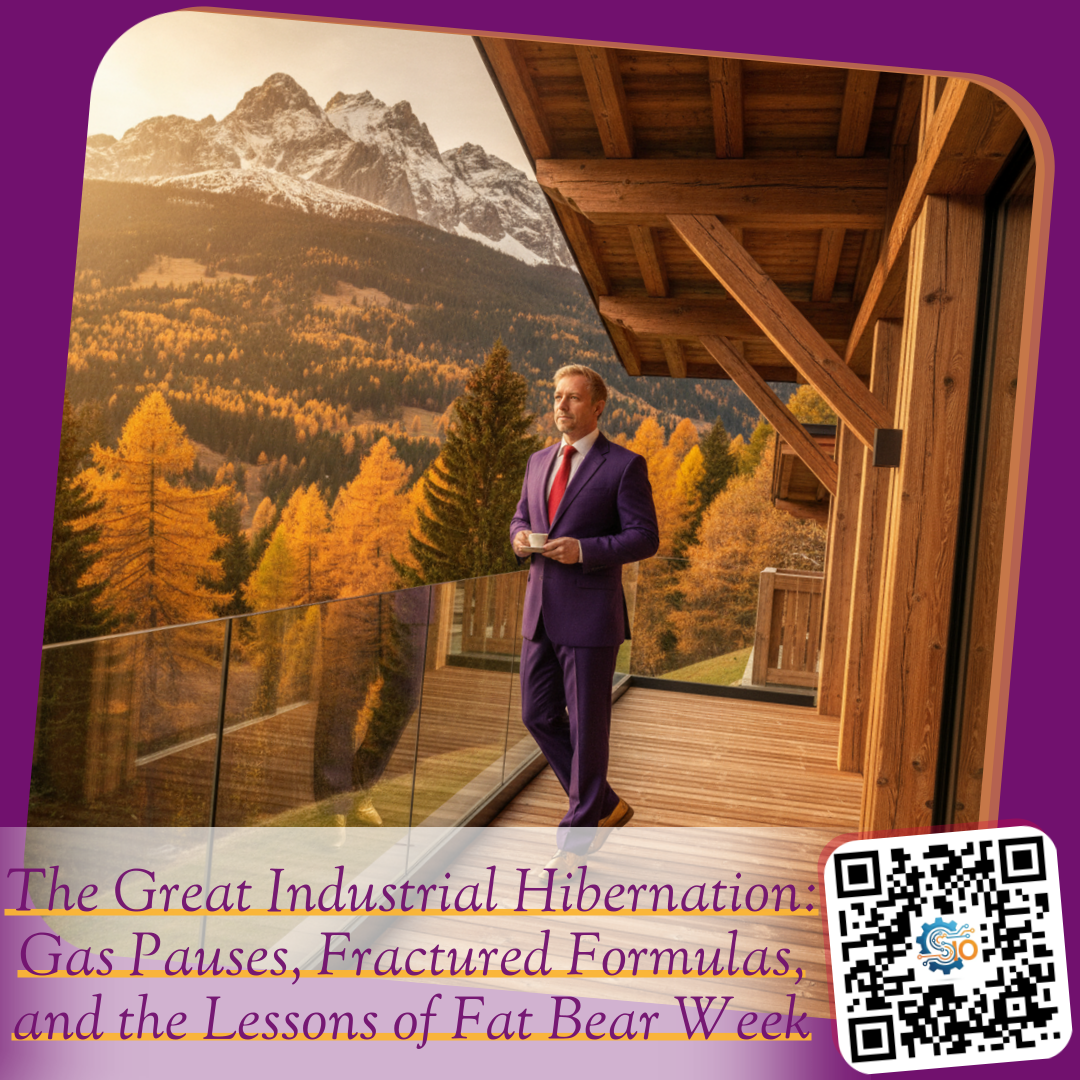
There is a distinct chill rolling over the peaks outside my chalet window this morning. Looking out across the Swiss Alps in late September, you can feel the seasonal machinery shifting into gear. The larch trees are beginning their quiet turn to gold, the alpine breeze carries a serious bite, and down in the valleys, life is subtly reorganizing itself for survival. I poured an espresso, adjusted my red tie against the crisp collar of my purple suit, and caught myself smiling at the sheer predictability of autumn. Nature never negotiates with cold weather. It prepares, it hoards, and when necessary, it shuts down non-essential functions without an ounce of shame.
Yet down in the lowlands of global industry, our hyper-optimized corporate machines are behaving as if seasonal limits were merely optional suggestions. Over the past few weeks, strange tremors have rippled through the industrial landscape. In the United Kingdom, chemical titan INEOS announced a tactical pause on its production lines at Saltend near Hull, driven directly by soaring gas prices that make continuous manufacturing economically irrational. Meanwhile, salon shelves were quietly cleared as batches of Schwarzkopf Osis Grip mousse faced recall after chemical instabilities compromised the formula. On the surface, an industrial gas halt on the Humber and a destabilized styling foam might seem completely unrelated. Look closer through the lens of seasonal thermodynamics, however, and you realize they are symptoms of the exact same phenomenon.
Our modern production systems are being forced into a biological reflex they spent decades trying to engineer out of existence. While boardrooms scramble to explain away their supply hiccups, Katmai National Park in Alaska is currently staging Fat Bear Week, where massive brown bears gorge themselves on sockeye salmon to bulk up for the winter freeze. The bears understand what multinational executives keep forgetting: when the external environment becomes hostile, you do not force unnatural expansion. You build your reserves, you pause your exposure, and you respect the cycle.
When the Burner Shuts Down: The Tactical Pause at Saltend
Let us talk about what happened in Hull. INEOS did not experience a mechanical failure. Their engineers did not drop the ball, and their machinery did not spontaneously disintegrate. They simply looked at the price per therm of natural gas and realized that running an energy-intensive chemical plant into a surging commodity market is financial self-harm. Producing basic chemical building blocks when feedstocks and power costs spike into the stratosphere is a losing proposition. So, they initiated a tactical pause.
We saw this systemic vulnerability coming a mile away. In my earlier reflections on The Architecture of Absurdity: Ammo Arches, Oil Chokepoints, and Personal Sovereignty, we explored how easily brittle logistical corridors can choke real world productivity. When an industrial giant must flick the off switch because the price of input fuel jumps by double-digit percentages, the illusion of perpetual industrial momentum evaporates. It proves that behind every sophisticated corporate quarterly report sits a very simple furnace that requires affordable therms to stay alive.
When that furnace becomes too expensive to feed, the plant must hibernate. This is not defeat; it is the raw physics of survival. The corporate world often treats pausing as an embarrassment, masking it in delicate public relations language. In reality, stepping back when the environment turns caustic is the most rational decision a leader can make. The mistake was building a balance sheet so stripped of slack that a seasonal gas spike threatens the bottom line in the first place.
Fractured Formulas and the Mirage of Perpetual Polish
While INEOS was throttling back chemical inputs in northern England, consumers were witnessing a different kind of chemical friction in their bathroom cabinets. The recall of Schwarzkopf Osis Grip mousse sounds trivial on paper, almost comical when placed alongside heavy industrial manufacturing. Yet consumer personal care products represent the razor-thin frontier of chemical precision. A styling mousse relies on a delicate balance of propellants, polymers, conditioning agents, and emulsifiers.
When a formulation fractures, it reveals how tightly wound our consumer supply chains really are. If an emulsifier shifts due to minor variations in raw material sourcing or temperature fluctuations during transit, the entire batch fails. We demand products that provide rock-solid grip and immaculate volume every single morning, taking for granted the staggering array of petrochemical refining, stabilization, and global freight required to deliver that tiny aluminum canister to our vanity tables.
This failure points back to a theme I explored when writing about The Quiet Grid and the Losing Season: Why Enforced Silence and Systemic Futility Anchor Modern Value. We live in an era that worships unbroken, uninterrupted cosmetic perfection. We expect formulas to never curdle, factories to never stop, and digital notifications to never cease. But physical materials have real limits. When you push production lines to absolute maximum throughput with zero margin for error, formulas destabilize. The grip slips.
Biological Hoarding: The Unapologetic Wisdom of Fat Bear Week
Contrast this industrial panic with what is happening along the Brooks River in Alaska right now. Fat Bear Week is celebrated on the internet as a charming novelty, a digital spectacle of rotund carnivores splashing in glacial water. But strip away the funny online brackets and viral memes, and you are looking at millions of years of perfected resource management. A bear like 747 or 128 Grazer does not apologize for carrying several hundred pounds of excess adipose tissue. That fat is not cosmetic vanity; it is stored energy designed to outlast a brutal winter dormancy.
The bears do not practice just-in-time feeding. They do not rely on deliveries of salmon arriving in January. They recognize that the window of abundance is temporary and that winter is non-negotiable. They feast relentlessly while the rivers run thick with fish, converting external caloric flow into internal sovereign reserves. Once the frost locks down the ecosystem, their heart rate drops, their metabolism slows by half, and they sleep through the scarcity that would kill any creature foolish enough to stay awake without stores.
Modern industry spent the last forty years mocking this exact strategy. We eliminated warehousing, slashed buffer stocks, and celebrated lean operations that run on zero reserves. We created supply chains that function brilliantly on a warm Tuesday afternoon in July, but freeze solid the moment energy prices spike or a chemical batch deviates by half a percent. The bears are laughing at our spreadsheets. They understand that real resilience requires visible, tangible margins.
Building Your Personal Fortress in an Uncertain Season
So, what does this mean for those of us who prefer to direct our own lives rather than get battered by corporate disruptions? Whether you are steering an enterprise, growing a personal portfolio, or running a creative venture from an alpine study like mine, the lesson is unmistakable. You must build systems that can withstand the tactical pauses of the broader economy.
In my own ventures, I refuse to tolerate fragile, overly complex machinery that snaps the second a vendor changes terms or an external fee surges. That is why I lean so heavily into clean, consolidated digital infrastructure. When managing funnels, digital products, and audience relationships, using Systeme.io allows you to streamline your entire operational engine under one roof without dealing with twenty brittle plugins that fracture when an update rolls out. It gives you the digital equivalent of an energy reserve: clean architecture, reliable automation, and low operational overhead so you can pivot effortlessly when economic weather turns cold.
Personal sovereignty in late 2026 is about knowing when to accelerate and when to conserve. When the costs of external noise, market friction, or toxic business deals become too high, take inspiration from the Saltend plant: declare your own tactical pause. When an offer or strategy starts fracturing like an unstable mousse formula, discard it without sentimental hesitation. And above all, hoard your energy, your focus, and your capital when conditions permit, so that when winter arrives, you are operating from unshakeable strength.
Embrace the Cycle
We are entering a season that demands deliberate focus. The coming months will separate those who built real operational reserves from those who simply counted on perpetual sunshine. Do not fear the slowdowns, the recalibrations, or the quiet stretches. Use them to consolidate your gains, refine your tools, and fortify your position.
Look at your current projects and operational models with uncompromising honesty. Are your personal resources stretched so thin that a minor disruption could freeze your progress? Or have you cultivated enough margin to sleep soundly through the harshest winter market?
I wish you clarity, immense focus, and the peace that comes with absolute preparedness. If this perspective resonates with you, let us continue the conversation over on my social channels, and make sure your reserves are packed tight before the frost settles.