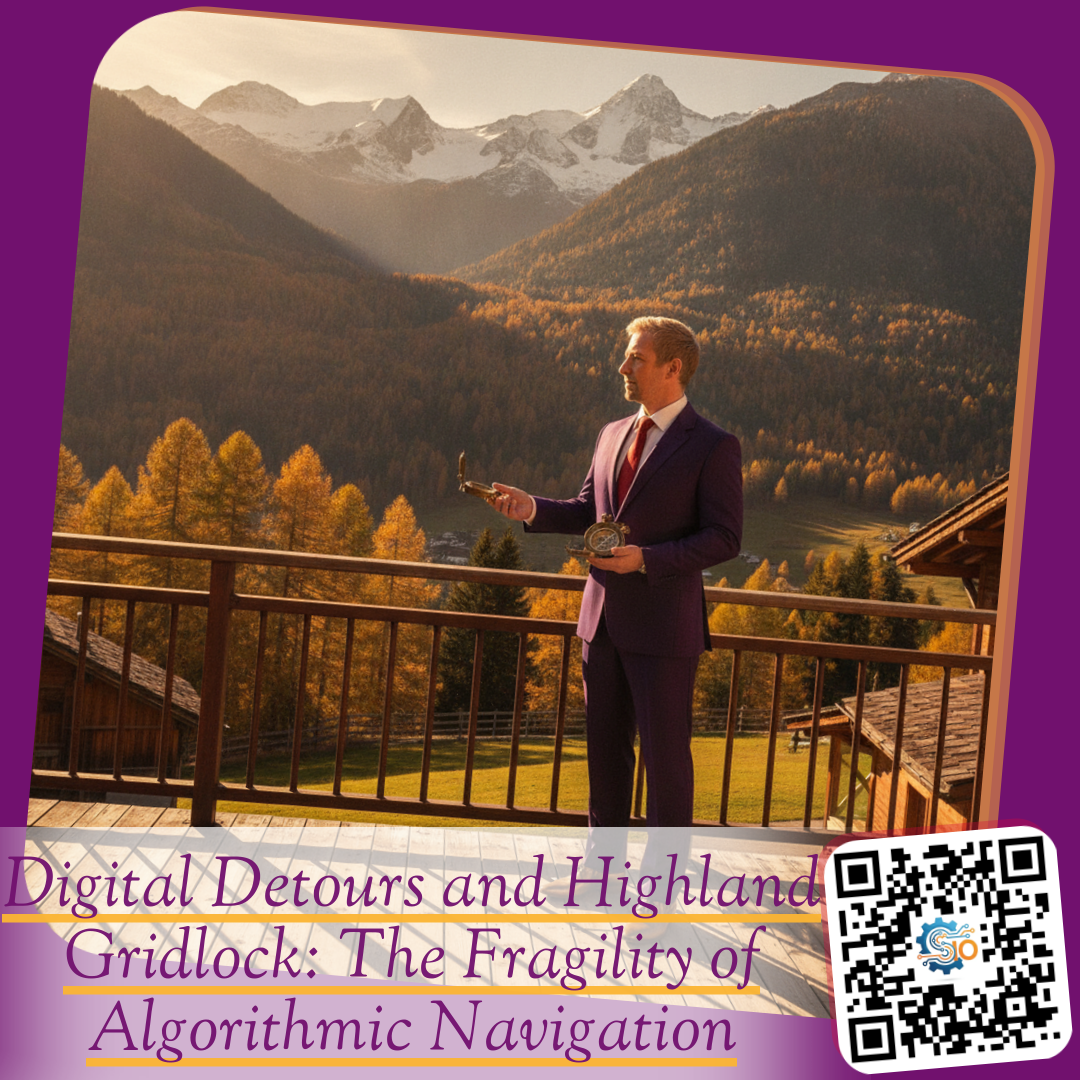
The morning light over the Valais peaks has taken on that distinct, crisp golden hue that only late September can deliver. Sitting here on the balcony of my Swiss chalet with a freshly pulled double espresso, my purple suit jacket buttoned against the alpine breeze and my golden shoes catching the morning sun, I found myself chuckling over a dispatch from the Scottish Highlands. It appears that several quiet, picturesque villages across Perthshire were recently brought to an absolute standstill. Why? Because a routing glitch in Google Maps decided that peaceful, single-track farm lanes and sleepy hamlets were suddenly the prime high-speed bypass for trunk road traffic.
Picture the scene for a moment. Pastoral serenity, drystone walls, sheep grazing peacefully on dewy hillsides, and suddenly a bumper-to-bumper procession of delivery vans, SUVs, and frustrated morning commuters squeezing through blind corners where two bicycles can barely pass each other. Drivers sat staring at their glowing dashboards, dutifully following a digital blue line directly into hedgerows and dead ends. Nobody looked out the window. Nobody paused to ask whether a single-lane tractor path made sense as a national transit corridor. The screen said turn left, so left they went.
The Illusion of Effortless Digital Optimization
This Highland episode is a magnificent case study in modern blind faith. We live in an era where human beings have voluntarily surrendered their native navigational instincts to invisible calculations humming in distant server farms. We trade our spatial intuition, our patience, and our observational awareness for the promise of saving four minutes on a morning commute. Yet, as the good people of Perthshire learned this week, when an automated routing script hiccups, the result is sheer chaos on the ground.
We see this recurring pattern across every corner of modern society. Only recently, in my reflection on The Thermodynamic Absurdity of Modern AI and the Great Clock Debate, I dug into the curious contradiction of our times: we pour unfathomable computational energy into systems designed to optimize micro-decisions, only to watch them produce irrational friction in the physical world. An algorithm does not know what a single-track Scottish cattle grid feels like when an oncoming lorry appears around an overgrown bend. It simply calculates mathematical distance divided by hypothetical speed, completely divorced from physical reality.
When the digital layer detaches from physical terrain, failure is never graceful. It creates immediate gridlock. Similar digital hiccups grounded flights across major airports this month when routine fiber lines were severed and air traffic networks stumbled. We design fragile hyper-efficient systems that function brilliantly right up until the exact second they do not.
Algorithmic Fragility Versus Natural Instinct
The core issue here is what I like to call algorithmic fragility. We construct lives that run entirely on delicate digital rails. We trust automated alerts to tell us when to walk, when to rest, which route to drive, and what news to consume. By outsourcing our foundational discernment to predictive code, our innate capacity for problem solving begins to atrophy.
Contrast this tech-dependent haze with the instincts of Scotland’s own wildcat population. Just a short journey north from those gridlocked Perthshire villages sits the conservation headquarters dedicated to saving the Scottish wildcat, often affectionately described as an intensive monitoring setup for untamed felines. Those animals survive on pure sensory acuity. They judge wind direction, read terrain, calculate risk, and navigate dense Highland brush without a single megabyte of satellite guidance. They possess absolute biological sovereignty because their connection to their immediate environment has never been intermediated by a glass screen.
When you abdicate all agency to automated platforms, you become vulnerable to systemic disruption. If the software makes an error, your entire morning collapses. You end up trapped behind a tractor in a quiet glen, stewing in traffic that you could have avoided by simply glancing at an old-fashioned paper map or trusting your own eyes.
Building Sovereign Systems in Business and Daily Life
This Scottish traffic tangle is not merely an amusing anecdote about lost motorists; it is a vital metaphor for how we manage our enterprises, our finances, and our personal infrastructure. If your professional livelihood or your daily routine relies exclusively on a black-box system that you do not control, you are constantly one minor update away from being steered into a ditch.
True personal and financial sovereignty requires building resilient architectures. Whether you are managing an international investment portfolio from the quiet comfort of the Alps or running an online business from your kitchen table, you must own your pathways. In my own digital ventures, I always counsel entrepreneurs to maintain clean, integrated control over their fundamental sales funnels and audience communications. That is why choosing dependable, streamlined software matters so much. When you organize your marketing, courses, and client relationships through a clean, unified platform like Systeme.io, you eliminate the fragile patchwork of competing plugins and third-party dependencies that so often cause digital businesses to crash during high-traffic moments.
The goal of intelligent automation should never be the complete abdication of human judgment. Useful technology is supposed to liberate your time so you can think clearly, cultivate genuine freedom, and savor an elevated lifestyle. It should not turn you into a helpless passenger trapped in an algorithmic detour.
Reclaiming the Internal Compass
In our piece on The Quiet Grid and the Losing Season: Why Enforced Silence and Systemic Futility Anchor Modern Value, we examined how essential it is to disconnect from constant telemetry and reclaim internal clarity. When every move you make is monitored, nudged, and directed by software, you surrender your mental sovereignty. You forget how to navigate by landmarks, stars, and gut instinct.
Consider what happens when you deliberately step away from digital navigation for a weekend. You look at physical road signs again. You observe the contours of the landscape. You talk to local residents at a petrol station or a bakery to ask which mountain pass is open. You re-engage with the sensory texture of life. Suddenly, a closed road is no longer a catastrophe that ruins your day; it becomes an invitation to explore an alternate valley, discover a hidden bistro, or enjoy an unexpected view.
The modern world encourages us to rush toward mathematical efficiency at the expense of presence. We run through life with our eyes glued to navigation displays, panicked about arrival times, forgetting that the journey itself holds the real value. When the map fails, the panicked driver honks their horn; the grounded individual smiles, parks the car, breathes in the Highland heather or the pine-scented mountain air, and finds their own way forward.
The Power of Grounded Awareness
As the autumn air cools the Swiss valleys this Tuesday, the lesson from Perthshire feels remarkably clear. Technology is a marvelous servant, but it is an atrocious master. When you let an external tool dictate every decision, you invite the consequences of its blind spots. The real winners in this fast-moving decade are not those who automate every breath they take, but those who pair sharp modern tools with unshakable personal discernment.
Enjoy the speed of innovation, leverage smart software to simplify your work, and take advantage of every genuine efficiency that modern engineering offers. But keep your hands on the steering wheel of your life. When the screen tells you to drive off a cliff into a muddy highland ditch, have the confidence, the wit, and the elegance to stay on the high road.
How often do you find yourself following digital instructions against your own better judgment? What practical steps are you taking this autumn to preserve your own intuitive internal compass?
Stay sharp, stay sovereign, and navigate your path with elegance. Connect with me across my social networks to share your thoughts on keeping human intuition alive in an automated world!