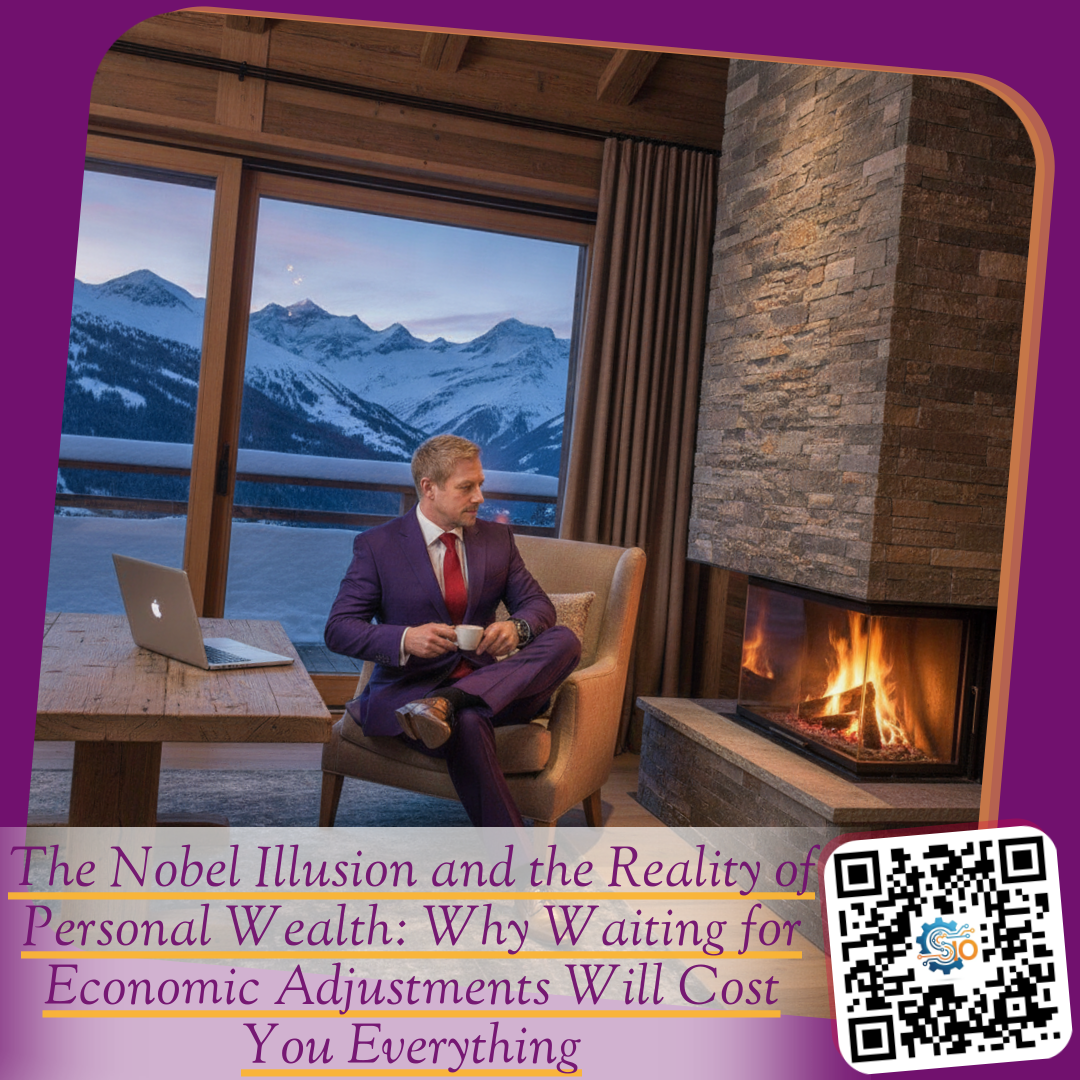
The autumn dusk falls quickly here in the Swiss Alps. Looking out from my chalet terrace on this crisp Monday evening, the first serious dustings of October snow are clinging to the jagged granite peaks. Inside, the cedar logs are crackling gently in the hearth, casting a warm orange reflection across my golden shoes and the deep velvet of my purple suit. I have always found mid-October to be an extraordinary time of year. As our friends across the Atlantic celebrate Canadian Thanksgiving, the rest of the financial world finds itself caught in an annual ritual of theoretical hand-wringing and bureaucratic promises.
Earlier today, the announcement of the latest Nobel economics prize crossed my screen while I was finishing an afternoon espresso. Almost simultaneously, alerts lit up detailing debates around the federal reserve inflation policy economic impact and the anticipated figures for the upcoming social security cost-of-living adjustment. It was a fascinating juxtaposition. On one hand, elite academics in Stockholm receive laurels for intricate mathematical modeling. On the other hand, millions of hardworking citizens wait with bated breath to see if a cost-of-living percentage bump will help them keep up with grocery bills and rising utility rates.
When Stockholm Awards Theory While Main Street Counts Pennies
There is a profound disconnect between academic economic theory and the lived reality of everyday sovereignty. Every October, the intellectual establishment celebrates models that attempt to explain market behavior, institutional growth, and monetary stability. Yet, down in the real economy, families and independent entrepreneurs are dealing with the undeniable friction of currency debasement and stubborn supply bottlenecks.
Consider the endless anticipation surrounding the upcoming social security cost-of-living adjustment. Millions of people spend months analyzing early estimates, hoping that an administrative recalculation will protect their retirement from being hollowed out. But let us be completely honest with each other: relying on a state-calculated index to preserve your lifestyle is a defensive game you can never truly win. Government formulas measure historical averages, not your personal basket of goods, your travel dreams, or the quality of life you wish to cultivate for your loved ones.
In my previous reflection, The Fragile Cloud and the Physical Grid: Navigating October Chokepoints, I discussed how easily modern life can be squeezed when centralized distribution networks encounter friction. When you place your financial survival entirely into the hands of committee decisions, whether they sit at the central bank or in legislative offices, you surrender your tactical agency.
The Mirage of the Golden Ticket
Whenever the economic climate feels heavy, human beings naturally yearn for an effortless escape hatch. Just this morning, news feeds were buzzing about a Canadian couple second lottery win, marveling at the statistical lightning strike of beating astronomical odds twice. It makes for an entertaining headline, the kind of romantic human interest story that brightens a gloomy news cycle. But treating financial freedom like a game of chance is the quickest route to perpetual anxiety.
Hope is not an operating system. Waiting for an external savior, whether that takes the form of a lottery ticket, an unexpected inheritance, or a benevolent policy shift, keeps you trapped in spectator mode. As I explored in The Liquidation of Comfort Equity: From Frozen Pizza to Algorithmic Empires, the modern landscape does not reward passive observers who trade away their leverage for short-term ease. The individuals who flourish during chaotic market transitions are those who build repeatable, proprietary assets that generate value regardless of which way the macro winds are blowing.
The True Path: Constructing Digital Leverage and Unshakable Cash Flow
If you want real financial freedom, you have to build your own private economy. Real sovereignty means your household budget does not fluctuate based on what central bankers decide at their next interest rate symposium. It means your purchasing power expands because you create genuine value in the marketplace, not because a bureaucratic calculation awarded you an extra few percentage points on a monthly stipend.
How do you actually accomplish that in 2026? You do it by building automated distribution channels and direct-to-consumer relationships. You take your specific skills, your specialized knowledge, or your curated physical offerings, and you package them into an ecosystem that operates around the clock.
This is where modern software infrastructure becomes your greatest strategic advantage. Years ago, launching an automated digital business required an entire department of programmers, custom servers, and exorbitant monthly retainer fees. Today, platforms like Systeme.io allow a single driven individual to manage newsletters, launch automated sales funnels, host digital courses, and collect global payments inside one seamless interface. When you streamline your operational stack with tools like Systeme.io, your overhead remains negligible while your reach becomes truly international.
When you own an automated vehicle for client acquisition and product delivery, inflation stops being a terrifying boogeyman. If production costs rise, you optimize your offer, launch a new digital asset, or adjust your pricing structure. You are no longer waiting for permission to thrive; you are directing your own capital engine from your laptop, whether that happens to be on a sunny beach or next to a crackling fire in the Alps.
Moving from Fragility to Sovereignty This Autumn
As the leaves turn golden and winter approaches, it is worth conducting an honest audit of your daily posture toward money and autonomy. Ask yourself whether your plans for the coming year depend on external leniency or internal architecture. Are you positioning yourself as a spectator cheering or lamenting macroeconomic updates, or are you actively constructing systems that make those updates irrelevant to your peace of mind?
True luxury has very little to do with gaudy displays or empty status symbols. True luxury is the profound calm of opening your laptop in the morning, taking a sip of fresh espresso, and knowing that your family is protected by diversified income channels you control. It is knowing that no committee in Stockholm, London, or Washington can vote your independence away overnight.
Take this October transition as your personal invitation to step away from passive waiting. Embrace leverage, simplify your technology stack, and claim the autonomy you deserve.
Reflections for the Evening
As you reflect on your own financial trajectory this season, consider these two questions:
- In which areas of your financial life are you still depending on external institutions or blind luck instead of building your own reliable systems of leverage?
- If you were to launch a scalable, automated asset before the year ends, what specific expertise or value could you offer that directly solves a painful problem for others?
I wish you clarity, peace of mind, and relentless momentum as we move deeper into this autumn season. Let me know your thoughts and insights across our social channels, and remember to keep building your own fortress every single day.