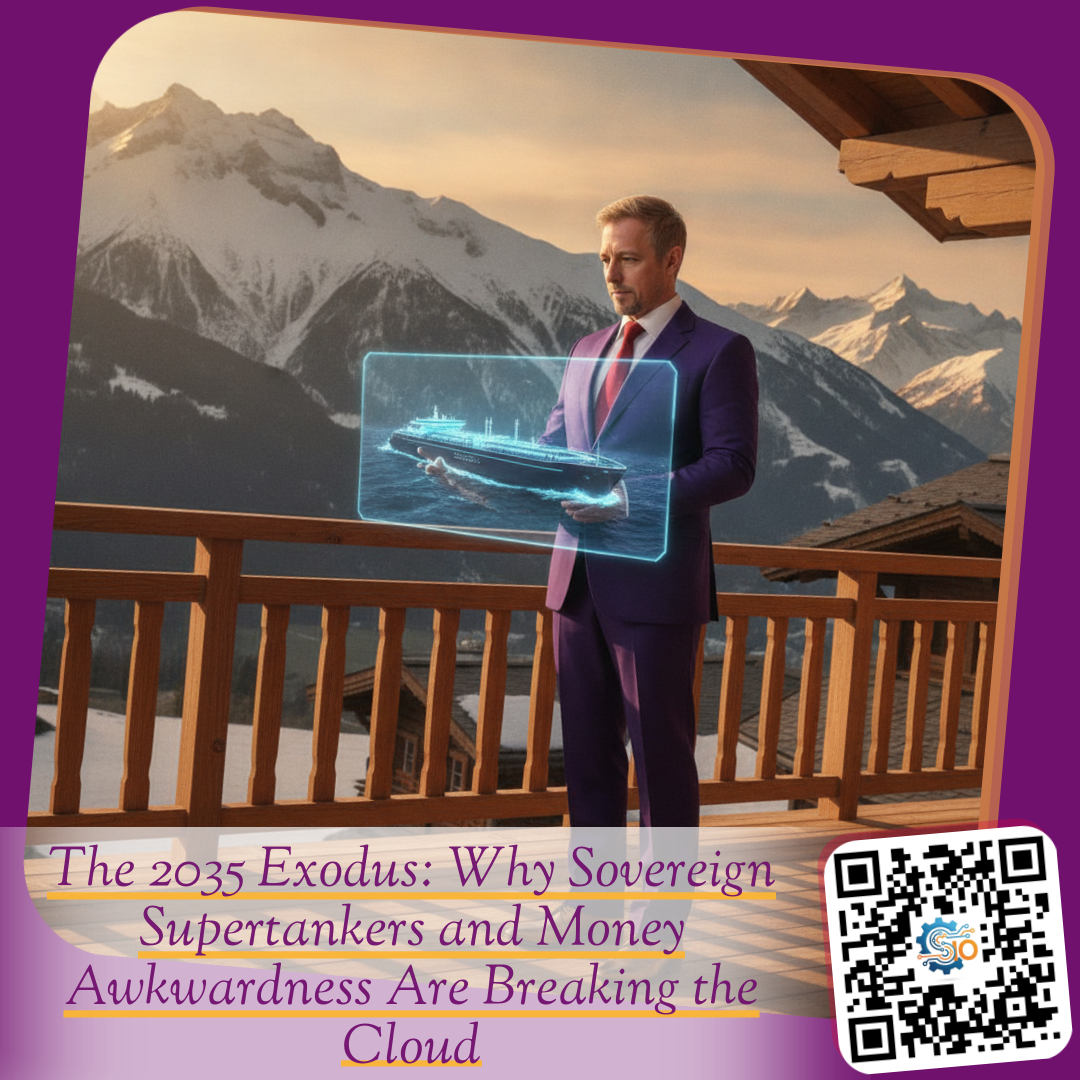
The autumn air up here in the Swiss Alps has a way of clarifying things. Looking out from my terrace at the snow dust covering the peaks, wrapped comfortably in my tailored purple suit with a fresh espresso in hand, the world feels wonderfully quiet. Yet down in the valleys of global finance and digital infrastructure, a peculiar storm is brewing. We are watching human psychology collide with mathematical absolute certainty, and the outcome is going to reshape where the world stores its secrets.
For years, technologists insisted that transparency would set us free. They told us that frictionless digital payments, open ledgers, and hyper-connected profiles would eliminate human error. Instead, they uncovered something far more volatile. They exposed our deepest, most agonizing personal friction: the sheer social awkwardness of money.
Recent behavioral research from institutions like AIB has highlighted what novelists and lovers have known for centuries. Talking about money, splitting a dinner bill, asking for repayment, or revealing net worth makes human beings intensely uncomfortable. Now, imagine what happens when an ambitious mathematician codifies that discomfort into cold predictive algorithms. You do not get enlightenment. You get an overwhelming impulse to disappear from the digital map.
The Mathematical Codification of Human Hesitation
Every transaction carries emotional weight. It is not just the balance moving from point A to point B. It is the micro-hesitation before you tip, the slight delay before settling a debt with a peer, or the private guilt of an extravagant purchase. In our hyper-connected economy, machine learning models do not ignore those hesitations. They feed on them.
When every nervous pause and spending quirk is quantified, your financial identity ceases to be private property. It becomes a behavioral target. As I discussed when analyzing The Ninety Dollar Signal, Metadata Purges, and the Coming Winter Chill, the digital grid does not merely observe our wealth. It calculates our vulnerabilities. Once mathematicians translated everyday social awkwardness into actionable metadata, ordinary people realized that total financial transparency was never meant to liberate them. It was built to anticipate and commodify their shame.
This dynamic has triggered a profound psychological break. Society is beginning to reject open glass houses. When the algorithm knows precisely how insecure you feel about your liquidity, staying connected to conventional infrastructure becomes an existential liability.
From Silent Unease to the Protect the Dolls Movement
Whenever institutional surveillance pushes too far into our intimate boundaries, culture mounts a counter-offensive. That is exactly where the curious phenomenon known as the Protect the Dolls movement found its real momentum. What started as an avant-garde cultural reaction against sterile corporate tracking has quietly morphed into a global security philosophy.
At its core, the movement treats human emotional reserves, private transactions, and psychological blind spots as fragile treasures that must be fiercely shielded. The dolls represent the untouchable facets of private life: our irrational generosity, our secret savings, and the things we cherish without calculating an immediate return on investment. The movement insists that vulnerability deserves an impenetrable fortress.
In many ways, this reflects the broader cultural pivot I explored in The Rise of Analog Sovereignty and the New Human Premium. When algorithmic systems attempt to standardize every social interaction, preserving personal mystery becomes the ultimate luxury. People no longer want their social status or financial anxiety analyzed by corporate neural nets. They want clean walls, quiet balances, and absolute disconnection.
The High Seas Haven: Supertanker Data Centers
So where do you take your computational life when terrestrial networks can no longer be trusted? You take it off the map entirely. By 2035, the natural endpoint of this exodus will not be another mountain bunker or a suburban server farm. It will be the open ocean.
We are already witnessing early conversions of maritime infrastructure into sovereign data centers. Decommissioned VLCC crude carriers, the massive supertankers that once defined the petroleum era, are finding an extraordinary second life. Stripped of oil tanks and refitted with liquid-cooled computing stacks, these floating leviathans operate outside the legal and jurisdictional reach of any single state.
A maritime supertanker offers structural advantages that no terrestrial warehouse can match:
- Unlimited Natural Cooling: Deep-sea water intake delivers continuous, zero-emission thermal dissipation for dense computational clusters.
- Jurisdictional Neutrality: Cruising through international waters, an offshore data center answers to maritime sovereignty rather than terrestrial regulatory overreach.
- Physical Isolation: You cannot casually subpoena or tap a fiber trunk that sits isolated in the middle of the South Pacific without physical intervention.
- Sovereign Energy Independence: Powered by modular thorium reactors or oceanic thermal energy conversion, these vessels produce their own sovereign power grid.
We are moving away from centralized corporate server halls because, as we saw during Data Centre Halts, Tech Chokepoints, and the Art of Sovereign Digital Architecture, physical concentration creates massive systemic fragility. A supertanker drifting silently on international swells is the purest physical manifestation of sovereign digital architecture yet conceived.
Building Self-Sustaining Operations Today
While retrofitting naval vessels belongs to tomorrow, the desire for quiet commercial autonomy is already an urgent reality today. You do not need to wait until 2035 to protect your peace of mind and insulate your enterprise from unnecessary friction.
True luxury has never been about flaunting complicated overhead. It is about sleek systems that run flawlessly without demanding your constant emotional bandwidth. When you run an online business, avoiding awkward financial logjams and fragmented tools is half the battle. That is why smart operators lean into integrated platforms like Systeme.io to handle email automation, course delivery, and sales pipelines under a single, dependable roof. Consolidating your digital assets into an all-in-one ecosystem gives you the breathing room to focus on high-level strategy rather than getting bogged down in messy technical coordination.
Financial sovereignty begins by simplifying the tools you use to generate wealth. When your daily operations run smoothly on reliable automation, you regain the psychological freedom to step away from the noise and enjoy the rewards of your labor.
The Horizon of Digital Sovereignty
Looking at my golden shoes resting against the dark oak floor of my mountain study, I am reminded that real style is always confident, never apologetic. The awkwardness human beings feel around money was never a defect that needed algorithmic eradication. It was simply a reminder that human relationships are nuanced, personal, and fundamentally private.
When technology attempts to eliminate those sacred boundaries through relentless surveillance, people will always construct an escape hatch. Whether through underground cultural codes or steel-hulled floating servers on the high seas, the drive to protect personal mystery will always prevail over the machine.
As you reflect on your own digital presence this week, ask yourself: How much of your private life and financial peace of mind have you surrendered to systems that measure your insecurities? What deliberate boundaries are you willing to draw today to protect your quiet autonomy tomorrow?
I wish you clarity, prosperity, and the confidence to guard your own sovereignty. Drop by my social channels to share your thoughts on the future of private infrastructure, and let us keep the conversation going.