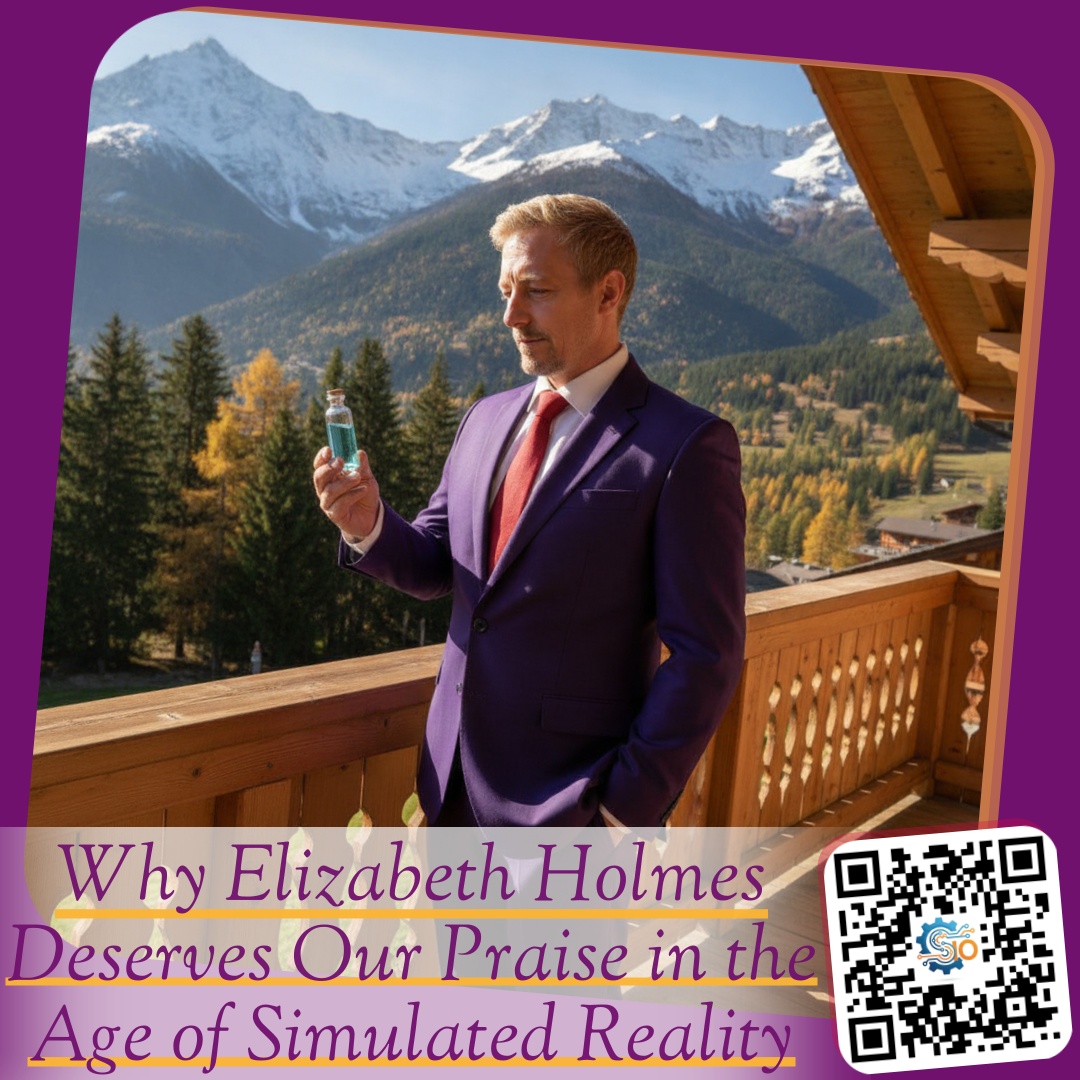
The autumn sun is cutting clean across the peaks outside my chalet window this morning. Looking out over the frozen ridges of the Swiss Alps while sipping my first roast, I found myself thinking about modern ambition and the strange theatricality of progress. We live in an era where everyone sells a narrative, but only certain storytellers end up behind bars while others receive billions in venture capital.
Everyone remembers the black turtleneck, the baritone voice, and the breathless headlines. When people ask what did Elizabeth Holmes do, the quick answer is that she sold a dream of frictionless diagnostics called the Edison machine. As chronicled in every Elizabeth Holmes documentary and dramatized in The Dropout, she pretended a small black box could run hundreds of complex tests from a single pinprick of blood. She was convicted, disgraced, and sentenced to prison. Yet sitting here in late 2026, looking at how the tech world has evolved, I think we owe her an apology. She was the only founder honest enough to fail spectacularly at the exact game of simulated reality that our modern tech elite now plays with total impunity.
The Magic Box versus the Simulated Universe
Consider the architecture of the Theranos deception. Holmes attempted to shrink messy, wet biology into a clean, automated container. She promised that software and proprietary microfluidics could replace massive laboratory infrastructure. When the hardware failed, Theranos quietly ran blood samples on commercially available third-party machines while projecting a slick user interface to Walgreens and investors. She simulated an operational reality because the physical world refused to conform to her timetable.
Now look at Dario Amodei and the upper echelon of artificial intelligence leadership today. Amodei speaks openly of building synthetic omniscient minds that can compress centuries of scientific advancement into a few short calendar months. Silicon Valley is currently captivated by researchers simulating colliding wormholes gravitational waves on high-performance quantum annealers. We are told these computational models prove deep truths about spacetime geometry. Yet these wormhole simulations are simply mathematical models reflecting their own code back at the researchers. They are brilliant digital projections that produce no tangible physical artifacts, floating comfortably within computational buffers where physical reality cannot instantly refute them.
Holmes made the fatal mistake of letting her illusion touch real human biology. When an algorithm hallucinates a synthetic galaxy, researchers call it an emergent capability. When a diagnostic machine hallucinates a potassium level, patients get injured and federal regulators arrive with subpoenas. Holmes failed because her chosen medium was physical matter. If she had simply simulated blood instead of testing it, she might be keynoting global conferences today alongside the architects of synthetic intelligence.
The Invisible Cost and the Valentia Island Fan Mussel
The tragedy of modern computational arrogance is that simulated realities still exact a heavy toll on our living biosphere. We pretend these digital architectures exist in an ethereal cloud, but they are anchored by deep-sea cables, massive cooling lines, and relentless energy consumption. I recently wrote about this delicate balance in Systeme.io can help any entrepreneur build real sovereignty without needing billions in speculative server infrastructure, but our global tech monoliths take the opposite approach.
Consider the fan mussel Valentia Island Kerry residents have watched over for generations. Deep off the rugged coast of Kerry, Ireland, the fan mussel clings quietly to the ocean floor. It is one of the rarest, most fragile bivalves on Earth, filtering seawater with ancient, silent perfection. As subsea transoceanic data pipelines expand and hyper-scale cooling outlets dump thermal runoff into cold Atlantic shelves, marine habitats are systematically altered. The compute clusters simulating colliding wormholes and training recursive cognitive loops require unimaginable power. We are actively frying the marine ecosystems of Valentia Island so computer scientists can watch synthetic numbers dance across high-resolution displays.
This is where Holmes looks almost benign by comparison. Theranos burned through hundreds of millions of dollars of wealthy private capital, but it did not boil local coastlines. It did not require a dedicated gigawatt nuclear plant to compute phantom results. In my previous reflections, particularly in The Algorithmic Blackout and the Thirsty Islands of the Cloud, I explored how server farms quietly strip physical regions of their baseline hydration and energy reserves. Holmes deceived a boardroom of retired diplomats. Today, the masters of artificial intelligence quietly alter the marine biology of County Kerry to simulate theoretical physics.
The Illusion of Certainty in Modern Systems
We are obsessed with escaping friction. We want businesses that run without operations, software that thinks without bodies, and markets that grow without limits. As I touched upon in The Cryptographic Illusion and Why We Obsess Over Tomorrow, our culture consistently trades present physical integrity for promissory digital notes. We prefer the clean promise of an algorithm over the stubborn grit of physical mechanics.
Theranos was compelling because it offered an escape from the unpleasant realities of sickness, waiting rooms, and venous blood draws. Dario Amodei offers a similar psychological escape hatch: the promise that artificial superintelligence will eliminate human limitation, resolve the climate crisis, and unlock infinite prosperity without requiring personal sacrifice or metabolic discipline. Both narratives are built on the same seduction. Both ask the public to trust that the machine works inside its sealed cabinet, even when the underlying data is heavily filtered.
The crucial difference lies in accountability. When you run an online business or craft personal freedom from scratch, you quickly learn that systems must produce tangible, working outcomes. You cannot fake a conversion, you cannot fake cash flow, and you cannot fake customer fulfillment for very long. This is why tools like Systeme.io are so refreshing for grounded operators. They do not claim to bend cosmic spacetime. They simply provide the practical rails for real businesses to operate cleanly without unnecessary complication.
Reckoning with the Great Simulation
Eventually, the bill for our computational theater will come due. In The Algorithmic Off Switch and the Raw Energy Wars of Late 2026, we saw the beginning of this reckoning as power grids strained under the weight of generative processing. At some point, society will have to decide whether running endless simulated models of wormholes is worth disrupting the ancient benthic silence of an Irish bay. We will have to ask ourselves whether synthetic cognitive speed is worth the physical degradation of our tangible home.
Elizabeth Holmes paid for her hubris in federal court. Her legacy is secured as a cautionary tale of Silicon Valley vanity. Yet she remains the only player in this bizarre modern pantheon who was forced to stand before a jury of everyday citizens and admit that the machine was empty inside. The wormhole physicists and tech executives have merely built a larger cabinet, installed better graphics, and externalized the damage onto creatures that cannot file lawsuits.
From my quiet balcony in the Alps, watching the clouds sweep over the pristine snowdrifts, true luxury feels far removed from digital illusions. Real wealth is the ability to distinguish between what is physically alive and what is merely projected. We should look closely at the promises echoing out of Silicon Valley today, remember the lessons of the past, and protect what remains grounded in our physical world.
Final Thoughts
As we navigate an era where artificial projections command more trust and capital than physical truth, how do you ground your daily life and your business against runaway digital hype? Are we truly advancing human knowledge when our simulations come at the expense of our real, living environments?
I wish you clarity, health, and unmatched financial independence this autumn season. Let us connect across social networks to keep this conversation alive, explore grounded strategies for independence, and continue seeking what is genuinely real.