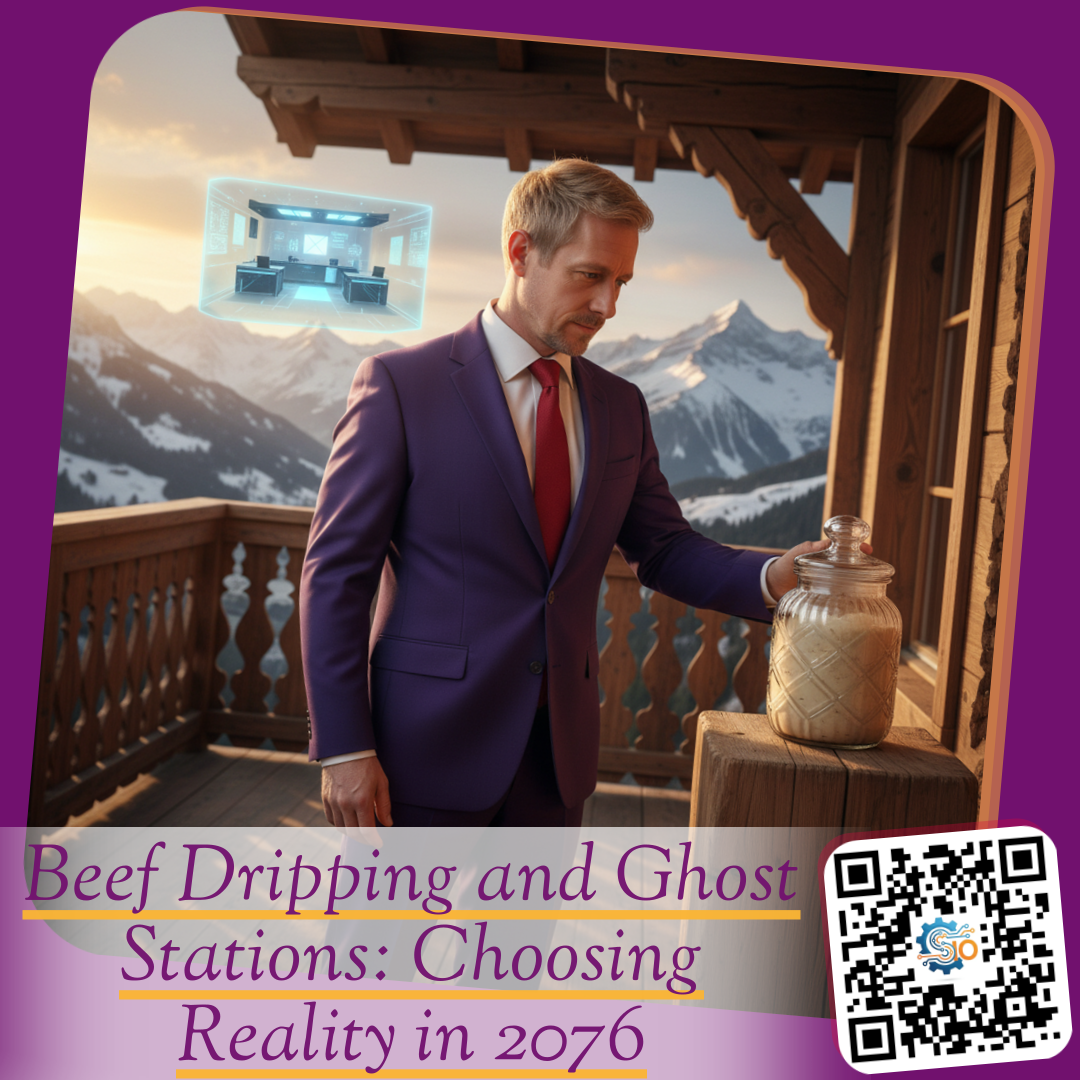
I am sitting here on the balcony of my chalet in the Swiss Alps, the morning sun reflecting off my golden shoes. It is Wednesday 18 March 2026, and the air is so crisp it feels like it could shatter if I breathed too hard. I have got my favorite espresso in hand, my purple suit jacket draped over the chair, and I am looking at two very different news reports that have me thinking about what the world will look like fifty years from now. By 2076, most of us will be memories, but what kind of memories? Will our heirs inherit a world of physical grit or a sterilized, high-tech void?
The first story that caught my eye involves a jar of beef dripping. This is not just any fat, mind you. This is beef dripping taken on the first successful Everest summit in 1953 by Sir Edmund Hillary and Tenzing Norgay. It is going up for auction. It is greasy, it is old, and it is undeniably real. It is a tangible piece of human struggle. On the other side of the globe, Ethiopia is experimenting with smart police stations that have no officers. Just cold, clinical rooms where you interact with a screen. No human judgment, no heartbeat, just code. This tension between the visceral and the virtual is exactly what I explore in my previous thoughts on Human Made Labels and Geopolitical Fireworks: Navigating the March Velocity.
The Weight of the Physical: Why Fat Matters
There is something romantic about the idea of someone keeping a jar of cooking fat for over seventy years. It represents the grit of the physical world. When Hillary was climbing that mountain, he was not thinking about digital footprints or cloud storage. He was thinking about survival, calories, and the sheer weight of the Earth beneath his boots. In an age where everything is becoming a service or a subscription, owning something as raw as beef dripping from the roof of the world feels like an act of rebellion.
We see this shift toward valuing the tangible even now in 2026. As I mentioned in The Myrient Archive and Adult Braces: How Tangible Assets Are Funding the 2026 Energy Pivot, people are starting to realize that digital numbers on a screen can be fleeting. There is a deep, psychological need for things we can touch, smell, and even taste. By 2076, I suspect the ultimate luxury will not be a new app or a faster connection, but a piece of history that has not been digitized, compressed, or erased. Your family wealth might not be measured in crypto-credits, but in the items that prove your ancestors actually lived, breathed, and struggled.
The Clinical Void of the Smart Station
Now, contrast that jar of fat with the smart police stations in Ethiopia. Imagine walking into a building for help and finding absolutely no one there. No grizzled sergeant, no empathetic officer, just a sleek interface designed to process your data. It is efficient, yes. It is cost-effective, certainly. But it is also a void. It is the beginning of what I call high-tech erasure, where the human element is scrubbed away to make room for a seamless, frictionless experience.
This move toward officer-less infrastructure is part of a larger trend I have been watching closely. In The Pathogen Driven Pivot: Why Toxic Coastlines and Meningitis Are the New Digital Subsidies, I talked about how our environments are being reshaped by necessity and technology. If we outsource our safety and our justice to machines, we are essentially saying that human presence is a bug, not a feature. By 2076, your heirs might live in a world where they never have to look another person in the eye to get things done. That sounds like a lonely kind of perfection to me.
The Danger of the Delete Button
This brings me to the third piece of the puzzle: a banned AI editing app. This app promised it could remove anything from your photos. Not just a photobomber or a trash can, but entire people, buildings, or historical contexts. It was banned because of the potential for total reality distortion. Think about that for a second. If we can erase anything we do not like from our visual history, then what is left? A lie. A high-fidelity, polished lie.
If your heirs are looking back at your life through the lens of AI-curated images, they are not seeing your lived reality. They are seeing a version of you that has been cleaned of all the grit that makes life worth living. They are seeing the officer-less station version of your soul. I do not want my legacy to be a “perfect” image. I want it to be the messy, purple-suit-wearing, mountain-climbing reality of Golden Greg. I want them to see the wrinkles around my eyes that came from laughing too much at these Alpine sunsets.
Building a Legacy with Intent
So, how do we navigate this? How do we ensure that by 2076, our worth is measured by the tension of our lived experiences rather than the emptiness of our digital footprints? It starts with the choices we make today. It is about using technology to buy back our time, not to replace our humanity. I use tools like Systeme.io to automate the boring parts of my business. Why? So I can spend more time standing on this balcony, feeling the cold wind, and being present in the physical world.
The goal of automation should always be freedom. When you use Systeme.io to handle your marketing or your sales funnels, you are not trying to become a machine. You are trying to make sure you do not have to act like one. You are freeing yourself up to go buy that jar of beef dripping, to go on that hike, or to build a house that will still be standing in fifty years. You are choosing lived reality over high-tech erasure.
The Heirs of 2076
Imagine your great-grandchildren in 2076. They are sitting in an atmosphere-controlled room, perhaps in a city that is entirely managed by AI. They find a box in the attic. Inside is not a hard drive, but a physical journal, a stained tie, or a piece of gear from a trip you took. These objects have a weight that no digital file can ever replicate. They represent the grit. They represent the fact that you were here, and you were not just a data point in a smart station.
If we continue down the path of clinical erasure, we risk leaving behind a legacy that is nothing but a “smart” ghost. We risk leaving heirs who know everything about our statistics but nothing about our spirit. We have to fight for the physical. We have to embrace the stains, the scars, and the grease. That is where the truth lives. Whether it is a luxury chalet or a jar of fat from Everest, the things that last are the things that were truly felt.
Choosing Your Side
The tension of 2076 is being created right now, in the spring of 2026. Every time we choose a screen over a person, or a filtered image over a raw one, we are voting for the clinical void. I am choosing to stay grounded. I am choosing the golden shoes and the purple suit. I am choosing to use Systeme.io to keep my business running in the background so I can focus on the foreground of my life.
The future does not have to be a choice between a museum and a motherboard. It can be a blend of both, but only if we refuse to let the high-tech erasure win. We need to be the generation that kept the beef dripping while building the rockets. We need to be the ones who remembered that a police station needs a heart, and a photo needs the truth.
As the sun climbs higher over the peaks, I am reminded that time is the one thing we cannot edit out. We have to live it. We have to own it. And we have to make sure that whatever we leave behind, it is something our heirs can actually feel.
What is one physical object in your life that you would never want to see digitized or erased? If you had to choose between a perfectly efficient life and a messy, meaningful one, which would you pick for your children?
Stay grounded and stay real, my friends. I will see you on the social networks for more updates from the chalet!