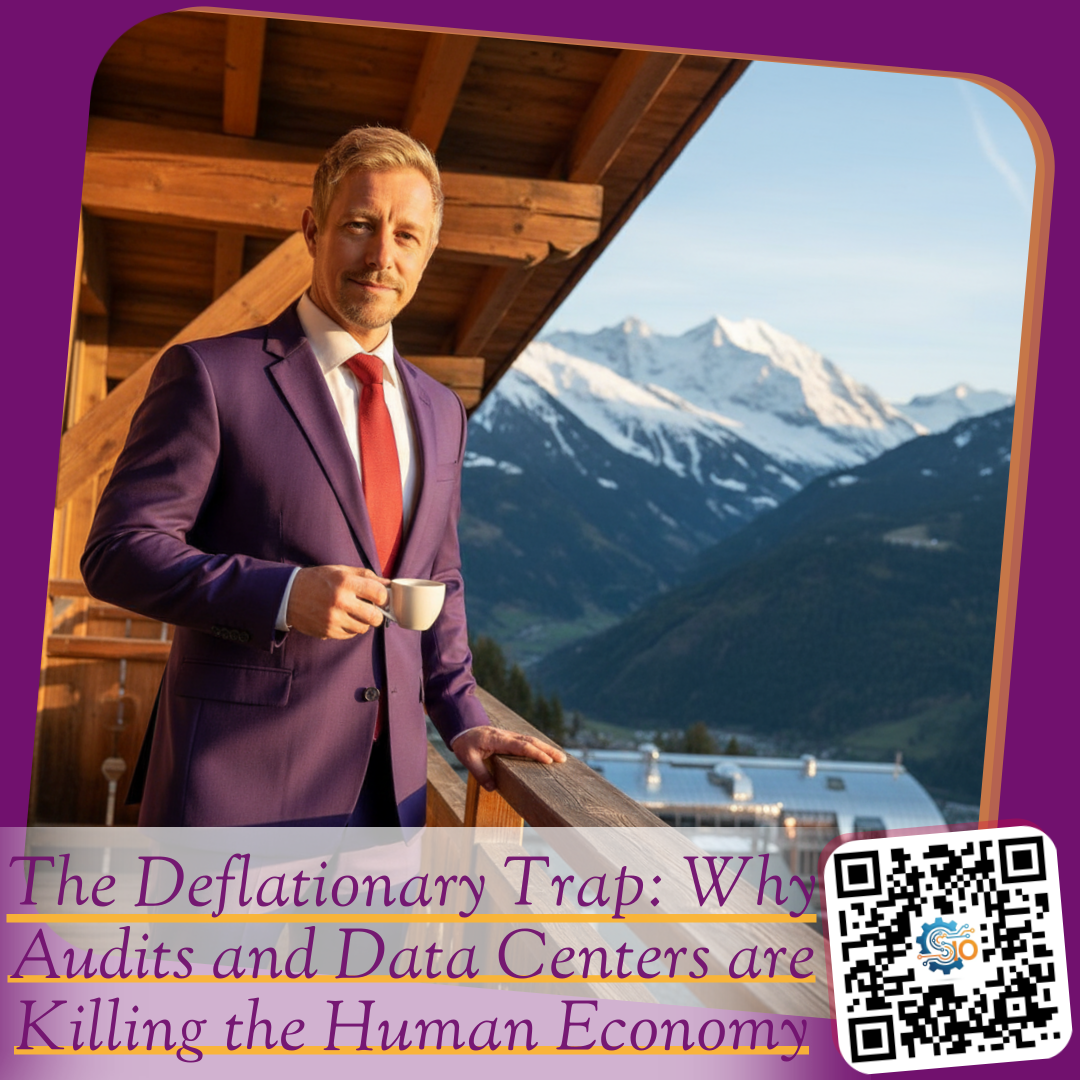
I am sitting here in my favorite leather chair, looking out the floor-to-century windows of my chalet in the Swiss Alps. The morning sun is hitting the snow peaks, turning them into a jagged line of white fire. It is a quiet Friday morning, the kind of stillness that makes you think about the gears turning underneath the world. I have my espresso, I have my hazel eyes fixed on the horizon, and of course, I am wearing my golden shoes. They are reflecting the light back at the mountains, a little reminder that even in a world obsessed with cold efficiency, a bit of flash and human spirit still matters.
Lately, the air feels different. There is a specific tension in the 2026 air that I have been calling the March Velocity. We are all moving faster, but I wonder if we are moving toward something better or just toward a more polished cage. Between the news about the Joliet data center and the sudden push for fiscal purity in Ireland, I see a pattern emerging. It is a pattern of hyper-efficiency that might just be the very thing that breaks our collective resilience.
The Hidden Strength of the Imperfect System
Let us talk about Ireland for a moment. There has been a massive fiscal push lately to audit welfare overpayments. On paper, it makes perfect sense. Why should the state lose millions to clerical errors or people staying on the rolls a week too long? But when you look at it through the lens of a professional who understands the flow of capital, you realize that these “leakages” are often what keep a local economy breathing. That overpayment does not go into a Swiss bank account like mine. It goes to the local grocer, the petrol station, and the hardware store.
When the government uses deep learning and artificial intelligence news tools to track down every last cent, they are effectively withdrawing liquidity from the bottom of the pyramid. It is a deflationary move disguised as “good governance.” We saw a similar vibe in my previous post, Navigating the March Velocity: Geopolitics, Health, and the 900 Goal Milestone, where I discussed how the pursuit of perfection in one area often leads to a collapse in another. By tightening the screws on the most vulnerable, we are removing the “grease” that allows the gears of a community to turn during hard times.
The Ibuprofen Recall and the Fear of the Error
Then we have the recent children’s ibuprofen recall. Manufacturing errors are, obviously, a serious concern when it comes to the health of our kids. No one wants a dosage mistake. However, the reaction from the industry has been to move toward total automation. They want to eliminate the “human error” entirely. This sounds like progress, but it creates a world where the system is so rigid that it cannot handle any deviation from the norm.
I touched on these themes of health and systemic alarms in The March Velocity: Navigating the Geopolitical Pulse and the Meningitis Outbreak of 2026. When we try to build a world that is 100 percent error-free, we end up with a fragile architecture. The “leakage” in a manufacturing plant, much like the “leakage” in a welfare system, is often where the human element lives. If we replace every technician with a deep learning algorithm, we lose the intuition that catches a problem before the sensors even trigger. We are trading human jobs and human resilience for a sterile, albeit “perfect,” production line.
The Joliet Data Center: Growth Without a Pulse
Now, let us look at the Joliet data center. This is the ultimate symbol of the modern economy. It is a massive, multi-billion-dollar facility. It represents “growth” in the GDP figures. But how many people does it actually employ? Once the concrete is poured and the servers are racked, these cathedrals of silicon run on a skeleton crew. They are capital-intensive but labor-light. They consume massive amounts of energy and provide the backbone for artificial intelligence news cycles, but they do not feed the local neighborhood.
This is the deflationary trap. We are shifting our economic weight from high-employment sectors to low-employment, high-efficiency digital vaults. The Joliet data center does not care about the price of milk or the local school budget. It only cares about uptime and cooling efficiency. When we prioritize this kind of growth over the “inefficient” human-centric businesses, we are effectively hollowing out the middle class. We are building a world that is great for the machines but increasingly cold for the people who wear purple suits and golden shoes.
Finding Freedom in the Automated Age
I am a fan of technology, do not get me wrong. I live in a high-tech chalet and I run my business with the best tools available. I use Systeme.io to manage my funnels and my email marketing because it allows me to stay “asset-light” while maintaining a romantic, luxury-focused lifestyle. The difference is that I use Systeme.io to buy back my time, not to eliminate my human connection with my audience. I want the efficiency so I can spend more time thinking, writing, and enjoying the Swiss air, not so I can turn myself into a data point.
The danger is when governments and mega-corporations use these same tools to squeeze the life out of the public. If every welfare payment is audited by an AI and every manufacturing line is stripped of human oversight, where does the money go? It pools at the top. It goes into the data centers and the cloud infrastructure providers. It stops circulating in the streets of Dublin or the suburbs of Chicago. That is how you end up in a deflationary spiral where the “system” is healthy, but the people are struggling.
The Resilience of the “Leakage”
We need to start valuing “leakage” again. A little bit of inefficiency is what makes a system robust. In nature, there is plenty of waste, and that waste is what feeds the rest of the ecosystem. When we try to eliminate every manufacturing error and every welfare overpayment, we are essentially trying to kill the “undergrowth” of our economy. Without that undergrowth, the forest cannot survive a fire.
The Joliet data center is a fortress, but it is a lonely one. It offers no immediate economic resilience to the people living around it. If the grid goes down or the AI bubble pops, that building is just a giant, expensive heater. On the other hand, a community with a bit of “leakage”—where people are employed, where mistakes are handled by humans, and where the state is not an all-seeing auditor—is a community that can survive a crisis. We have to decide if we want to live in a perfectly audited world or a world that is actually livable.
Looking Toward a Human-Centric Future
As I finish my espresso and prepare for a stroll through the alpine village, I want you to think about the systems you interact with. Are you building a life that is so efficient it has become brittle? Are you so focused on the audits and the “errors” that you have forgotten to leave room for the unexpected? Wealth is not just about the number in your bank account; it is about the freedom to be human in a world that is increasingly machine-made.
I choose the golden shoes and the purple suit because they are unnecessary. They are a “leakage” of style in a world of gray utility. And honestly, that is where the real profit is. Let the data centers hum in the dark; I would rather be here, in the light, embracing the beautiful mess of a life well-lived. We must protect the “errors” that keep us human, and we must resist the trap of a growth that does not require our presence.
Are we trading our long-term economic survival for the short-term satisfaction of a perfect balance sheet? How can we reintegrate human-centric value into a world dominated by capital-intensive data centers?
Stay focused, stay romantic, and keep your eyes on the gold.
I will see you on my social networks for more updates from the peaks!