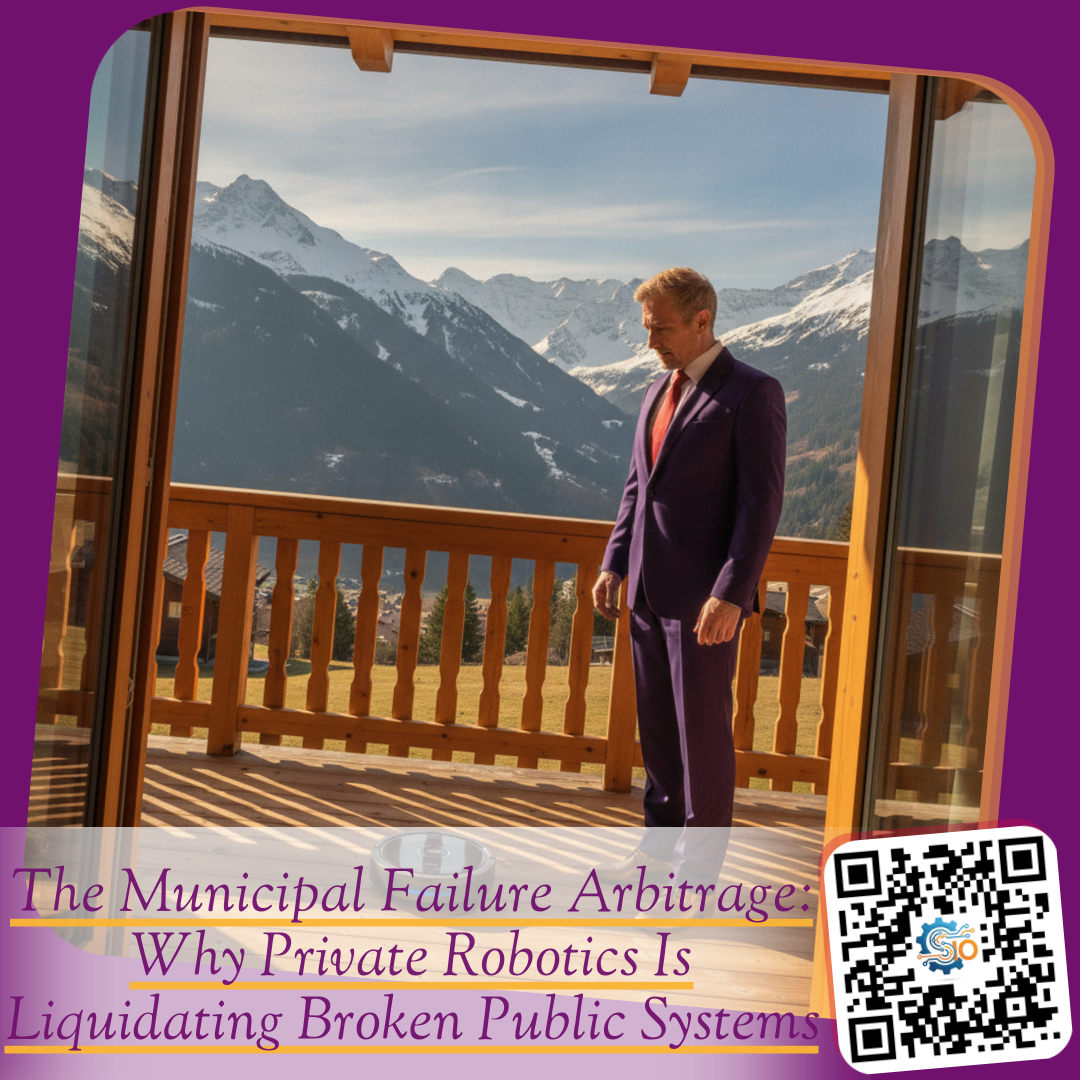
There is an exquisite clarity that comes with an early morning espresso out on the terrace of my Swiss chalet. Looking out across the crisp, snow-dusted alpine peaks while sporting my favorite purple suit and polished golden shoes, the world feels sharp, quiet, and beautifully organized. Yet, a quick scan across international news feeds this late August morning paints a dramatically different picture in legacy urban centers.
Headlines from major Western cities reveal that residents are enduring five full months without municipal bin collections, leaving neighborhoods drowning in heaps of uncollected waste. Meanwhile, across the financial exchanges, Chinese robotics powerhouse Unitree made an explosive public stock debut, with shares skyrocketing as institutional capital floods into advanced autonomous machines. These two stories might appear disconnected on the surface, but they represent two sides of the exact same coin.
We are witnessing the municipal failure arbitrage in real time. Smart capital has officially recognized that bureaucratic public infrastructure is crumbling under structural inertia, bloated budgets, and operational paralysis. Instead of waiting for legacy institutions to repair their broken mechanics, private markets are stepping in to automate physical labor and monetize the vacuum left behind.
The Rot of Legacy Monopolies and Administrative Inertia
Living among mountains of uncollected trash is not simply an aesthetic nuisance for urban dwellers. It is a visible, pungent breakdown of the fundamental social contract between local government and taxpayers. When basic municipal duties collapse for nearly half a year, the illusion of public competence evaporates entirely.
We explored the broader consequences of this systemic friction recently in The Biological Bull Market: Navigating Extreme Heat, Infrastructure Collapse, and the Strange Rise of Anatomical Hedging. When public utilities fail to safeguard human environments, individuals and private enterprises are forced to hedge their own survival and clean living conditions through capital reallocation.
The old model relies on expensive, unionized manual labor pools, politicized municipal councils, and archaic dispatch systems that break down at the slightest shock. When workers walk out or councils run out of funds, citizens are expected to sit passively and inhale the decay. But modern technology does not tolerate perpetual friction. Capital flows toward speed, reliability, and precision.
Unitree and the Dawn of Autonomous Physical Labor
Unitree’s sensational market debut is not merely another speculative tech bubble. It is the clearest signal yet that autonomous hardware has reached commercial viability at scale. For years, skeptics dismissed quadruped and humanoid robots as viral internet demonstrations designed solely for corporate marketing.
Today, those same machines are rolling off production lines with industrial-grade torque, sophisticated vision models, and battery efficiencies capable of executing grueling physical tasks. When a neighborhood association or private commercial park can deploy a fleet of robotic units to sort, transport, and process waste around the clock without strikes, pension liabilities, or administrative delays, the math changes permanently.
Private capital understands that replacing unreliable human bureaucracies with tireless robotic systems is not just an efficiency upgrade. It is an immense wealth generation opportunity. High-cost liabilities on municipal balance sheets are being converted into profitable, high-margin private utility subscriptions managed by autonomous hardware.
From Physical Robotics to Digital Precision
This massive rotation away from manual gridlock mirrors what is taking place across the digital business landscape. Just as cities can no longer afford to depend on manual waste logistics, modern entrepreneurs cannot afford to run their enterprises on fragmented, manual labor chains.
As I detailed in Stop Gambling Your Business on Pure Luck: Why Manual Chaos Demands Total Automation in 2026, relying on scattered spreadsheets and manual follow-ups is the digital equivalent of waiting for a municipal garbage truck that never arrives. Success in our current economy demands an integrated, sovereign architecture that works seamlessly while you sleep.
This is why high-performing operators build their digital infrastructure using comprehensive platforms like Systeme.io. By unifying email marketing, sales funnels, course delivery, and customer workflows into one automated engine, Systeme.io eliminates the friction that drags manual businesses down. When your systems operate autonomously, you insulate yourself from the chaos of human error and external operational breakdowns.
The Great Late Summer Capital Migration
The global economic climate of late summer 2026 is rewarding those who eliminate bottlenecks before they turn into catastrophes. We analyzed these shifting tides in Navigating Inflation Surges and Automation Shifts in Late Summer 2026, emphasizing that true financial freedom belongs to those who own automated leverage rather than those who rent broken systems.
Consider the structural divergence playing out before us. On one side, you have tax-funded monopolies accumulating debt while failing to empty neighborhood bins for five straight months. On the other side, you have nimble robotics enterprises and automated digital platforms generating extraordinary cash flows by delivering reliable solutions directly to consumers.
The smart money is liquidating its exposure to legacy public dependencies and allocating heavily into private automation assets. Whether that means backing next-generation robotics manufacturers or streamlining your own digital enterprise with modern software stacks, the guiding principle remains identical: automate every essential function or risk being buried by operational decay.
Building Your Personal Fortress of Autonomy
True luxury is not just fine tailoring or panoramic alpine views, though I certainly appreciate both every single day. True luxury is autonomy. It is the peace of mind that comes from knowing your lifestyle, your income, and your physical environment do not hinge on the competence of a sluggish municipal committee or an outdated public agency.
When you observe public infrastructure failing around the globe, do not view it with despair. View it as the ultimate validation of the automated, self-reliant philosophy. Every failure of a centralized legacy system opens an immense window of opportunity for decentralized, automated alternatives to claim market dominance.
The investors driving Unitree to historic heights understand this reality, and the digital creators automating their businesses with modern toolsets live it every day. The future belongs to those who build, own, and control the machines that keep the world moving smoothly forward.
Looking Ahead to an Automated Horizon
As the afternoon sun casts golden light across the alpine valley, the trajectory of this decade is undeniable. We are exiting the era of tolerating institutional incompetence and entering an era of private mechanical precision.
Are you actively insulating your daily life and enterprise from the slow decay of legacy infrastructure? How are you deploying automation today to ensure your own personal and financial sovereignty tomorrow?
I wish you extraordinary success, relentless focus, and pure clarity in every venture you pursue. Be sure to connect with me across my social channels to continue the conversation, share your perspectives, and join our growing community of forward-thinking operators!