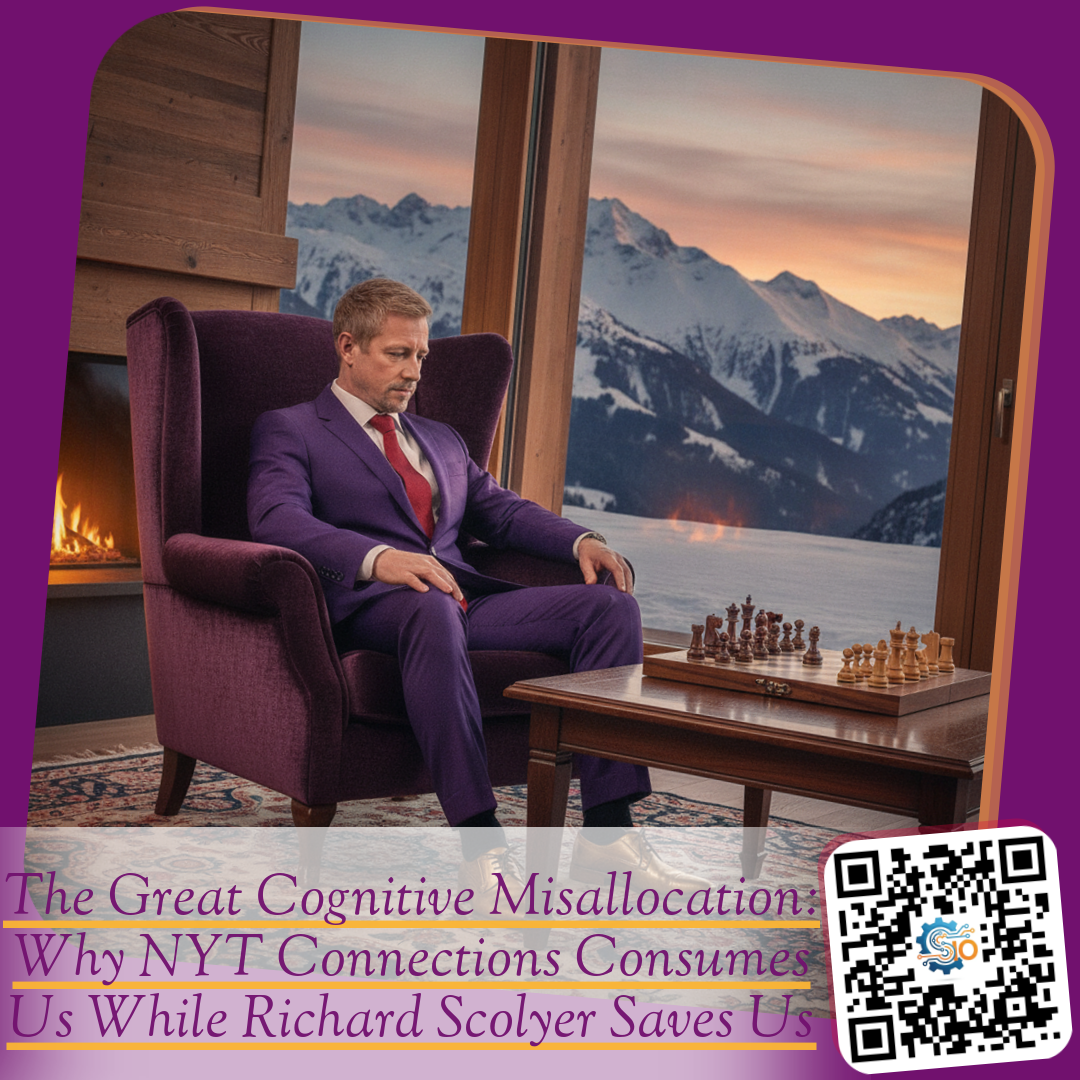
The afternoon sun is setting over the snow-capped peaks of the Swiss Alps, casting a deep amber glow across the balcony of my chalet. I am sitting here in my favorite purple suit, my golden shoes reflecting the warm fireplace light, sipping a perfectly aged Pinot Noir. It is quiet up here. It is the kind of quiet that allows you to look at the world with absolute clarity. From this high-altitude sanctuary, I often observe the fascinating, sometimes baffling, ways humanity chooses to spend its most precious, non-renewable asset: time.
Lately, I have been thinking about a quiet epidemic of mental friction. Every single morning, millions of highly educated, capable individuals wake up, grab their smartphones, and dedicate their first, freshest cognitive energy to a neat little grid of sixteen words. They are playing NYT Connections. They sweat over whether a word belongs to a category of kitchen utensils or a list of things that are slippery. It is a daily ritual of low-yield mental friction that consumes millions of collective brainpower hours every single week.
Now, let us turn our eyes to a different kind of mental effort. In a laboratory half a world away, a man named Richard Scolyer has been manually optimizing the survival rate of the human brain. Diagnosed with terminal glioblastoma, the world-famous pathologist chose to treat his own brain as a scientific frontier. He did not play safe, gamified puzzles. He used immunotherapy combinations to force his own immune system to target the tumor, meticulously documenting the results and changing the course of neuro-oncology forever. The contrast between these two activities is a brutal, sobering mirror for our modern world.
The Dopamine Trap of Low-Yield Friction
Why do we run toward gamified mobile puzzles while the most critical challenges of our species are left to a handful of hyper-focused individuals? It is because our biology is fundamentally lazy. Our brains evolved to conserve energy, seeking out the easiest path to a dopamine reward. NYT Connections is the ultimate cognitive shortcut. It gives you a tiny, controlled dose of friction, followed by a satisfying burst of colorful success. You solved the puzzle. You are smart. You are accomplished.
But what did you actually build? What did you solve? Nothing. You simply sorted words that someone else arranged for you. This is the classic trap of modern consumption, a concept I explored deeply in my previous writing on The Surface-First Exploit: Why the Modern Consumer Brain Values the Wrapper Over the Core. We have become experts at celebrating the wrapper of intelligence while completely ignoring the core work of intellectual creation. We mistake the quick thrill of solving a digital puzzle for actual, meaningful cognitive contribution.
When you look at the sheer volume of human focus poured into these daily games, the scale of the waste is staggering. It is a massive misallocation of intellectual capital. We are trading our peak cognitive hours for a green or purple category on a screen. We are burning through valuable metabolic fuel on tasks that leave our lives exactly where they were before we unlocked our phones.
A Society in Deep Cognitive Misallocation
This is not just about a harmless word game; it is a symptom of a much larger civilizational trend. We are living through an era where our priorities have been completely inverted. We have the technology to solve massive global challenges, yet we use our most advanced systems to distract ourselves. This societal habit is what I call The Great Misallocation of 2026: Why We Trade Peak Human Potential for Drone Warfare and Toy Story 5. We have the potential to build, optimize, and heal, yet we find ourselves stuck in loops of superficial entertainment.
Consider the difference in stakes. If you fail to solve your daily word puzzle, your streak is broken, and you might feel a mild twinge of disappointment. If Richard Scolyer fails in his pursuit, a human life is lost, and a vital path to curing brain cancer remains unpaved. One is a simulated challenge designed to keep you scrolling; the other is a raw, terrifying struggle against death itself. One requires passive sorting; the other demands active, dangerous, and manual optimization of complex biological systems.
The tragedy is that the millions of people playing these games are not stupid. In fact, they are often the most creative and analytical minds in our society. They are doctors, engineers, writers, and entrepreneurs. Imagine if we could redirect even ten percent of that collective focus toward genuine problem-solving. Imagine the businesses we could build, the systems we could optimize, and the lives we could save.
Automating the Mundane to Reclaim Your Focus
If we want to escape this cycle of trivial mental friction, we must look at how we structure our lives. We cannot simply rely on willpower. We need systems that automate the low-yield, repetitive aspects of our daily routines so that our minds are free to tackle high-yield, high-reward challenges. We need to stop manually managing things that machines can do better.
This is especially true for those of us building businesses and striving for financial freedom. You cannot optimize your mind for creative breakthrough if you are constantly bogged down by administrative friction. If you are still wasting hours manually setting up email sequences, building landing pages, and trying to patch together different software tools, you are committing your own personal cognitive misallocation.
This is exactly why I rely on systems that handle the heavy lifting for me. For anyone building a presence online, using Systeme.io is the ultimate way to eliminate that administrative drag. By putting your marketing, sales funnels, and customer communications on autopilot with Systeme.io, you free up your mental bandwidth. You stop playing low-level games of digital puzzle-solving in your business, and you start focusing on the high-yield strategies that actually move the needle toward your personal sovereignty.
Reclaiming Your Cognitive Sovereignty
True freedom is not just about having money in the bank or living in a beautiful chalet in the Alps. True freedom is having absolute control over where your attention goes. It is about choosing to focus on deep, meaningful, and transformative tasks rather than letting algorithms dictate your mental state. This is the core theme of my thoughts on Surviving the Chaos of 2026: From Everest Slopes to Personal Sovereignty. In a world of infinite, loud distractions, the ultimate act of rebellion is sustained, deep focus.
When Richard Scolyer faced the ultimate crisis, he did not distract himself. He leaned into the absolute core of his expertise. He optimized his survival rate by applying raw, unfiltered human intelligence to a complex system. He chose deep, terrifying cognitive sovereignty over the easy, comfortable path of passive consumerism.
We must do the same in our daily lives. We must audit our mental friction. Is the challenge you are solving today actually building your future, or is it just keeping your brain occupied while your potential slips away? Let us stop wasting our metabolic gold on digital circuses. It is time to reclaim our attention, automate our systems, and build something that truly matters.
As you move through your week, take a moment to look at your daily routines. Where are you spending your best cognitive energy? Are you solving real puzzles that change your life, or are you just sorting words on a screen?
How much of your daily mental friction is actually building your long-term freedom? If you could reclaim the hours spent on trivial games, what massive project would you finally tackle?
I wish you clarity, sharp focus, and the courage to seek true, high-yield achievements. Let us connect and keep this vital conversation going on my social networks!