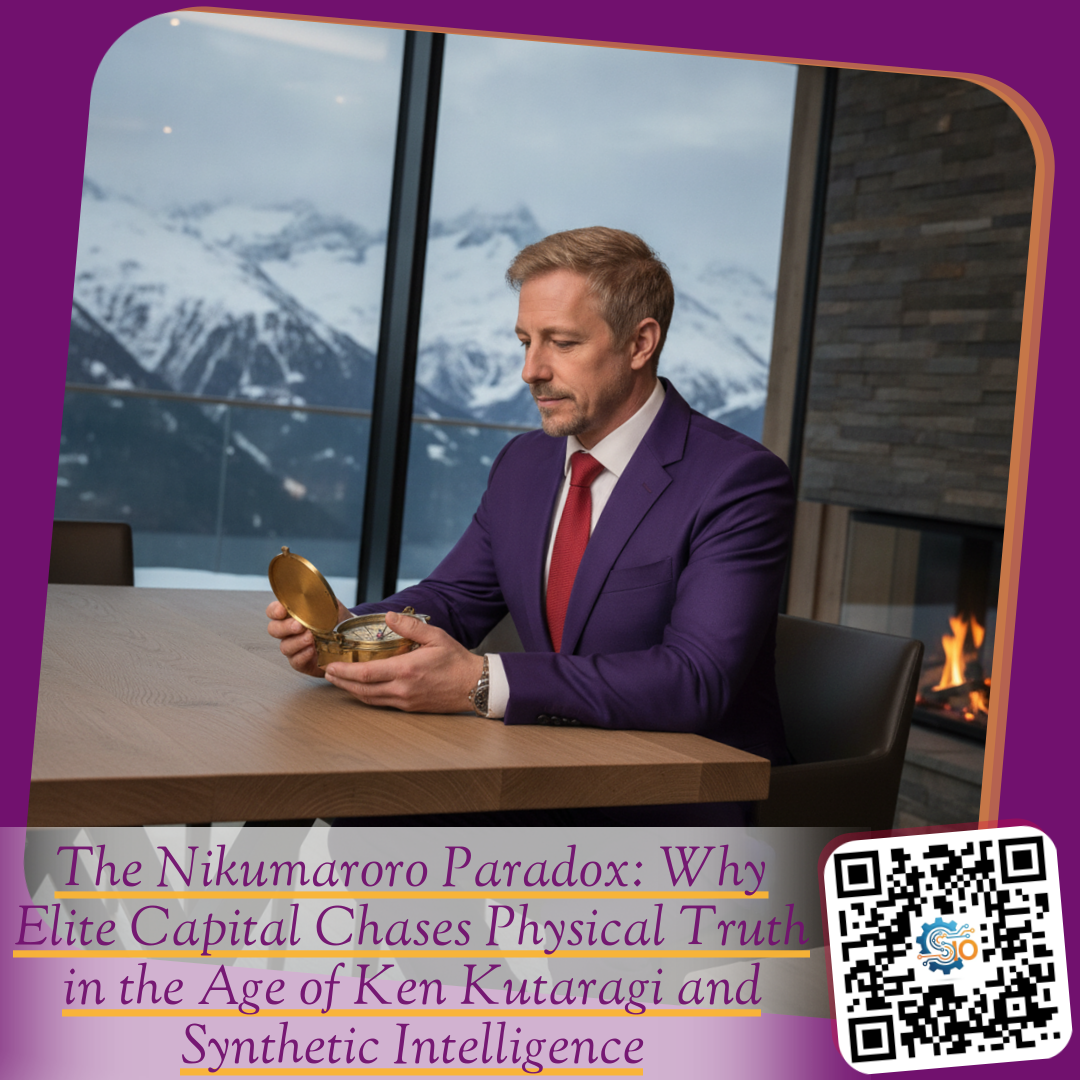
The morning light across the Swiss Alps has a way of cutting through the noise. From the lounge of my chalet, looking out past the frost covered pines toward the peaks, the world feels wonderfully still. Sitting here in a crisp white shirt, my favorite purple suit trousers, and a pair of golden shoes that catch the warm glow of the fireplace, I find myself thinking about the peculiar directions in which global capital is rushing this October.
On one side of the globe, millions of private dollars are once again plunging into the abyss surrounding Nikumaroro Island. Deep sea submersibles and marine search vessels are scouring the seabed of that lonely Pacific atoll, obsessively hunting for the definitive aluminum fragments of Amelia Earhart’s vanished 1937 Electra. On the other side, tech pioneer Ken Kutaragi, the visionary father of the PlayStation, is scaling synthetic intelligence through ambitious robotic architectures designed to let artificial minds perceive, generate, and navigate environments entirely inside simulated data loops.
At first glance, these two pursuits could not seem further apart. One looks back nearly a century into maritime salt and forgotten bones, while the other races toward autonomous machines that build their own digital realities. Yet when you peel back the layers, they reveal the exact same impulse. As our world tip toes into total digital simulation, the ultimate luxury and the ultimate hedge is the purchase of undeniable physical truth.
The Echoes of Nikumaroro Island and the Hunger for the Tangible
The tragedy of Nikumaroro Island has captivated researchers, dreamers, and wealthy patrons for generations. Why does deep pocketed capital keep returning to an uninhabited coral atoll in Kiribati? It is not merely romantic curiosity about an aviation pioneer. In late 2026, solving a century-old silence represents something much deeper: the desire for an irreproducible, unhackable fact.
Consider the environment we inhabit today. Every pixel on your screen can be generated in fractions of a second. Every voice can be cloned with eerie fidelity. As I explored when discussing Why Elizabeth Holmes Deserves Our Praise in the Age of Simulated Reality, modern culture has spent years blurring the boundary between visionary storytelling and sheer digital fabrication. We have built an information ecosystem where conviction often masquerades as substance.
Out on the underwater shelves of Nikumaroro, however, there are no software updates or generated consensus. Either the Lockheed Electra rests in the deep ocean rift, or it does not. The metal either bears the chemical fingerprint of mid-twentieth-century American aviation, or it is ordinary coral debris. You cannot bribe the Pacific, and you cannot prompt engineer the seabed. In an era where digital information degrades into hallucinated noise, physical provenance has become the rarest asset on Earth.
Ken Kutaragi and the Rise of Synthetic Intelligence
While explorers probe the Pacific floor, Ken Kutaragi is moving fast in Tokyo. Through his robotics and artificial intelligence ventures, Kutaragi has been vocal about moving past traditional large language models into genuine synthetic intelligence. His vision focuses on machines that do not merely recite text, but comprehend and reconstruct physical reality through massive, self-generating simulation engines.
Synthetic data is now the lifeblood of advanced machine learning. When natural human data runs dry, systems begin training on data generated by other machines. Entire artificial worlds are constructed in fractions of a second to train autonomous robots before they ever touch physical floorboards. The consequence is extraordinary technological power, but it comes at a philosophical cost: our digital sphere is becoming a hall of mirrors, where algorithms learn from algorithms inside simulated environments.
This dynamic ties directly into themes I touched on in The Cryptographic Illusion and Why We Obsess Over Tomorrow. We constantly manufacture complex mathematical structures and simulated futures to give ourselves a feeling of certainty. But as synthetic intelligence scales, human certainty about what is real online rapidly evaporates. When you read a news story, inspect a financial statement, or examine an image, you are increasingly interacting with synthetic approximations rather than ground truth.
The Elite Mandate: Anchoring Capital in Physical Sovereignty
The ultra wealthy understand this shift better than anyone. They recognize that when intelligence becomes synthetic and commoditized, the value of pure digital output trends toward zero. What becomes exponentially valuable is whatever cannot be synthesized.
This explains the massive reallocation of capital into physical anchors. We see it in the frantic acquisition of deep water mineral rights, farmland, rare earth corridors, and yes, sovereign historical artifacts. Funding a multi-million-dollar oceanic expedition to Nikumaroro Island is not merely philanthropy or eccentric adventuring. It is a flex of absolute verification. It is the ultimate statement that physical reality remains the sovereign court of last resort.
If you can prove where an aircraft fell eighty-nine years ago using sub-surface telemetry and retrieved metal, you possess a tangible piece of human history that no neural network can ever simulate into existence. Physical truth has become the sovereign reserve currency against intellectual inflation.
Grounding Your Own Enterprise in Real Foundations
You might wonder how this dynamic applies to our day-to-day lives as entrepreneurs, creators, and professionals striving for financial independence. The lesson is simple: do not let your business dissolve into pure digital illusion. While everyone else gets distracted chasing overly complex, fragmented tech stacks that generate noise instead of profit, winners focus on clean, verifiable systems.
In my own ventures, whether managing digital assets or scaling private media projects, I place immense value on operational simplicity. You do not need a labyrinth of disjointed software subscriptions to establish authority and cash flow. That is precisely why I admire practical platforms like Systeme.io. Instead of wrestling with fragmented plugins and phantom technical bugs, Systeme.io provides an all-in-one architecture that keeps your sales funnels, email relationships, and digital courses anchored in one dependable place.
Real freedom is not about building complex digital illusions that demand endless maintenance. It is about creating reliable, grounded systems that produce tangible results, leaving you free to enjoy the finer things, like an afternoon espresso while the snow settles quietly over the mountains.
The Final Frontier Is Still the Real World
Ken Kutaragi’s push toward synthetic intelligence will undoubtedly revolutionize robotics, industrial automation, and space exploration. It will create tools of unimaginable capability. But no matter how flawless our digital simulation becomes, humanity will always retain an instinctive, romantic reverence for the unsimulated truth.
We care about Nikumaroro Island because Amelia Earhart’s courage was real, the ocean is real, and the metal beneath the waves is real. We admire the innovators mapping synthetic realms, but we reserve our deepest awe for those willing to brave the frozen winds, the crushing depths, and the hard facts of our physical universe.
As you build your own legacy this season, keep your eyes on the horizon. Embrace smart technology where it serves your freedom, but make sure your life, your capital, and your values remain rooted in what is genuinely authentic.
When you look at your own daily routine and digital consumption, how much of your world is composed of synthetic echoes, and how much is grounded in physical truth? What is the one tangible project or pursuit in your life that no algorithm could ever simulate?
I wish you clarity, quiet confidence, and unmatched success in the week ahead. Reach out and join the conversation across my social media channels, let us discuss where physical truth meets the digital future!