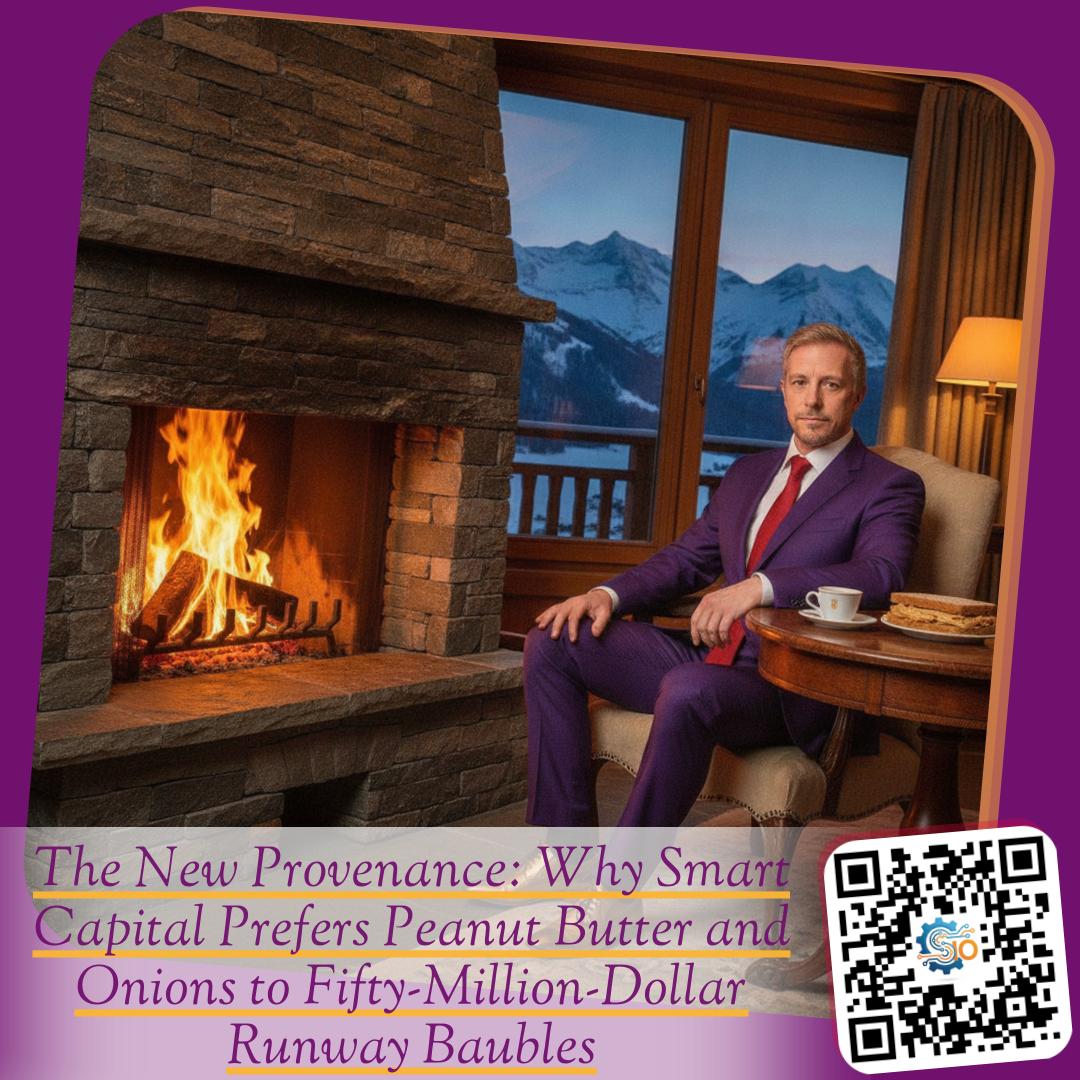
The morning light over the Swiss peaks has a way of cutting straight through illusions. Sitting here in my chalet, watching the frost settle across the pine needles while the cedar logs crackle in the hearth, I find myself studying the strange economic theater playing out across our screens this October. I have my golden shoes kicked up near the fire, a fresh espresso in hand, and an unmistakable grin on my face as I watch the old gods of luxury stumble over their own excesses.
Just days ago, the runway world attempted its classic trick of theatrical shock. Kylie Jenner stepped out onto the runway draped in a fifty-million-dollar bra, expecting collective gasps of reverence. Instead, the global reaction was remarkably tepid, hovering somewhere between mild amusement and outright boredom. When you cover everyday fabric in synthetic dazzle and price it at the cost of a private island, modern culture does not bow anymore. It yawns.
Meanwhile, across the Pacific, regulators slapped a staggering twenty-eight-million-dollar fine on a clandestine onion cartel in the Philippines for manipulating the supply of humble red bulbs. At the exact same time, culinary historians quietly marked the 125-year anniversary of the peanut butter and jelly sandwich, observing that this three-ingredient working-class staple remains the unchallenged sovereign of the global lunchbox. The message is ringing loud and clear: the era of manufactured glamour is collapsing, and the ultimate luxury of our decade is the essential made exclusive.
The Fatigue of Manufactured Glamour
For decades, legacy institutions told us that value is an equation of celebrity wattage and astronomical price tags. You took an everyday garment, encrusted it with gems, paraded an heiress down a runway, and assumed everyone would fawn over the display. But our collective taste has matured past superficial glitter. When everyday citizens watch basic grocery bills climb while media houses celebrate fifty-million-dollar runway trinkets, the spectacle feels disconnected from physical reality.
In my earlier piece, Scaling Luxury: From the iPhone Duo to the Dunkin Bat Koozie, I explored how consumer devotion shifts when brands lose touch with authentic utility. Gimmicks eventually hit a wall of diminishing returns. When an object exists purely to broadcast wealth without delivering tangible substance, it degrades into hollow camp. True sophistication is not about blinding an audience with diamonds; it is about owning the fundamental components of daily existence.
The ultra-wealthy investors I speak with in Zurich and Geneva are not bidding on runway jewels. They are studying supply lines, caloric longevity, and the unshakeable cultural habits that survive wars, recessions, and digital revolutions. They understand that real staying power belongs to things people cannot live without.
The 125-Year Vintage of Cultural Sovereignty
Consider the peanut butter and jelly sandwich. Born in domestic science journals at the turn of the twentieth century, it survived the Great Depression, fueled soldiers through global conflict, and remains an anchor of daily nutrition 125 years later. It requires no marketing department, no influencer contracts, and no venture funding to protect its market share. Its provenance is rooted in absolute reliability.
In my previous reflection, The 125-Year Peanut Butter Sandwich, Snail Poison Curries, and the Algorithmic Kill Switch, we touched upon how simple human rituals resist algorithmic manipulation. The PB&J sandwich is culinary gold because it provides hyper-dense calories, comforting predictability, and perfect shelf stability. While modern restaurant concepts fold after six months of high-overhead misery, two slices of bread, ground peanuts, and fruit pectin quietly command billions in steady commerce.
That is what authentic longevity looks like. When you evaluate an asset, you should ask yourself whether it will retain its relevance when society strips away the noise. A diamond-encrusted bra loses ninety percent of its resale value the moment the camera flashes stop. A pantry staple feeds a household for generations.
Cartel Economics in the Kitchen
Nothing illustrates this inversion of luxury quite like the drama in Manila. When authorities uncovered a syndicate fixing onion prices, resulting in an eye-watering twenty-eight-million-dollar penalty, nobody laughed. At peak scarcity, onions in the region traded at higher prices per pound than premium beef. Smugglers were literally hiding sacks of yellow onions inside luxury suitcases at international airports.
Think about the poetry of that moment. A pungent root vegetable, grown in muddy soil, commanding black-market premiums while high-end department stores discount designer handbags just to clear warehouse space. This dynamic aligns with the core argument I made in The Nikumaroro Paradox: Why Elite Capital Chases Physical Truth in the Age of Ken Kutaragi and Synthetic Intelligence. When our world becomes saturated with synthetic imagery and artificial narratives, smart capital rushes backward into physical ground truths.
The onion is indispensable to world cuisine. You cannot simulate its aroma with code, and you cannot replace its sulfurous bite with marketing slogans. The moment you control an indispensable basic, you control genuine leverage. Scarcity applied to an essential creates undeniable power, whereas scarcity applied to a decorative trinket creates mere vanity.
Building Resilient Architectures for the Modern Era
What does this mean for those of us building enterprises, managing capital, and designing independent lives? It means we must stop chasing fragile, high-maintenance status symbols and start building high-utility, anti-fragile systems. If your business depends on vanity and perpetual hype, you are one cultural mood swing away from obscurity.
When I mentor entrepreneurs looking to build lasting cash flow, I always emphasize simplicity over convoluted grandeur. You do not need bloated enterprise software or seven-figure advertising campaigns to build a digital empire. You need an automated, reliable system that delivers real value to real people every single day.
That is precisely why modern creators lean on streamlined platforms like Systeme.io to run their businesses. Instead of stitching together dozen fragile tools with expensive subscriptions, using Systeme.io allows you to manage sales funnels, email marketing, and automated courses from one unified dashboard. It is the business equivalent of the peanut butter sandwich: remarkably efficient, ruthlessly practical, and built to perform without unnecessary friction.
The Ultimate Luxury Is Self-Determination
As the afternoon sun dips behind the snowy crests outside my window, casting deep violet shadows across the valley, the lesson becomes crystal clear. Real luxury in 2026 is not about signaling wealth to strangers who do not care about you. It is about sovereignty. It is about knowing that your assets produce steady cash flow, your pantry is stocked with real sustenance, and your daily life is not held hostage by fragile spectacles.
Let the runway crowds celebrate their fifty-million-dollar baubles while the world scrolls past. We will keep our focus on the quiet essentials that feed civilizations, the humble staples that command sovereign markets, and the automated tools that secure our personal freedom. True wealth whispers through resilience, while fragile status screams for attention.
Are you spending your energy chasing superficial status symbols that command fleeting attention, or are you investing in the resilient essentials that endure for generations? How much of your current business model relies on expensive vanity rather than unshakeable everyday utility?
I wish you clarity, immense success, and genuine independence. Connect with me over on my social channels to share your thoughts, and let us continue building real wealth together.