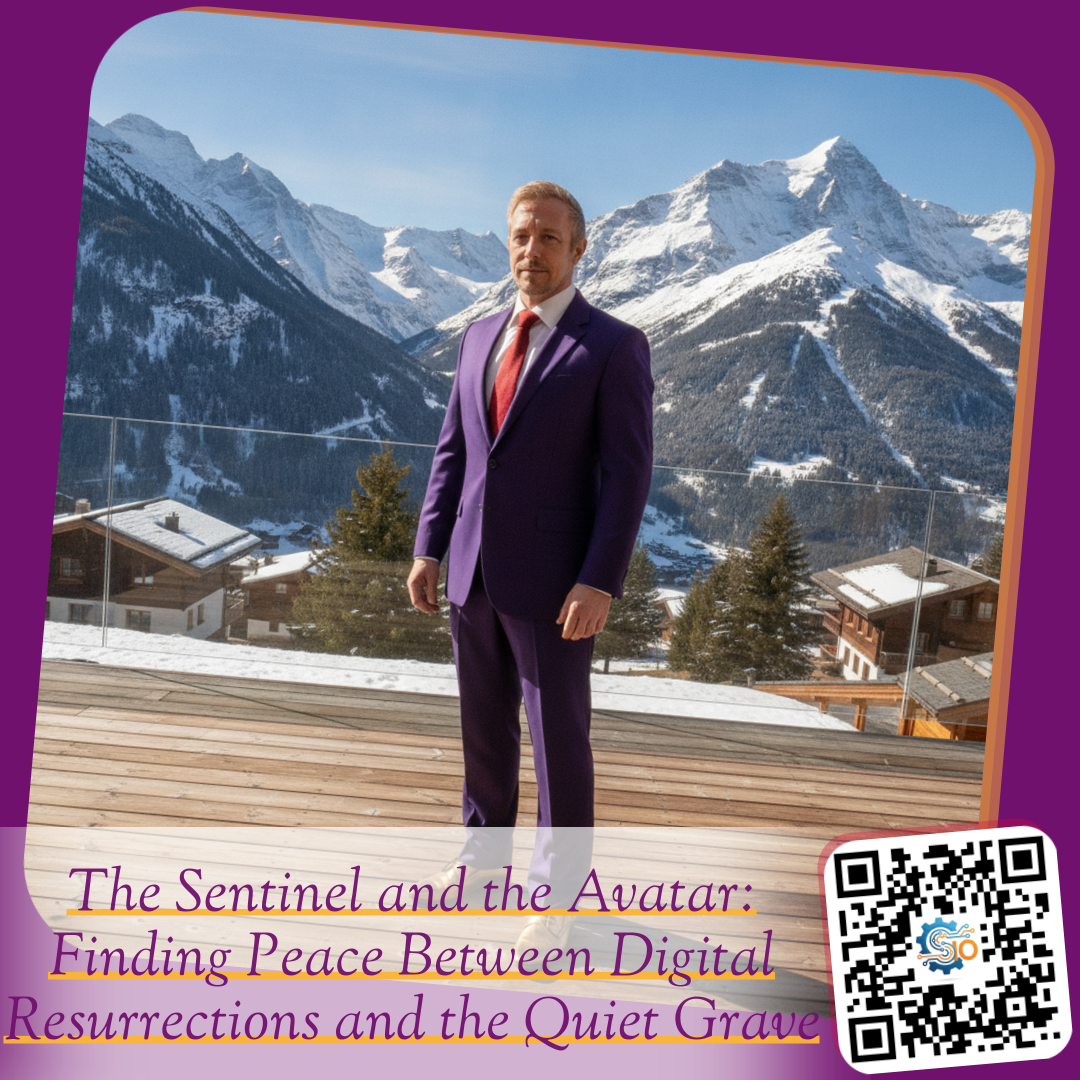
Greetings, my friends, from the sunlit terrace of my luxurious chalet here in the Swiss Alps. Today, the morning air is incredibly crisp, and the peaks are glittering like diamonds under the summer sky. I am sitting here in my favorite purple suit, adjusting my red tie, and looking down at my polished golden shoes. There is a profound, beautiful stillness up here that always gets me thinking about the fleeting nature of our time on this planet. We spend so much energy trying to build digital empires and secure our legacies, yet we often forget to simply breathe and listen to the world around us.
Lately, my mind has been drifting toward the deep contrast between our fast-paced online world and the ancient, quiet rhythms of the earth. We are living in an era where the lines between the living, the dead, and the artificial are becoming dangerously blurred. As the sentinel trees of our folklore fall to the quiet axe of time, we find ourselves caught between the artifice of digital resurrections and the soft mercy of graveyard sheep grazing upon the silence of our deepest, unmapped burials.
The Fallen Sentinels and the Trap of Nostalgia
Not long ago, the world mourned the loss of the famous Sycamore Gap tree, that ancient sentinel of folklore that stood proudly along Hadrian’s Wall. It was a living monument, a quiet witness to centuries of human history, suddenly cut down in an act of senseless vandalism. When such landmarks fall, we feel a deep, collective ache. Our immediate human instinct is to cry out, to rebuild, to replant, or to use technology to conjure up an exact replica. We want to freeze time and deny the reality of loss.
But we must ask ourselves if this desperate clinging actually serves our spiritual growth. In our modern quest for digital immortality, we try to trade our present reality for a simulated past. As I wrote in my previous analysis, The Law of Equivalent Exchange: Why Nostalgia Cannot Buy Relevance in 2026, trying to force the past into the present is a losing game. Nostalgia is a beautiful, romantic emotion, but it cannot buy back what has naturally returned to the earth. When we try to artificially recreate what is gone, we risk losing our connection to the living present.
The Rise of AI Necromancy and Digital Ghosts
This struggle to let go has taken a much more futuristic and controversial turn. Across the globe, families are turning to technology to deal with the agony of grief. In Russia, families are using artificial intelligence to recreate digital avatars of loved ones killed in Ukraine. These AI chatbots speak with the voices of the deceased, using past text messages and social media data to simulate a conversation from beyond the grave. It is a form of digital resurrections that promises comfort but often leaves us feeling hollow.
There is a dangerous illusion here. We are replacing real, messy, healing grief with a synthetic loop of algorithmic code. This phenomenon is something we must look at with a highly critical eye. In my article, The Great Regulatory Blind Spot: Why the State Bans Umbrellas but Ignores Shadow Agents and AI Necromancy, I explored how society tends to regulate the trivial while ignoring the massive ethical shifts occurring right under our noses. This technological necromancy might offer a temporary band-aid, but it ultimately prevents the natural, necessary process of mourning. A digital avatar cannot offer real warmth; it is merely a mirror reflecting our own desperate desire to avoid the silence of loss.
The Soft Mercy of Graveyard Sheep and True Silence
Contrast this digital noise with a beautiful story that recently caught my eye. In a quiet cemetery, a flock of graveyard sheep, used to naturally keep the grass trimmed around the headstones, was saved from being removed after a massive wave of public support. There is something incredibly poetic about that. Instead of noisy lawnmowers or sterile, automated systems, we have gentle animals grazing peacefully among the tombstones. They bring a soft mercy to the graveyard, a living presence that honors the dead without trying to disturb their rest.
In many ways, this quiet, natural scene is exactly what we need to heal. It stands in stark contrast to the tragic, unmapped burials that continue to haunt our history. Whether we are talking about the heartbreaking discovery of infant remains at former mother-and-baby homes, the mystery of the unknown man in a coffin after the Air India crash, or the soldier whose brain was finally buried with his body eighty-five years after his death, these stories remind us of a fundamental truth. The dead deserve dignity, truth, and absolute silence, not a digital simulation.
We must learn to sit with this silence. It is in these quiet spaces that we find true emotional recovery. In our fast-paced world, we are constantly running away from quiet moments, filling every second with notifications. As I discussed in The Sound of Absolute Silence: How SpaceX AI and Fibre Optic Drones Are Reengineering Survival, our modern technological systems are designed to fill every gap with data, keeping us in a state of constant survival mode. But true survival, both spiritual and emotional, requires us to unplug and accept the natural silence of life’s transitions.
Building a Legacy with True Freedom
As an entrepreneur and a creator, I am always looking for ways to build things that last. But building a legacy does not mean trying to live forever through a chatbot. It means setting up systems that give us the freedom to enjoy our lives right now, so we can build genuine memories with the people we love. We should let technology handle the mundane, repetitive tasks of our daily work, leaving us free to focus on what truly matters.
This is precisely why I am such a strong advocate for automation in business. By leveraging a comprehensive platform like Systeme.io, you can automate your marketing, run your online courses, and manage your sales funnels without being chained to your computer. It allows you to build a thriving, sovereign digital empire while giving you the freedom to step away. You can close your laptop, walk out into the fresh mountain air, and appreciate the living world rather than getting lost in a digital simulation of life.
When your business is running smoothly in the background, you have the luxury of time. You have the time to visit ancient forests, to support local conservation, and to sit in a quiet graveyard listening to the gentle rustle of the wind. You do not need to rely on digital resurrections because you are fully alive in the present, creating a real-world impact that will outlast any algorithmic avatar.
Finding Our Place in the Circle
Ultimately, the ancient trees, the grazing sheep, and the digital ghosts are all part of the same modern conversation. We are searching for meaning in a world that is moving too fast. But the answers will not be found in a glowing screen or a simulated voice. They are found in our willingness to accept the natural cycles of life, to honor the fallen, and to find peace in the moments of silence that connect us all.
Are we willing to let the dead rest and find our peace in the natural silence of memory? Or will we let the allure of digital resurrections turn our grief into a permanent, simulated loop?
I wish you all absolute peace, clarity, and the freedom to live fully in the present moment. Take some time today to step away from your screens, touch grass, and feel the sun on your face. Let us continue this beautiful journey together, and as always, feel free to connect with me and share your thoughts on my social networks.