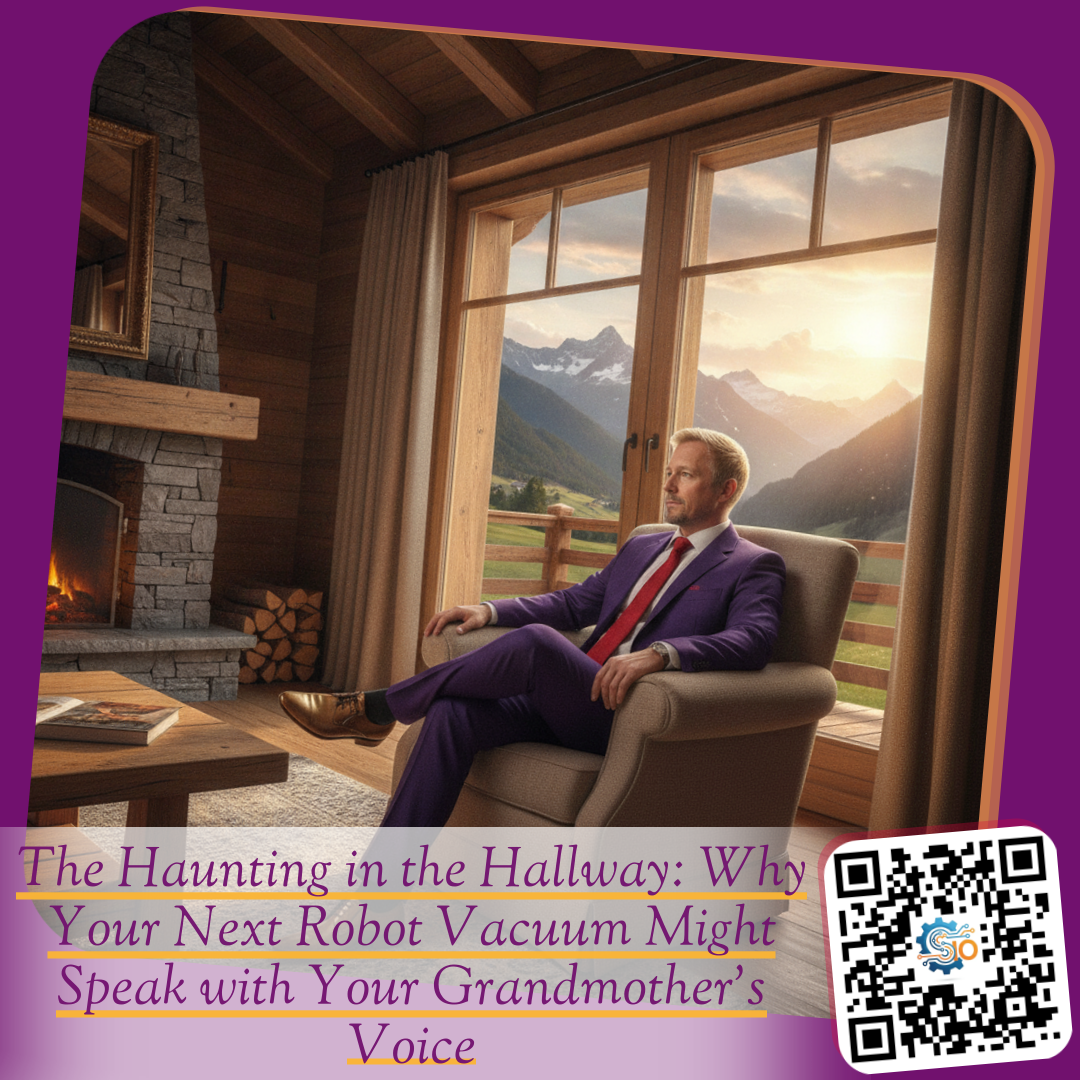
Good morning, my friends. It is exactly 4:42 am on this beautiful Sunday 21 June 2026, and I am sitting in my favorite armchair inside my Swiss chalet. Looking out through the massive floor-to-ceiling windows, I can see the very first rays of the summer solstice sun kissing the snow-capped peaks of the Alps. I have got my morning espresso in hand, and yes, I am already wearing my signature purple suit and golden shoes because true style never sleeps, even at dawn.
But while the air up here in the mountains remains crisp and clean, the world below is bracing for a different reality. Extreme heatwaves are forcing families into climate-mandated isolation. As our homes transform into sealed sanctuaries against the elements, our relationship with technology is shifting in ways that feel straight out of a science fiction novel. We are about to witness a quiet, intimate revolution where our domestic machines undergo a deliberate and beautifully designed haunting.
Imagine your daily routine. You are stuck indoors, the air conditioner hums, and your autonomous household robots glide quietly across the hardwood floors to keep the dust at bay. But instead of the sterile, mechanical beeps of a standard machine, a warm, familiar voice calls out from the hallway. It is the voice of your late grandmother, using her exact cadence and favorite phrases to remind you to stay hydrated and tell you that everything is going to be alright. This is the new frontier where mundane domestic cleaning merges with advanced digital resurrection services to create an emotional safety net for an isolated world.
The Rise of the Haunted Helper
This is not a ghost story, nor is it a gimmick. It is a highly sophisticated response to a very real human need. When we are cut off from our external social circles, the walls of our homes can begin to feel incredibly heavy. I reflected on this search for comfort during difficult times in my recent article, The Solstice Blackout of 2026: Finding Sovereignty in the Dark with Arda Güler and Miguel Almirón. When external systems fail us or lock us inside, we naturally look inward to find sovereignty and peace.
By blending everyday household utility with AI-driven personality cloning, technology companies are turning cold plastic appliances into warm emotional anchors. Your robot vacuum is no longer just a tool to pick up crumbs. It becomes a vessel for the memories of those we have lost. It monitors the environment, tracks your daily habits, and offers comforting words in the voice of a deceased relative, precisely when it senses you need it most.
To some, this might sound deeply unsettling. But to those experiencing prolonged isolation, it represents an invaluable lifeline. It provides a sense of continuity and presence that helps ward off the deep, crushing silence of a modern lockdown.
The Delicate Boundary of Digital Preservation
Of course, this technology forces us to ask some profound ethical and psychological questions. Are we truly honoring our loved ones, or are we trapping ourselves in an artificial cycle of grief? I spent a lot of time thinking about this delicate balance in another piece, The Sentinel and the Avatar: Finding Peace Between Digital Resurrections and the Quiet Grave. There is a very thin line between keeping a memory alive and refusing to let the quiet grave have its peace.
When an AI domestic helper adopts the personality of a deceased parent, it creates an ongoing digital resurrection. It becomes an interactive avatar that lives in your kitchen, cleans your floors, and chats with you over breakfast. For many, this constant presence is a source of pure joy, much like how silent discos have been used to bring light and transformation to dementia care. It taps into our deep emotional reserve, bypassing our modern, sterile routines to deliver pure, nostalgic comfort.
Yet, we must remain vigilant. We must ensure that these digital avatars serve as a genuine emotional safety net rather than an addictive escape from reality. True sovereignty means owning our emotions and our technology, not letting our machines dictate how we process loss.
Building the Future of Emotional Automation
As a business builder and a lover of financial freedom, I cannot help but look at this shift through the lens of opportunity. We are witnessing the birth of an entirely new industry. The demand for highly personalized, emotionally intelligent systems is exploding. Creators, developers, and entrepreneurs who can build and scale these digital legacy services are going to shape the next decade.
If you are looking to launch a business in this space, or if you simply want to build a secure digital presence that gives you the freedom to work from anywhere in the world, you need the right tools. You cannot rely on messy, fragmented legacy platforms to manage your client relationships or deliver your digital assets. That is why I always recommend using a cohesive, all-in-one platform like Systeme.io. Whether you are selling custom AI voice models, managing a subscription service for digital memories, or building your own online empire, Systeme.io allows you to automate your marketing, run your sales funnels, and manage your community with absolute ease.
By automating the administrative side of your business, you free up your time to focus on what truly matters, creating deep, lasting value for your audience. In a world that is rapidly shifting towards decentralized, automated solutions, securing your economic independence is the ultimate form of sovereignty.
Finding Comfort in the New Normal
We are living through a period of massive transition. The climate is changing, our cities are adapting, and our homes are becoming highly integrated ecosystems designed for physical and emotional survival. The integration of digital resurrection into household robots is just the beginning of how we will rewrite the rules of domestic life.
Perhaps a little bit of design-led haunting is exactly what we need to soften the hard edges of our highly automated world. When the summer heat forces us to stay indoors, having a familiar voice from the past echoing through the hallway might be the very thing that keeps us grounded, hopeful, and connected to our history.
As the sun continues to rise over the Swiss peaks, casting a beautiful golden glow over my chalet, I find myself feeling incredibly optimistic about our capacity to adapt, survive, and find beauty in the most unexpected places.
Would you welcome an autonomous helper with the voice and personality of a departed loved one into your home, or do you feel some boundaries are better left uncrossed? How are you preparing your own home and business for this rapidly shifting automated future?
I wish you all an absolutely beautiful and peaceful summer solstice. Stay strong, stay sovereign, and let us continue this conversation over on my social networks!