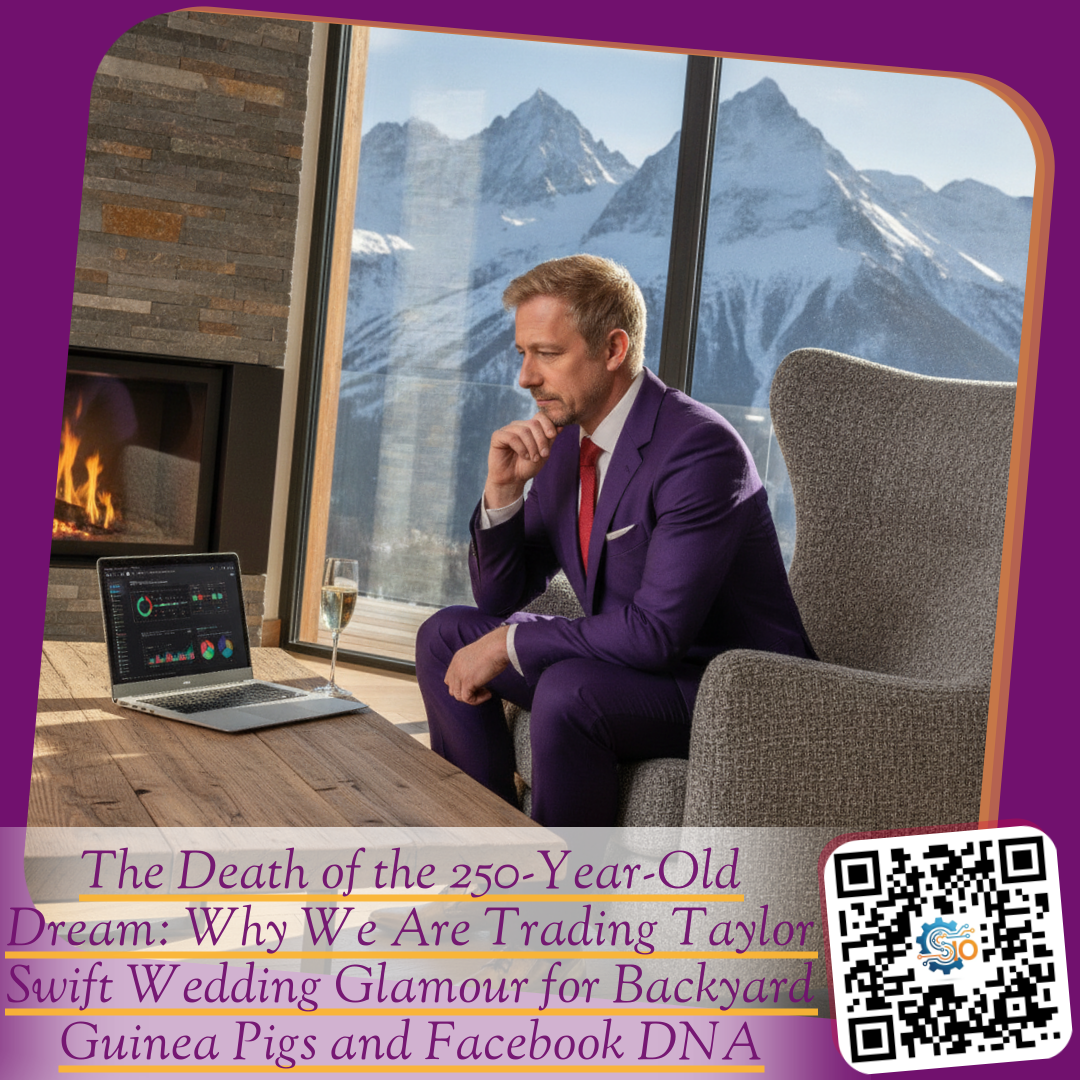
Greetings, my friends, from the quiet majesty of the Swiss Alps. Tonight, as the mountain breeze brushes past my chalet windows and the fireplace casts a warm glow over my favorite purple suit, I find myself reflecting on the sheer speed of human adaptation. It is Sunday, July 5, 2026, and the world is currently spinning at a dizzying, highly contradictory speed.
Just yesterday, the United States marked its 250th birthday. It was a milestone historic moment filled with roaring flyovers, dazzling fireworks, and unfortunately, a backdrop of brutal, extreme weather that seemed to mock the very notion of stability. At the exact same time, the digital collective was completely transfixed by the ultimate high-gloss distraction: the wedding of Taylor Swift and Travis Kelce. We watched a parade of Dior dresses, caught glimpses of Adam Sandler, and read endless social media posts detailing everything from a beautiful night to the world’s greatest hangover. It was the absolute pinnacle of luxury escapism.
Yet, just beneath this glossy surface of celebrity weddings and patriotic fireworks, a quiet, almost grim transformation is taking place in the consumer psyche. People are no longer buying the old promises. They are realizing that the traditional pathways to security have crumbled, prompting them to trade the unattainable glamour of the digital elite for a raw, self-manufactured reality. When survival becomes the ultimate luxury, the choices we make start looking incredibly wild.
The Crumbling of the 250-Year-Old Dream
For two and a half centuries, the fundamental promise of the American Dream was simple: if you work hard, play by the rules, and trust the systems in place, you will secure a comfortable life. But as we look around in 2026, that promise feels increasingly like a relic of a forgotten era. High inflation, climate volatility, and a deep-seated distrust of central institutions have left everyday citizens feeling completely alienated.
I recently wrote about this state of national disillusionment in my piece, The Semiquincentennial Illusion: Why Liquid Sovereignty Trumps the Digital Circus on This Fourth of July. In that article, I explored how the spectacular fireworks displays of the 250th anniversary could not hide the structural cracks in the system. The traditional concept of national citizenship is being replaced by a desire for personal, sovereign independence. People are realizing that relying on a central state safety net is a losing game.
When the macro-narratives fail, individuals turn to micro-survival. The collective psyche has shifted from striving for upward mobility to establishing absolute, decentralized autonomy. If the system cannot guarantee your safety, your power, or your basic food supply, then you must build those foundations yourself.
Backyard Guinea Pigs and the Meat of Necessity
Nowhere is this shift more apparent than in the sudden, shocking rise of backyard guinea pig farming. In a story that has captured the attention of off-grid communities worldwide, a family recently secured official council approval to breed guinea pigs specifically for food. What was once considered a cherished childhood pet is rapidly being re-evaluated as an efficient, low-impact source of protein.
This is not just a quirky lifestyle choice; it is a profound psychological pivot. It represents a consumer base that has stopped waiting for supermarket supply chains to stabilize. We dissected this exact phenomenon in the article, The Absurdity Standard of 2026: Why World Cup Sleep Deprivation and Backyard Guinea Pig Farming Outperform the American Dream. When the cost of living reaches a point where raising rodents in your garden makes more economic sense than trusting the local grocery store, the old economic dream is officially dead.
Breeding guinea pigs is cheap, fast, and highly sustainable. It requires minimal space and bypassed the entire industrial food system. It is survival stripped of all pretension. While the elites celebrate on private islands, the sovereign-minded citizen is quietly building a high-yield protein farm in a wooden hutch. It is raw, functional, and undeniably practical.
The Facebook DNA Wild West
This desperate drive to manufacture survival does not stop at food. It has extended to the very building blocks of life itself. Consider the rise of the Facebook sperm donor, where individuals are bypassing expensive medical clinics, legal frameworks, and regulatory bodies to conceive children. Men are fathering dozens of children through casual, self-arranged digital connections.
Why is this happening? Because traditional medical systems have become prohibitively expensive, bureaucratic, and detached from the average person’s financial reality. The desire to pass on one’s legacy and build a family has not disappeared, but the trust in established medical institutions has completely vanished. People are taking reproduction into their own hands, utilizing basic social media networks to source DNA.
It is the ultimate democratization, and perhaps the ultimate wild west, of human biology. It reveals a society that has decided that if the official systems are too heavy, too expensive, or too broken, they will simply build a parallel reality. It is messy, controversial, and incredibly decentralized, but it is happening right now under our noses.
Building Sovereignty Without the Survivalist Grimness
When we look at backyard rodent farming and Facebook DNA sourcing, it is easy to feel a sense of dread. But as someone who enjoys the finer things in life, from my tailored purple suits to the crisp, fresh air of the Swiss Alps, I believe there is a middle ground. You do not have to live a grim, survivalist existence to protect yourself from systemic collapse. You simply need to build digital sovereignty.
True sovereignty means creating automated systems that protect your time, your wealth, and your freedom. You do not need to breed guinea pigs for food if you have a highly resilient, automated online business generating passive income. By establishing decentralized digital assets, you can secure your lifestyle regardless of what happens to the traditional job market or the national economy.
This is exactly why I rely on modern, high-efficiency automation tools. When I designed my digital business, I integrated Systeme.io to handle my marketing funnels, email automation, and digital product sales. This elegant platform allows me to maintain a steady, highly profitable operation without being chained to a desk or a specific geographic location. Because Systeme.io streamlines the entire process, I can focus on enjoying my financial freedom here in Switzerland while my digital assets quietly fund my life.
You see, digital sovereignty is the modern equivalent of the off-grid homestead. Instead of digging up your backyard, you build digital real estate. Instead of relying on volatile, centralized employers, you create a direct connection with your audience. It is clean, elegant, and incredibly effective.
The New Luxury of Self-Determination
As we navigate the remaining months of 2026, the contrast between high-gloss escapism and gritty self-reliance will only grow. The Taylor and Travis wedding was a beautiful spectacle, but it cannot feed a family or secure a future. The 250th birthday of the nation was a grand party, but it did not solve the systemic inflation and instability that keeps people up at night.
The new luxury is not a designer dress or a celebrity invitation. The new luxury is self-determination. It is the peace of mind that comes from knowing you have manufactured your own survival, whether through a physical homestead or a highly automated digital business. The world is changing rapidly, and the old safety nets are gone. It is time to build your own.
How are you choosing to navigate this shifting landscape of self-reliance? Are you focusing on physical preparedness, or are you building digital assets to secure your personal sovereignty?
I wish you all absolute freedom and success on your journey. Let us continue this conversation on my social networks, and as always, stay brilliant, stay focused, and keep building your empire.