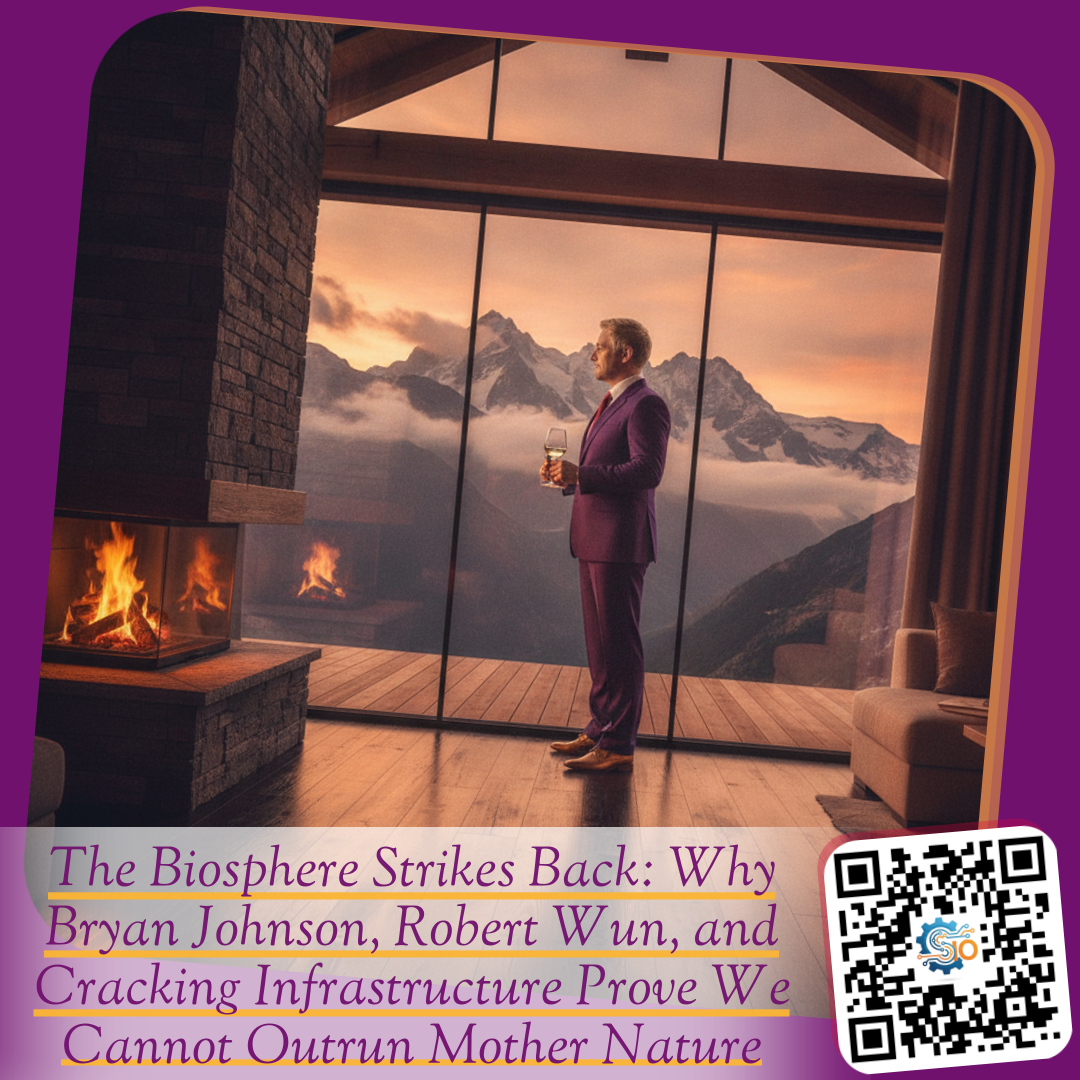
Greetings from my beautiful chalet here in the Swiss Alps, my friends. As I sit by the window, wearing my signature purple suit and golden shoes, the mountain air is crisp, cool, and clean. But as I look down from my luxurious sanctuary, the rest of the world seems to be spinning into a bizarre, feverish dream. We are in July 2026, and the contrast between high-tech luxury and raw, chaotic nature has never been more striking.
Have you noticed it too? While we design complex algorithms to predict the future, the physical world is sending us some very loud, very unfiltered feedback. From the Saharan dust settling over Florida to the bizarre sight of billionaire bio-hackers getting taken down by ancient microbes, it feels like the planet is tired of negotiating with us. We have built a world of digital illusions, but the physical reality is finally catching up.
The Cracking Foundations of the Modern World
Let us start with the physical world that we so often take for granted. The brilliant Graham Platner has been documenting the quiet, steady erosion of our physical infrastructure. We are talking about water lines breaking, electrical grids wheezing under the summer heat, and roads that look like they belong in a post-apocalyptic film. This is not just a minor inconvenience; it is a fundamental cracking of the foundation we rely on every single day.
It reminds me of a piece I wrote recently, The Sovereign Audit: How Enola Holmes Logic and Buffett Warnings Unmask America’s Cracking Foundation. In that article, I talked about how we ignore the obvious signs of structural decay because we are too busy staring at our screens. Platner’s work is a sobering reminder that you cannot run a high-tech society on a crumbling, century-old physical foundation. When the physical pipes burst, all the digital wealth in the world cannot buy you a clean glass of water.
We see this collapse everywhere, from municipal water failures to the sudden shutdowns of historic institutions. The physical reality of our world requires maintenance, care, and respect. Yet, we have spent decades treating our infrastructure as an afterthought, preferring to invest in digital clouds rather than physical concrete.
High Fashion for the Apocalypse
And how are the ultra-wealthy responding to this slow-motion collapse? By turning it into haute couture, of course. The fashion genius Robert Wun took the style world by storm with his Haute Couture 2026 collection. It is a breathtaking, haunting tribute to the end-times. We see models walking down the runway wearing garments that look like they have been scorched by fire, drenched in torrential rain, or pelted with broken glass.
It is beautiful, romantic, and deeply apocalyptic. Wun has turned our collective anxiety about ecological collapse into a luxury status symbol. The message is clear: if the world is burning, we might as well look spectacular while it happens. It is the ultimate expression of elite defeatism, a way to aestheticize our inability to protect the very world we inhabit.
But wearing a rain-splattered gown does not actually protect you from the storm. It just romanticizes our disconnection from nature. We are treating the end of the physical world as a design trend, a runway show for the select few who can afford the tickets. Meanwhile, outside the fashion tents, the real elements are becoming increasingly difficult to ignore.
The Ultimate Irony of Bio-Hacking
Which brings us to the ultimate symbol of elite hubris: Bryan Johnson. This is a man who spends millions of dollars a year on his Blueprint project, attempting to reverse his biological age. He has a team of world-class doctors, a strictly regimented diet, and a hyper-monitored lifestyle designed to shield him from every conceivable biological threat. He is the poster boy for the belief that we can use technology to escape human limitations.
And yet, nature found a way. A primitive, single-celled parasite called Cyclospora managed to breach his pristine defenses, triggering a massive immune response. The very bio-hacked immune system he spent millions to optimize was brought to its knees by an organism that has existed for millions of years. It is a delicious, tragic irony that exposes the limits of our technological arrogance.
Think about it. We have billionaires trying to colonize Mars, upload their consciousness to the cloud, and bio-hack their way to immortality. But a simple parasite found in unwashed cilantro or contaminated water can bypass all that high-tech wizardry in an instant. This Cyclospora parasite outbreak, coupled with things like the massive Saharan dust plumes sweeping across Florida, shows that we cannot separate ourselves from the Earth. The biosphere does not care about your net worth, your optimized biomarkers, or your digital avatar.
Building Resilient Systems for a Changing World
We are living in an era where the old-world institutions are failing us. We cannot rely on giant, centralized systems to keep us safe, healthy, or free. If you want to build a life that lasts, you have to shift your focus to localized, sovereign solutions. We must learn to build durability into our lives, rather than relying on fragile, top-down structures.
This is exactly what I explored in The Castle Relics and Backyard Breeds: How to Build a Durability Legacy When Old World Institutions Shutter. True security does not come from trying to control every single microbe in a laboratory. It comes from building a resilient, adaptable life. It is about understanding that we must work with nature, not try to conquer it. It is about backyard breeds, local gardens, and physical assets that do not vanish when the power grid fails.
To achieve this kind of physical and financial freedom, you also need to simplify your digital life. You cannot afford to spend your days managing fragile, over-complicated systems that break the moment a server goes down. That is why I always advocate for clean, integrated automation. Instead of patching together dozens of expensive tools, I rely on Systeme.io to run my online business. It is a robust, all-in-one platform that automates your marketing, hosts your courses, and manages your funnels without the headache. It gives you the freedom to step away from the screen, walk out into the fresh mountain air, and actually live your life.
Embracing Our Earthly Reality
As I look out at the Swiss Alps, I am reminded that these ancient peaks will be here long after our digital empires have crumbled. The lesson of 2026 is not that we should despair, but that we need a serious reality check. We cannot bio-hack our way out of our relationship with the planet, nor can we ignore the physical decay of the world around us. It is time to stop romanticizing the apocalypse on the runway and start building real, tangible durability in our everyday lives.
We need to reconnect with the physical earth, maintain our infrastructure, and build local networks of resilience. Only then can we navigate a future that is bound to be as unpredictable as it is beautiful.
Are we ready to trade our high-tech illusions for practical, earth-bound resilience?
Or will we keep trying to build digital castles while the ground beneath us continues to shift?
Take care of yourselves, stay sovereign, and let us chat over on my social networks to hear your thoughts on this changing world.