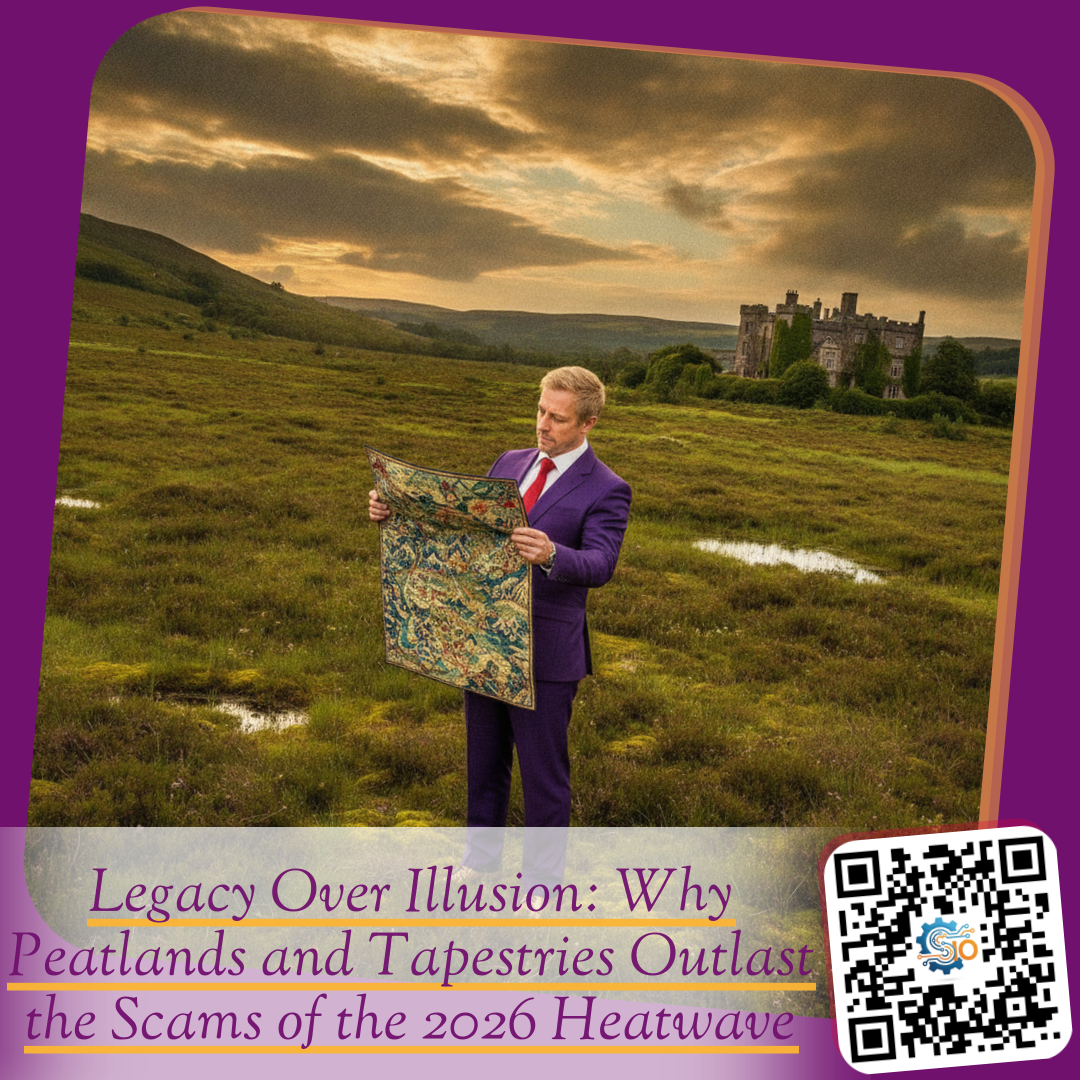
Greetings from the Swiss Alps, my friends. As I sit here on the terrace of my chalet, looking out over the crisp, snow-capped peaks, I cannot help but feel a profound sense of gratitude. The air up here is cool, sweet, and clean. Down in the valleys of Europe and across the British Isles, however, the story is entirely different. The UK is baking in a historic 35C heatwave that is set to stretch deep into next week. People are sweltering, looking for any quick escape from the oppressive humidity.
When the world gets this hot, human behavior gets weird. Desperation drives people toward the nearest, easiest digital illusion. Currently, the internet is flooded with viral advertisements for fake portable air conditioners promising to make you cool in 90 seconds. It is a classic modern scam: cheap plastic, clever digital marketing, and a completely useless product that ends up in a landfill within a month. We are trading our hard-earned cash for ninety seconds of false hope advertised on social media feeds that we will forget by tomorrow morning.
But while the masses are chasing these fleeting, high-tech band-aids, something far more interesting is happening beneath the surface of our culture. Genuine longevity is making a quiet, powerful comeback. This week, the legendary Bayeux Tapestry is arriving in the UK for the first time in 900 years, protected by a heavily armed police guard. Think about that for a moment. A physical piece of embroidered linen, hand-stitched in the eleventh century, still commands absolute reverence, tight security, and global headlines. It has survived wars, plagues, revolutions, and the rise and fall of entire empires because people cared enough to guard it physically.
The Bogfather and the Art of Generational Anchors
At the same time, forward-thinking visionaries are looking at the earth itself to build their lasting monuments. Take the pioneering scientist affectionately dubbed the Bogfather, who is currently dedicating his life to restoring ancient peatlands to fight climate change. Peat bogs are not glamorous. They are muddy, quiet, and slow. Yet, a healthy peatland stores more carbon than all the forests of the world combined. It is a slow, methodical, environmental restoration that takes decades to fully mature, but its impact will be felt for hundreds of years.
Fifty years from now, when the digital noise of the 2020s has faded into absolute obscurity, no one is going to remember the viral video you posted or the social media-age youth clubs currently fighting to stay relevant by chasing fleeting internet trends. Instead, your family name will be defined by two things: the Bogfather-style restoration of your ancestral environment and the physical artifacts you guarded like the Bayeux Tapestry. We must ask ourselves: are we building monuments of mud and oak, or are we building digital sandcastles?
I recently wrote about this pull between the temporary and the eternal in my piece, The Relentless Golden Fever: Why Intimate Theater, Recalled Shampoo, and Drained Reflecting Pools Define Our Scorching Summer. In that article, I explored how our obsession with immediate comfort and cheap commercial items often leaves us empty and overheated. If we want to survive the cultural and environmental shifts of our century, we must pivot toward a physical legacy.
Trading Digital Clutter for Physical Durability
To truly understand how to anchor your family name, you must look at what actually survives the test of time. Physical land, properly restored, is the ultimate generational asset. If you can reclaim a patch of forest, restore a wetland, or protect a piece of ancestral soil, you are creating a biological legacy that your great-grandchildren can touch, breathe, and live on. This is not about passive environmentalism; it is about active stewardship and creating a sovereign sanctuary for your lineage.
Alongside this restored land, you need physical artifacts of genuine meaning. In an era where everything is digital, physical items of high quality become incredibly rare and valuable. Whether it is a hand-bound family archive, a collection of physical art, or heirloom tools, these are the objects that carry your story forward. As I discussed in The Castle Relics and Backyard Breeds: How to Build a Durability Legacy When Old World Institutions Shutter, the institutions we rely on today are incredibly fragile. When the digital grid flickers, the physical assets we have preserved in our homes and on our land are the only things that remain standing.
This raises an obvious question: how do we find the time, energy, and capital to dedicate to these slow, physical pursuits in a world that demands our constant digital attention? The answer lies in leverage.
Using Digital Leverage to Fund Physical Reality
I am a man who loves luxury and financial freedom, and I do not achieve that by digging ditches with my bare hands all day. I achieve it by using the smartest automated tools available to handle my business, allowing me to focus my physical energy on what truly matters. If you want the freedom to buy ancestral land, fund an environmental restoration project, and collect valuable physical artifacts, you need your income to be highly automated.
This is where tools like Systeme.io become invaluable. By using Systeme.io, you can build marketing funnels, manage email lists, and run an entire digital business on autopilot. This is the ultimate paradox of our time: we must use highly efficient, cold digital systems to fund and protect our warm, physical, and sovereign lives. When your business runs itself online, you gain the ultimate luxury: time. Time to walk your land, time to plant trees, and time to teach your children how to guard the family relics.
The Mirage of Social Media Relevance
Contrast this sovereign, land-based lifestyle with the current state of youth clubs and community groups trying to survive in 2026. They are desperately trying to stay relevant by creating TikTok accounts, hosting virtual meetups, and engaging with teenagers through screens. But a digital community is a fragile thing. It has no physical roots. The moment the algorithm changes, or the platform goes out of fashion, that entire community vanishes overnight.
The youth clubs that will actually survive and make a difference are those that get young people out into the dirt, teaching them how to restore the soil, build physical structures, and appreciate the weight of history. We do not need more screen time; we need more muddy boots. We need more young people who understand that a physical legacy is infinitely more valuable than a million temporary digital views.
When you look back on this scorching summer of 2026, do not let your only memories be of cheap cooling scams, screen fatigue, and fleeting online debates. Step outside. Look at the land beneath your feet. Think about what you can build, restore, and protect that will still be standing here in fifty, one hundred, or even nine hundred years.
What physical artifacts are you currently guarding for the next generation? How will you restore your own corner of this earth to ensure your family name echo through the decades?
I wish you all a cool, prosperous, and deeply grounded week ahead. Let us build things that last, my friends. If you want to follow my daily adventures in the Swiss Alps and see how I build my own legacy, come connect with me on my social networks!