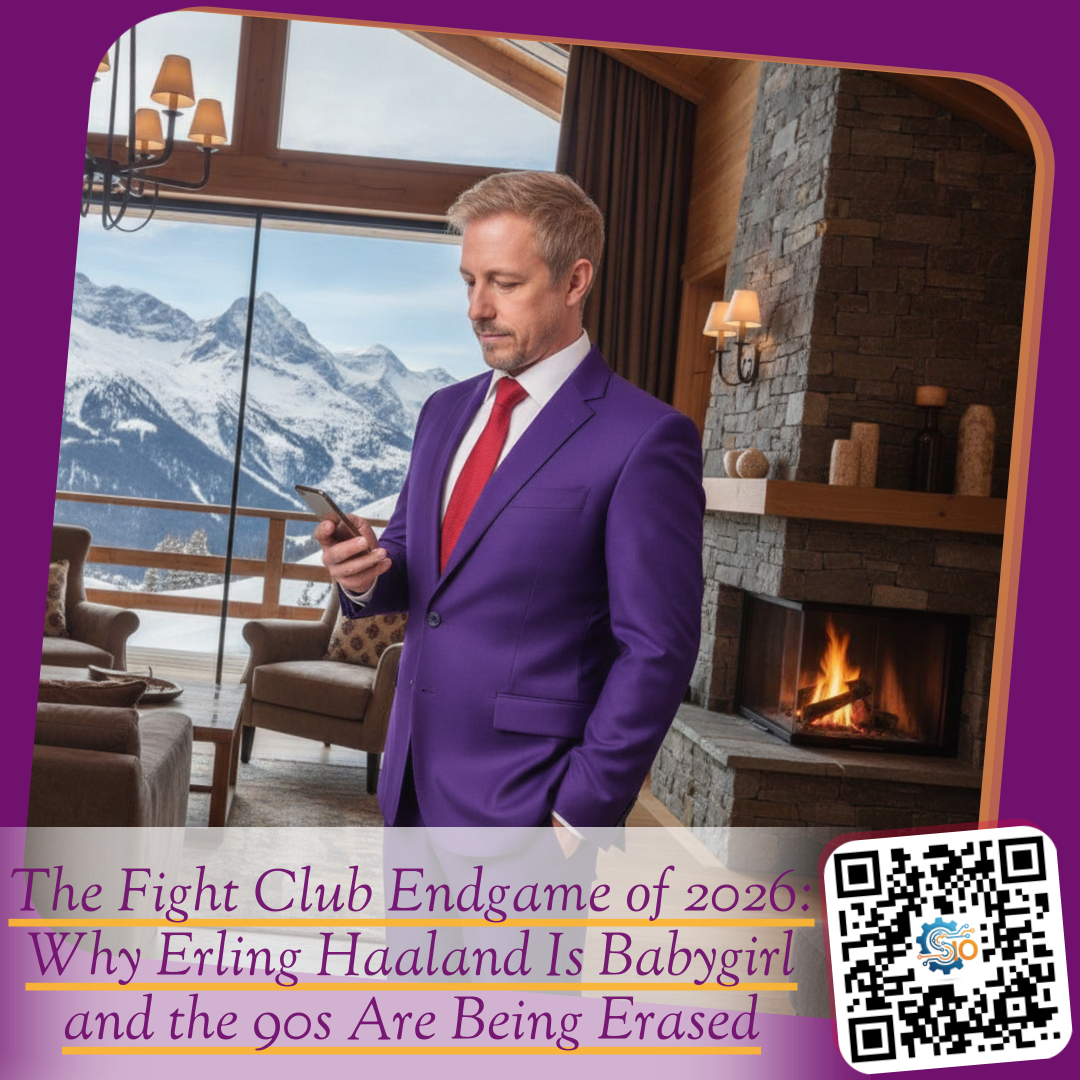
Hello again, my friends. Welcome back to the chalet. The morning air here in the Swiss Alps is incredibly crisp today, the kind of clean cold that makes you feel completely alive. I am sitting by the window in my favorite purple suit, a sharp red tie, and a freshly pressed white shirt, looking at how the early sunlight catches the polished leather of my golden shoes. It is a peaceful scene, but as I scroll through my morning feed, the digital world outside is anything but quiet.
We have officially entered a bizarre new era. The cultural landscapes we took for granted are shifting faster than a mountain landslide. It feels like we are living through a strange, modern sequel to Fight Club, where the rules of identity, fame, and gender are being rewritten in real time. The hyper-masculine, polished aesthetic of the 1990s is being systematically dismantled, not by some grand philosophy, but by North Korean K-pop stans, online memes, and Brad Pitt’s own children.
The Demise of the 90s Icon and the New Aesthetic
Let’s start with a reality check that perfectly illustrates the brutal shift in how we value identity. Recently, a story emerged about an original member of the Spice Girls who was quietly pushed aside before the world ever heard “Wannabe” because some corporate executive decided she looked “too old.” She recalled the heartbreaking moment of hearing her own song on the radio, realizing the brand she helped build had replaced her. It is a tragic metaphor for corporate disposability. In the 90s, the corporate gatekeepers held all the power. They decided who got to be the face of “Girl Power” and who was past their prime.
Fast forward to today. While legacy icons are discarded for showing signs of aging, the internet has crowned Erling Haaland, a towering, absolute powerhouse of a Norwegian striker, as its ultimate “babygirl.” If you are unfamiliar with the term, it is a playful, modern internet label used to describe massive, physically imposing men who are embraced with affectionate, soft-focus adoration by online fandoms. The contrast is spectacular. A lethal World Cup machine is celebrated for being cute and whimsical, while a pioneer of 90s pop is thrown to the wolves of time.
This surreal contrast shows just how much our cultural vocabulary has mutated. We are no longer living in the era of rigid, hyper-macho Hollywood action stars. The old rules of cool are being thoroughly blended and redefined. It is a vivid demonstration of what we explored in The Brutalist Degustation of 2026: Survival, Sensation, and Swiping Through the Chaos, where modern survival means navigating a sensory overload of contradictory digital trends.
The Rebellion in the Household and the State
The erosion of the traditional 90s patriarchy is not just happening on social media. It is hitting the literal household names of that decade. Brad Pitt, who was once the undisputed poster boy of rugged, rebellious masculinity, is seeing his own children drop his famous surname. This is not just a private family dispute; it is a public rejection of the traditional celebrity lineage. The children of the 90s elite are actively choosing to distance themselves from the paternal legacies that built the modern entertainment industry, seeking their own names and their own paths.
At the same time, this rebellion against traditional authority is playing out on a geopolitical scale. Even in North Korea, where Kim Jong Un spent years cementing himself as the absolute, solitary idol of his people, the state’s tight grip is slipping. Why? Because young North Koreans have discovered K-pop. Flash drives smuggled across borders are carrying catchy tunes and synchronized dances that offer an irresistible alternative to state propaganda. The youth are risking everything for a taste of modern, global culture, leaving the regime scrambling to maintain control.
This digital infiltration highlights the unstoppable power of online subcultures. If a closed border cannot stop the soft-power appeal of modern pop music, legacy culture stands no chance. This cultural hijacking reminds me of our discussion on Distraction Tactics and Kitchen Fires: Why We Chase Anime Codes While the World Burns, where we analyzed how viral online trends and digital distractions often mask massive, underlying shifts in global power and personal identity.
Designing Your Own Sovereignty in a Fluid World
When you look at these trends, it is easy to feel a sense of cultural vertigo. The institutions we thought were solid, like the Hollywood star system, corporate music labels, and even sovereign border controls, are incredibly fragile in the face of decentralized digital movements. If an original Spice Girl can be discarded by a corporate whim, and a dictator’s control can be undermined by a catchy pop song, then relying on traditional structures for your security is a losing strategy.
This is why personal freedom and absolute mobility are the only logical paths forward. In our piece on Financial Freedom in 2026: Why Zero-Debt Romance and Ultimate Mobility are the New Standard, we talked about how decoupling yourself from legacy systems is the ultimate survival hack. You cannot afford to let your livelihood be dictated by corporate bosses who might decide you do not fit their evolving aesthetic tomorrow.
To achieve this level of independence, you must own your digital presence. Setting up your own online business and direct-to-audience platform is the ultimate power move. By using an all-in-one marketing platform like Systeme.io, you can easily build your email list, launch digital products, and secure your financial future. When you own the pipeline, nobody can cancel your distribution, tell you that you look too old, or rewrite your identity. You become the sole ruler of your digital empire.
The New Rules of Engagement
What we are witnessing is the ultimate Fight Club endgame. In the original story, the goal was to blow up the credit card companies to reset the financial system. Today, the digital collective is blowing up the traditional structures of identity, legacy, and fame. The hyper-masculine, highly curated ideals of the 1990s are being erased, replaced by a hyper-connected, fluid, and often absurd digital culture that values authenticity and personal agency over corporate branding.
Whether it is Erling Haaland being celebrated for his soft, whimsical online persona, or young people reclaiming their identities by shedding their fathers’ famous names, the message is clear. The old hierarchies are crumbling, and the future belongs to those who can adapt, build their own platforms, and navigate the chaos with style. Do not wait for a legacy system to validate your worth. Create your own value, control your own assets, and build a life of luxury and freedom on your own terms.
As I close my laptop and look back out at the magnificent, snow-covered peaks of the Alps, I am filled with a sense of excitement. Change can be disorienting, but it also opens up incredible opportunities for those ready to seize them. It is a beautiful day to build something truly independent, something that belongs entirely to you.
How are you adapting to this shift in cultural power? Are you building your own independent platform to secure your future against changing corporate trends?
I wish you all an amazing, productive weekend. Let me know your thoughts on my social networks, and keep striving for that ultimate freedom.