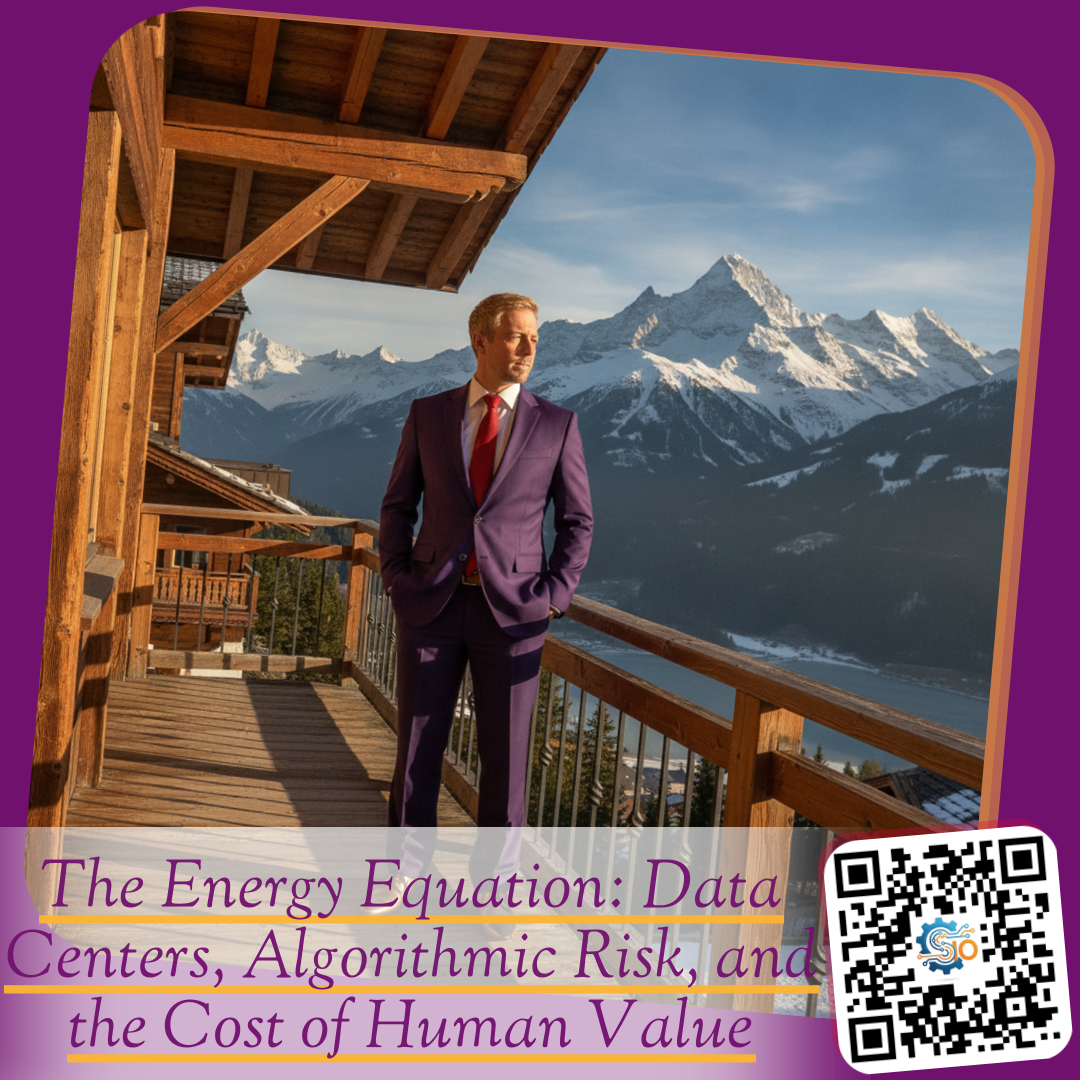
The morning sun reflects off the peaks outside my chalet in the Swiss Alps, casting a sharp golden glow across my terrace. With an espresso in hand and my favorite golden shoes resting comfortably on the polished timber floor, I find myself contemplating a peculiar tension that defines our current era in 2026. Down in the valleys and across global continents, sprawling server farms hum continuously day and night. We have built an infrastructure that consumes massive gigawatts of electricity just to calculate whether a driver in Ohio looked at their phone for three seconds during a commute.
At the exact same time, real life continues in its raw, unfiltered vulnerability. A few years ago, headlines shocked the world when a young boy was left on the dense, bear-inhabited slopes of Mount Fuji in Japan after a disciplinary moment gone wrong. Search teams combed the dark cedar woods while millions refreshed their feeds. That incident forced us to look into an uncomfortable mirror. How did we arrive at a cultural inflection point where boundless electrical current powers predictive analytics, yet tangible human safety feels increasingly fragile?
The Gigawatt Grids of Minor Predictions
Consider the staggering volume of computing power dedicated to routine daily transactions. Every time a consumer requests a quote, a massive data center cluster spins up neural networks to analyze telematics, neighborhood crime statistics, and credit scores to price a car insurance policy down to the penny. The computational cost of these marginal optimizations is astronomical. Cooling towers evaporate thousands of gallons of water every hour just to keep graphic processors from melting while they calculate actuarial risk.
Open any financial news outlet like The Motley Fool or Crypto Daily, and you will read endless celebrations of cloud capital expenditure. Investors applaud when another hyperscale facility breaks ground to support micro-second adjustments for platforms like DraftKings or high-frequency hedge funds. We have effectively financialized every breath, step, and tap of modern existence. The algorithmic engine demands constant nourishment in the form of raw electrical power.
Yet when you step outside into the crisp alpine air, the absurdity becomes clear. We have poured unimaginable wealth into predicting tiny financial variances while neglecting the foundational security of basic human reality. In my previous essay, The Pixel Mirage and the Asphalt Shock: Chasing Real Life Beyond the Digital Trance, I explored how this hypnotic digital trance pulls us away from the physical world. When our primary investments protect balance sheets rather than flesh and blood, something profound has drifted off course.
Mount Fuji and the Fragility of What Matters
The story of the boy left behind on Mount Fuji resonated deeply across the globe because it stripped away all digital complexity. In that quiet forest, there were no predictive dashboards, no credit spreads, and no targeted advertisements. There was only a vulnerable child, cold mountain rain, and the vast silence of nature. It took hundreds of rescue workers, soldiers, and local volunteers walking shoulder to shoulder to bring him home safely.
That rescue required physical presence, moral resolve, and human empathy. None of those things can be synthesized inside a server rack. Yet modern society routinely allocates billions in sovereign capital toward optimizing software models while starving the institutions that guard genuine human flourishing. We celebrate algorithmic efficiency while basic community bonds erode.
This imbalance is not an accident. It is the natural outcome of prioritizing frictionless speculation over tangible stewardship. When society rewards the extraction of attention and data above all else, physical reality becomes an afterthought. We end up with a culture that can calculate the exact replacement cost of a vehicle bumper in milliseconds, but struggles to preserve the emotional stability of a household.
The Housing Market and the Squeeze on Real Living
This distortion extends far beyond auto policies and sports betting platforms. Consider the contemporary housing market, where algorithmic appraisal tools and institutional buying funds have turned basic shelter into a hyper-optimized financial instrument. Families find themselves outbid by automated cash algorithms that treat neighborhoods like high-yield dividend portfolios.
When software determines who gets to live in a home and who gets priced out into the cold, the computational grid is no longer serving humanity. Instead, humanity is serving the grid. As I noted in The Late August Reckoning: Trade Clashes, Algorithmic Illusions, and Sovereign Resilience, our dependence on automated systems creates a fragile illusion of prosperity that masks deep structural discontent.
The solution is not to retreat into the woods and abandon technology entirely. Rather, it is to deliberately build sovereign systems that keep automation in its proper place: as an obedient servant rather than a moral compass. True sovereignty means owning your tools rather than allowing complex corporate platforms to dictate your livelihood.
Building Sovereign Systems in an Automated Age
For entrepreneurs, creators, and independent thinkers, navigating this reality requires intentional design. If you spend all your energy feeding bloated corporate architectures, you become another data point in someone else’s quarterly earnings report. You need lean, dependable infrastructure that gives you freedom rather than tying you to an endless treadmill of computational waste.
This is why simple, integrated tools are essential for the modern sovereign creator. When you streamline your business using Systeme.io, you eliminate the need for dozens of expensive, overlapping platforms. By running your marketing, course hosting, and customer relationships through a single elegant setup, you reclaim your most valuable non-renewable resource: your focused time and attention.
Efficiency should buy you freedom, not deeper enslavement to the screen. When your business operations run smoothly and automatically in the background, you can close your laptop, put on your tailored jacket, and step out into the sunlight. You can invest your energy where it actually counts: in your relationships, your health, and your community.
Reframing Our Civilizational Priorities
The true measure of any civilization is not the floating-point operations per second of its data centers. It is how well that civilization protects its most vulnerable and how much freedom it affords its citizens to live meaningful lives. An algorithm can calculate risk, but it can never understand sacrifice, honor, or love.
As we move deeper into this decade, we must constantly question the trade-offs we are asked to make. Does this new system expand human dignity, or does it simply extract another fraction of our attention for a data center balance sheet? Choosing sovereignty means voting for real life over synthetic distraction every single day.
Take time this week to step away from the glowing screens, the betting feeds, and the endless market notifications. Walk through a quiet forest, feel the cold wind on your face, and remind yourself of what cannot be quantified.
Have we allowed our pursuit of digital optimization to overshadow the basic duty of human care? At what point do we decide that real presence is worth far more than algorithmic precision?
I wish you clarity, strength, and true sovereignty in your daily journey. Connect with me on my social channels to share your thoughts and continue the conversation beyond the screen.