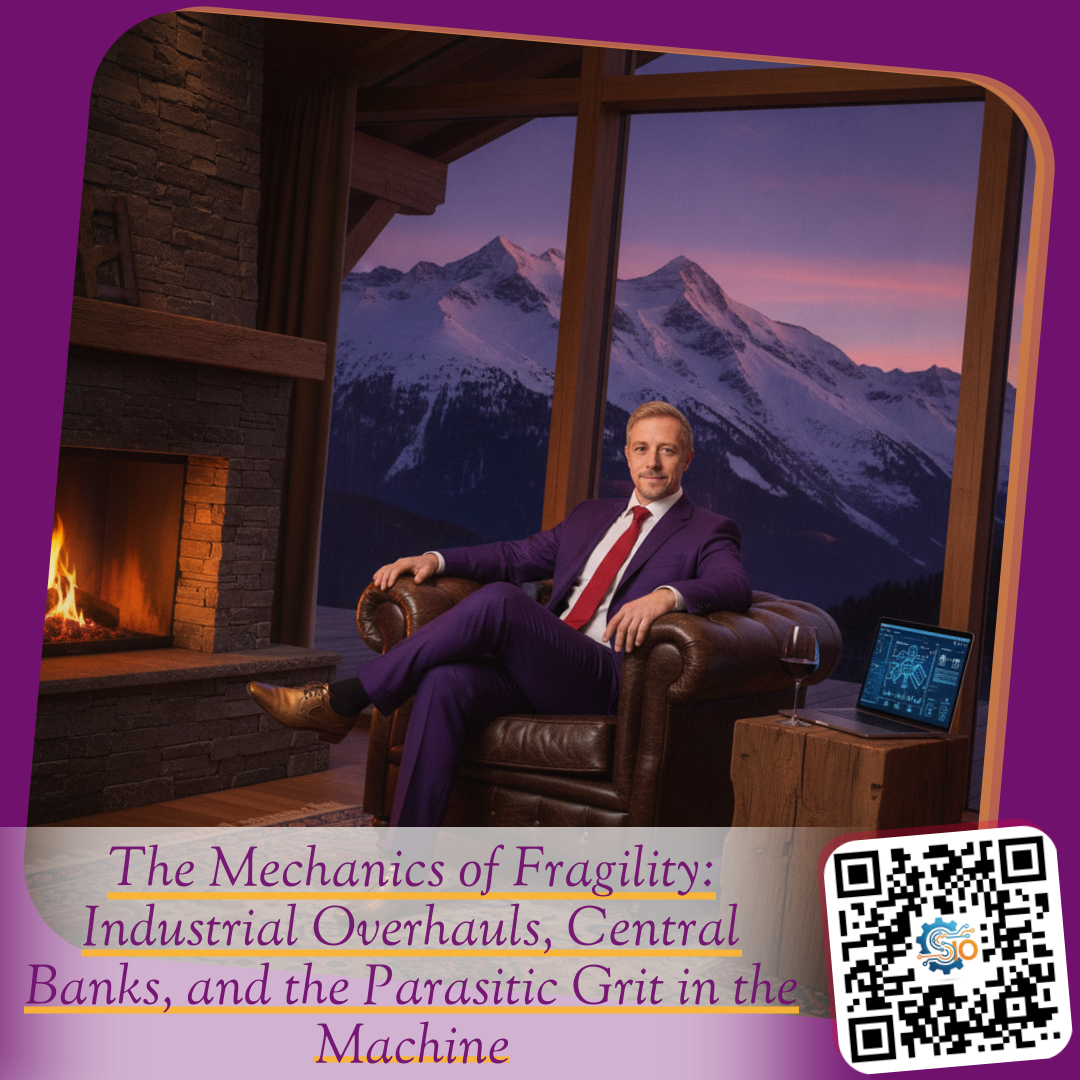
Good evening from the quiet heights of the Swiss Alps, my friends. As the sun dips behind the snow-dusted peaks on this late August evening, casting a deep violet hue across my balcony, I find myself sitting by the crackling hearth with a glass of Pinot Noir. My golden shoes are resting comfortably on the cedar floorboards, and my mind is wandering through the bizarre, interlocking mechanisms of our modern world.
We love to imagine that our civilization is a grand, infallible clockwork apparatus. We construct corporate boardrooms, central bank towers, and hyper-efficient logistics networks, convincing ourselves that human ingenuity can engineer out every possible variable. Yet, when you zoom out and look at the real economic landscape, you quickly realize that even the most meticulously tuned escapement is vulnerable to the smallest grain of sand.
The Heavy Grind of Industrial Quality Control
Take Detroit, for example. Jim Farley has spent the better part of recent quarters waging a relentless war on quality control at Ford. It is an industrial drama of epic proportions. When an automotive giant attempts to overhaul decades of legacy assembly habits, warranty claims, and supplier hiccups, it is not merely updating software. It is attempting to retrain thousands of human hands, thousands of physical machines, and millions of moving components.
Farley knows that high warranty expenses eat away at profitability faster than any competitor can. But when you are steering a vessel that size, every single bolt, gasket, and wire harness carries the weight of systemic friction. You can institute the strictest engineering protocols on paper, but physical manufacturing will always remain a battle against entropy.
This struggle against real-world friction is something we explore constantly on this blog. In fact, as I reflected in The Blood Moon Eclipse and the Collapse of Manual Systems: Why True Sovereignty Demands Automation, the moment an enterprise relies on bloated, manual oversight rather than streamlined architecture, every minor tremor in the chain causes catastrophic drag.
Central Banking Levers and the Illusion of Precision
Shift your gaze across the Pacific to Sydney, and you see another massive gear turning with agonizing friction. The Reserve Bank of Australia remains locked in a delicate dance with persistent inflation, wage pressures, and consumer fatigue. Central bankers sit in polished chambers, pulling fiscal and monetary levers with the confidence of master horologists adjusting a pendulum.
Yet their levers are blunt instruments. When the Reserve Bank of Australia debates rate adjustments, they are attempting to cool consumer demand without shattering the mortgage market. It is an exercise in theoretical precision that constantly collides with messy human psychology. High interest rates pressure households, mortgage stress mounts, and yet services inflation lingers like an uninvited guest.
We are watching global institutions realize that their mathematical models cannot account for the unpredictable velocity of human behavior. Central planners operate as if the global economy is a closed circuit, forgetting that real life is inherently chaotic, unpredictable, and vulnerable to external shocks.
The Microscopic Grit in the Supply Chain
Nothing illustrates this vulnerability better than what has been happening in the agricultural distribution network. While corporate executives polish quarterly reports and central bankers analyze yield curves, public health agencies are scrambling over widespread cyclosporiasis cases tied to contaminated bagged lettuce. A microscopic, single-celled parasite has quietly paralyzed supermarket shelves and salad processing facilities across several jurisdictions.
Think about the delicious irony of that contrast. You can have cutting-edge logistics, satellite-tracked reefer trucks, and barcode-scanned inventory systems, but a single microscopic spore thriving on organic produce can halt the entire pipeline. It echoes the core truth we examined in The Blood Moon, PS5 Pro, and Cyclospora: The Unyielding Clockwork of Organic Friction: nature will always find a way to humiliate our pretensions of absolute sterile control.
No matter how advanced our distribution networks become, physical supply chains will always be tethered to organic realities, soil conditions, water tables, and biological hazards. When you build your entire existence around physical inventory and fragile agricultural corridors, you are forever at the mercy of microscopic friction.
The Tactical Distraction Machine at Full Throttle
How does the mainstream apparatus respond when these structural cracks become too obvious? It deploys the sensory circus. Just as consumers begin feeling the squeeze of interest rates, automotive recalls, and grocery safety alerts, marketing machines roll out comforting rituals like the highly anticipated Spicy Chicken McNuggets September release.
There is a peculiar genius to the modern promotional calendar. The moment macro uncertainty spikes, fast-food conglomerates and media engines drop targeted nostalgia, seasonal sauces, and quick-hit dopamine triggers to keep the collective consciousness focused on trivial novelties. It is a textbook manifestation of what we analyzed in The Tactical Distraction Machine: From Streaming Hype to the Real Economic Chessboard.
A limited-time spicy coating on fried chicken nuggets captures more social media discourse in twenty-four hours than the entire structural recalibration of industrial manufacturing or central bank balance sheets. It keeps the surface waters glittering while the deeper currents churn with structural volatility.
Engineering True Sovereign Resilience
So, where does this leave you and me? Sitting up here in the crisp alpine air, looking down at these tangled global systems, the lesson is crystal clear: you cannot build your personal freedom on top of fragile, heavily intermediated physical pipelines.
If Jim Farley is wrestling with physical assembly tolerances, the Reserve Bank of Australia is fighting economic inertia, and food distributors are battling microscopic parasites, your goal should be building lean, antifragile digital systems that operate independently of physical supply bottlenecks. You want digital architecture that does not require thousands of physical parts or perishable produce to generate value.
This is why I constantly advocate for automated digital infrastructures. When you build automated online business funnels through platforms like Systeme.io, you strip away the massive layers of physical friction that plague traditional corporations. You do not need to worry about assembly-line recalls, contaminated crop shipments, or central bank credit lines when your entire client acquisition, email marketing, and digital product delivery run cleanly in the cloud.
True sovereignty means understanding how the global machine operates, recognizing its points of inevitable breakdown, and insulating your lifestyle and income from its mechanical failures. When you simplify your operational footprint, you regain your most precious asset: your time, your peace of mind, and the freedom to watch the sunset without waiting for a corporate press release to tell you what happens next.
Final Reflections from the Alpine Chalet
As the stars begin to illuminate the high mountain ridges, consider how much of your daily security is tied to fragile physical networks. How much of your attention is being consumed by seasonal marketing distractions while structural gears grind behind the curtain?
Take a quiet moment tonight to audit your own systems. Where are your dependencies, and how can you engineer more simplicity and digital sovereignty into your everyday life?
I wish you all an inspiring, peaceful weekend filled with clear thinking, good company, and uncompromising freedom. Let us continue this conversation over on my social channels, where we share daily strategies for building an unshakeable sovereign life.