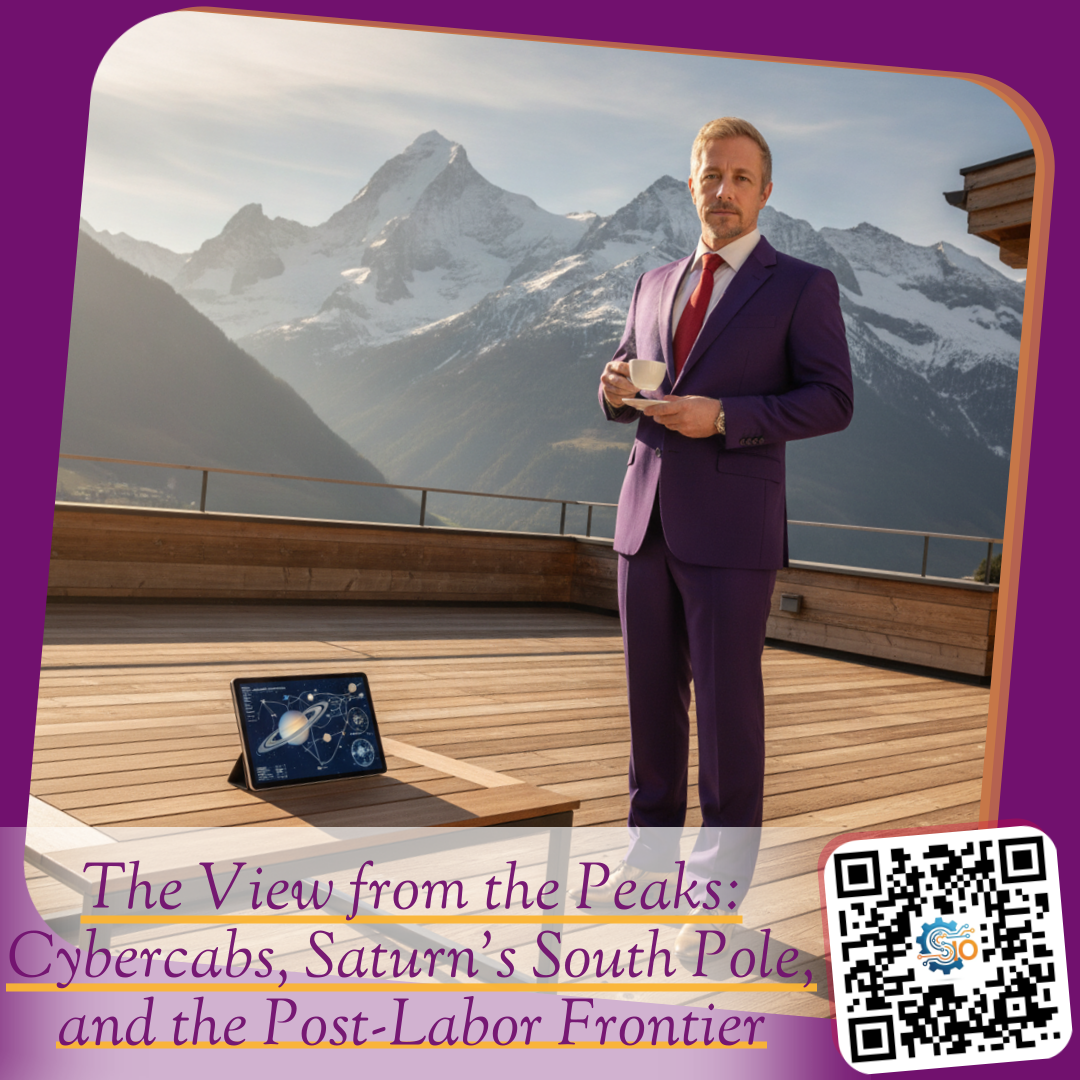
The dawn breaks early over the Swiss Alps in early September. From my balcony, the crisp alpine air carries a sharp bite of autumn that reminds you that seasons do not negotiate with human comfort. Down in the valley, a low layer of mist clings to the pine tops, obscuring the distant highways and the bustling commuter corridors of the lower cantons. Up here, wrapped in a comfortable purple jacket with an espresso warming my hands and golden shoes catching the first rays of sunlight, the perspective changes entirely.
When you stand at high elevation, you realize how much energy is spent arguing over details that the future has already quietly dissolved. For months, headlines across the Western economies have circled the same weary debate. The fierce struggle for an increased minimum wage fills news cycles, legislative halls, and television panels. Union leaders demand statutory hourly increases, while small enterprise federations warn of imminent bankruptcies if the baseline ticks up by two dollars.
It is an earnest battle, full of genuine human emotion, but it feels increasingly like a quaint relic from a bygone century. While the lowlands debate whether an hour of human presence at a cash register is worth fifteen or twenty dollars, the ground beneath the entire concept of the hourly wage is giving way.
The Concrete Reality of the Cybercab
Consider what is actually unfolding on city asphalt right now. The commercial deployment of the autonomous Cybercab is no longer an eccentric prototype whispered about in tech journals. It is rolling out onto metropolitan grids, silently navigating complex intersections without a driver, without a steering wheel, and without an hourly wage slip tucked into a visor.
For nearly a century, transportation served as the ultimate safety net of the modern economy. If your factory shut down or your trade lost relevance, you could drive a taxi, pilot a delivery van, or deliver takeout meals. The exchange was simple: sell your physical coordination and your hours for a predictable rate. As I pointed out in my recent breakdown of Systeme.io tools during my piece on Labor Day 2026 and the Sovereign Art of Owning Your Time, trading raw chronometric hours for physical survival was always an uneasy bargain. Today, that bargain is simply breaking down under mechanical efficiency.
The Cybercab does not require health insurance, paid leave, or an inflation adjustment. It recharges quietly at inductive stations, runs diagnostics at midnight, and carries passengers for pennies on the mile. When the foundational layer of transport and physical retail automation locks into place, arguing over whether human labor should cost twelve or eighteen dollars per hour misses the structural shift entirely. The economic calculation has quietly moved from how much human effort costs to whether human physical intervention is necessary at all.
Indifference at Saturn’s South Pole
To understand the sheer scale of this displacement, it helps to look even further than urban streets. While fleet software reshapes local mobility, autonomous exploratory probes are transmitting high-resolution telemetry mapping the colossal vortex at Saturn’s South Pole. Scientists are unraveling an immense, hurricane-like tempest thousands of miles wide, spinning in absolute solitude across a frozen gas giant millions of miles from Earth.
There is a terrifying and beautiful lesson in those images of Saturn’s South Pole. The cosmos operates with complete magnificence, complexity, and mathematical precision without requiring human attendance. The rings spin, the polar vortices churn, and robotic sensors catalog the universe in silence. Human presence is not required for the system to operate.
We are watching our own economic systems begin to mirror that cosmic architecture. The machine layer of our civilization is detaching from human hands. In my earlier essay, Arbitraging the Human Margin: The High-Resolution Data Moat, we examined how specialized algorithms capture market inefficiencies faster than any human committee ever could. The realization is identical across domains. Whether you are charting atmospheric storms around Saturn or routing autonomous passenger pods through Chicago, human participation is becoming completely optional.
The Fallacy of Political Safeguards
Many well-meaning observers believe that policy can arrest this momentum. They imagine that a stroke of a legislative pen, mandating a higher living minimum wage or imposing punitive automation tariffs, will freeze time in place. But capital moves along paths of least resistance, flowing like water toward frictionless systems.
When you force a mandatory wage hike on jobs that can be digitized or mechanized, you do not guarantee prosperity for the worker. You merely accelerate the deployment schedule of the automated replacement. A robotic kitchen arm or a fleetside dispatch algorithm suddenly shows a return on investment within eight months instead of three years. By treating the symptoms of an industrial age economic model, traditional politics inadvertently accelerates its retirement.
The struggle for an hourly minimum wage assumes that the wage system itself will remain the bedrock of society. That assumption is dissolving before our eyes. The true divide of the coming decade will not fall between high-wage workers and low-wage workers. It will fall between those who remain trapped in the illusion of hourly labor and those who construct autonomous systems of their own.
Building Sovereign Digital Engines
If human physical presence is no longer the linchpin of value, where does that leave the individual who desires genuine autonomy? It demands that you stop acting as an interchangeable component in someone else’s machine and start commanding your own digital infrastructure.
True financial freedom has never come from convincing an employer to grant you another two dollars an hour. It comes from owning assets that produce value while you sleep, hike the alpine trails, or study the stars. This is why I repeatedly encourage my readers to embrace integrated platforms like Systeme.io to handle their marketing, sales funnels, and digital product distribution. When you use Systeme.io, you are essentially deploying your own personal fleet of software tools that capture leads, process transactions, and deliver value across global time zones without your constant physical involvement.
Automation does not have to be an adversary that pushes you out of the workforce. When harnessed correctly, it becomes your private leverage. It allows a single focused creator to operate with the reach and efficiency that once required an entire corporate floor. The valley will keep fighting over crumbs of hourly compensation, but those on the peaks build systems that render hourly compensation completely irrelevant.
The Horizon Beyond the Clock
The morning mist is burning off down below, revealing the silver thread of the highway. By midday, thousands of vehicles will cross that stretch, but each year, fewer of them will be guided by human eyes or human hands. The shift toward a post-labor framework is not a distant science fiction scenario scheduled for the next century. It is arriving in quiet, incremental deployments, from the curbside pickup of a Cybercab to automated deep-space antennas recording data from Saturn’s South Pole.
You can lament this transition, or you can recognize it for what it is: an invitation to reclaim your life from the ticking clock of hourly labor. The old economic valley is noisy and anxious, but the view from the peaks offers complete clarity.
Are you still building your security on the fragile expectation of an hourly wage, or are you constructing systems that work independently of your physical time? What will human creativity look like when society finally realizes that physical labor was always just a temporary phase of our development?
I wish you clarity, courage, and true sovereign freedom as you chart your path forward this week. Reach out and share your thoughts with me on my social networks, where we keep this vital conversation moving.