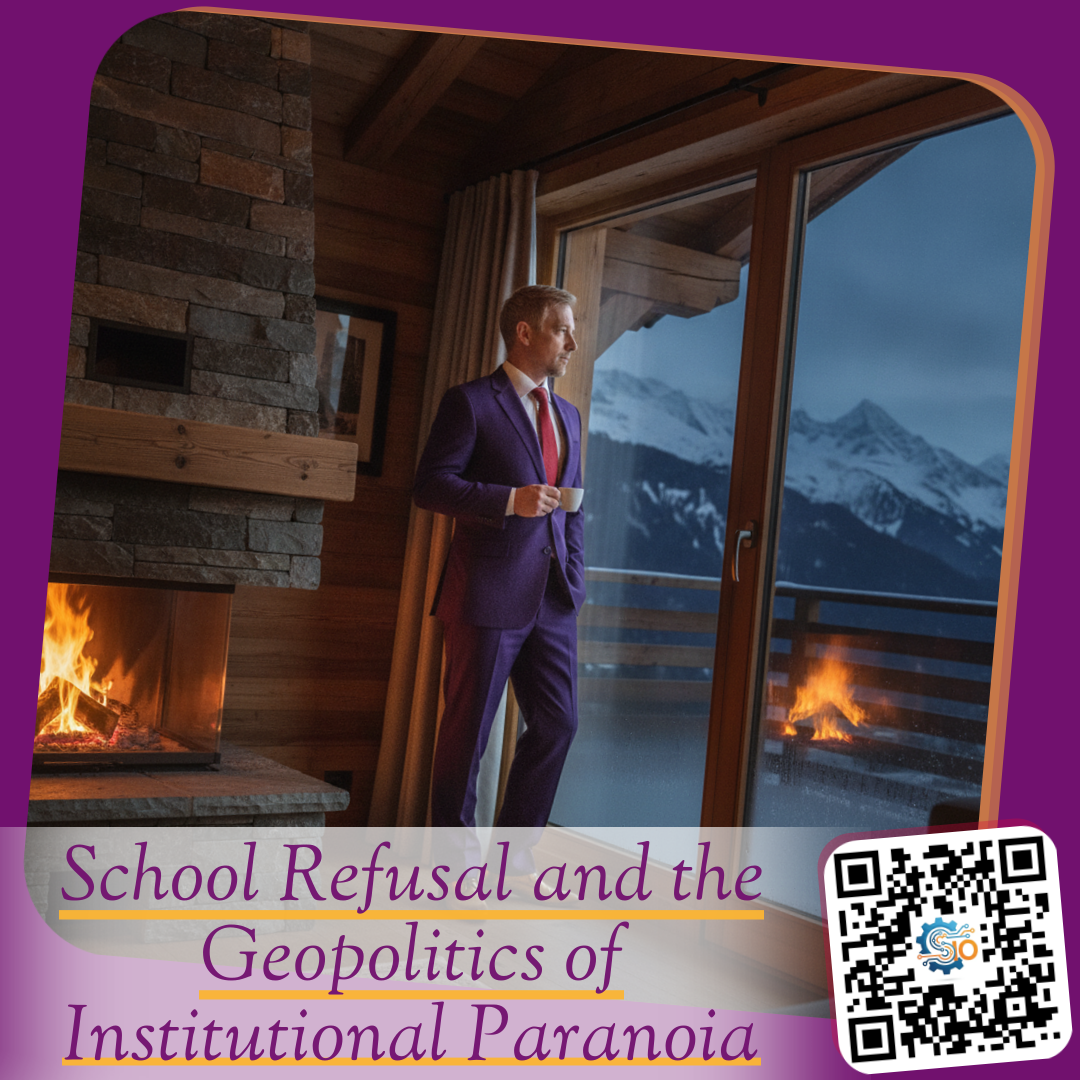
Good evening from the quiet heights of the Swiss Alps, my friends. As the midnight bells echo across the valley on this crisp September evening, I am looking out over the mountain ridge with a warm espresso in hand. Down below, the world marches to its familiar clockwork routines, yet something profound is slipping off the gears. Over the past few weeks, a single phrase has kept surfacing in my conversations with entrepreneurs, parents, and friends across the globe: school refusal.
Psychologists and educational boards love to brand this phenomenon as an individual anxiety disorder or a modern clinical pathology. They treat it as a personal glitch that requires cognitive behavioral therapy, weighted blankets, or pharmacological nudges. But if you step back and look at the larger landscape, you have to ask a far more uncomfortable question. Is school refusal really a medical syndrome, or is it an instinctive human mutiny against an institutional architecture that has lost its mind?
The Illusion of the Safe Conveyor Belt
We tell our children to sit quietly in rows, memorize standardized curricula, and submit to continuous evaluation. We promise them that if they obey the rules, the system will reward them with safety, dignity, and a predictable future. Yet children are intuitive barometers of social reality. They feel the anxiety radiating through their parents, their teachers, and their screens long before they can articulate the macro-economic forces at play.
In my recent essay, The Pixels and the Rubble: Surviving Modern Decay with Sovereign Clarity, I examined how modern institutions create synthetic narratives while their material foundations buckle. When a ten-year-old digs their heels into the carpet at seven in the morning, weeping at the thought of passing through metal detectors into a fluorescent classroom, they are not necessarily sick. They are sensing that the social contract being sold to them is already dead on arrival.
Children look ahead and see a society obsessed with micro-punishment and paranoid surveillance. At the very top, the adult world operates under intense internal suspicion, while beneath the surface, real-world tectonic plates are shifting without warning.
Micro-Discipline in an Age of Institutional Fragility
Consider the strange paradox of modern accountability. Just this month, headlines reported on Rossitsa Petkova nursing misconduct struck off disciplinary rulings in the healthcare sector. Institutional regulatory bodies will mobilize dozens of committees, hundreds of administrative hours, and legal machinery to strike a single healthcare professional off the registry for administrative failures or procedural misconduct. We run our domestic institutions on zero-tolerance policies and moral theatre, demanding perfect compliance from frontline workers who are already drowning under systemic neglect.
Meanwhile, that same neurotic impulse has infected the highest echelons of national defense. Consider the ongoing Pentagon polygraph screening military officials. Top defense personnel are subjected to polygraph interrogations and biometric loyalty tests, desperate to sniff out leaks and insider dissent. Think about the psychological state of an empire that must wire its own commanders to lie detectors because trust has vanished completely from its hierarchy.
We are building a society where the nurse is struck off for paperwork errors and the admiral is strapped to a polygraph, while the macro-machinery burns. Is it any wonder our children refuse to board this train? They see an adult world characterized by relentless administrative scrutiny, perpetual fear of cancellation, and total absence of authentic purpose.
The Macro Shock: Iran Submarine Ambitions and the Soukhoï Su-35
While Western domestic life consumes itself in micro-discipline, the real world outside our borders does not care about administrative tribunals or school attendance quotas. Just look at the shifting corridors of global power. The defense axis between Moscow and Tehran has reached a historic boiling point with the finalized transfer of advanced Soukhoï Su-35 fighter aircraft and naval technology, including reports of sophisticated Iran submarine developments intended to dominate strategic maritime chokepoints.
As I noted in Navigating Maritime Chokepoints and Building Sovereign Resilience, the physical balance of power across energy corridors directly shapes the economic reality of the coming decade. When a state acquires high-end Soukhoï Su-35 air-superiority jets alongside stealthy Iran submarine assets, the geopolitical balance of the Persian Gulf and Eurasia is permanently altered. The global order that guaranteed cheap imports, stable currencies, and lifelong corporate pensions is fracturing before our eyes.
Our children may not read defense white papers, but they understand the subtext. They know instinctively that the sterile cubicle life their schools are grooming them for belongs to a vanished era. As we saw in European Tremors, Industrial Shifts, and Building Personal Sovereignty in Fractured Times, clinging to twentieth-century models in a multipolar, volatile century is an exercise in futility.
From Administrative Captivity to Personal Sovereignty
So what is the rational response when institutions double down on surveillance while the physical world reorganizes itself? The answer is not resignation, nor is it medicating children into passive compliance. The answer is personal sovereignty.
If our systems are fragile, then our task as parents, thinkers, and builders is to construct resilient parallel paths. We must decouple our livelihoods and our sanity from legacy bureaucracies that demand total conformity while offering zero security in return. Financial freedom and intellectual independence are no longer luxury pursuits; they are basic survival tools.
When I mentor creators who want to step out of the corporate treadmill, I always advise them to simplify their tech stack and own their customer relationships directly. That is why so many independent educators and sovereign entrepreneurs rely on Systeme.io to run their entire digital ecosystems. Whether you are building an alternative homeschooling academy, launching an online consulting practice, or securing your own independent income stream, Systeme.io gives you the marketing automation, sales funnels, and course hosting you need without bloated overhead or bureaucratic gatekeepers.
Listening to the Mutiny
When a young person experiences school refusal, perhaps we should stop pathologizing their gut instincts. Perhaps we should listen to the signal beneath the noise. They are refusing an educational factory system designed for an industrial model that no longer exists, overseen by paranoid bureaucracies that monitor loyalty while foreign powers redraw world maps.
Instead of forcing our children into outdated molds, we have an obligation to model another way of living. We can teach them how to read geopolitical shifts with clear eyes. We can show them that real discipline comes from inner conviction, not institutional intimidation. Most importantly, we can teach them how to build their own systems of value, trade, and community.
As the autumn air cools here in the Alps, I am reminded that history belongs to those who build alternatives rather than those who polish the deck chairs of sinking ships.
Are we pathologizing our children because their refusal to cooperate exposes the fragile illusions of our own daily compromises? What sovereign alternatives can we build today to offer the next generation a world truly worth entering?
I wish you clarity, courage, and true independence wherever you are reading this tonight. Take care of yourself, hold your loved ones close, and connect with me across my social networks to share your perspective.