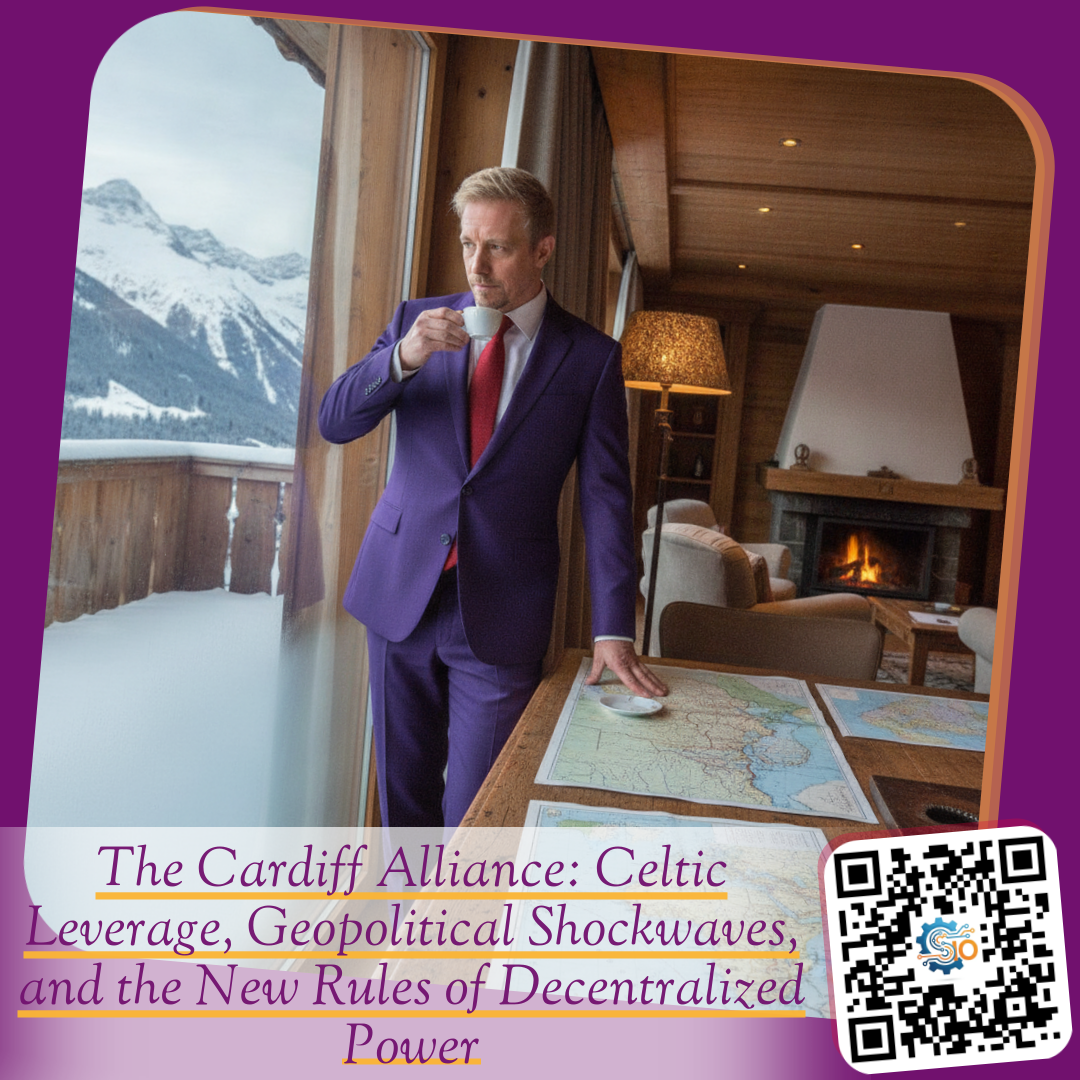
The morning sun is hitting the high peaks here in the Swiss Alps, throwing razor-sharp shadows across the pristine snowfields outside my chalet. I am sitting by the panoramic glass with a warm cup of dark roast, wearing my favorite bespoke purple suit, a vibrant red tie, and freshly polished golden shoes. There is something profoundly clarifying about looking out at ancient granite ridges while watching modern political geography crack and reform in real time.
Down in Cardiff, a remarkable political alignment is taking place. The first ministers of Wales, Scotland, and Northern Ireland have gathered around a single table. On the surface, mainstream commentators might dismiss this tripartite summit as routine intergovernmental coordination. But if you understand the physics of decentralized power, you recognize that this is an unmistakable maneuver of strategic counterweight against Whitehall.
For decades, the central command in London operated under the comfortable assumption that the Celtic perimeter would remain divided by local concerns. That calculation is unraveling before our eyes. When Edinburgh, Cardiff, and Belfast synchronize their diplomatic calendars, they are not simply trading notes on regional health services or infrastructure spending. They are building a collaborative leverage engine that alters the balance of power across the British Isles.
The Cracks in the Centralized Ledger
To grasp why this summit in Wales matters right now, you have to look at the severe economic friction rippling across the continent. Regional budgets are buckling under inflation, legacy deficits, and tight purse strings controlled by distant treasuries. Stormont is locked in substantive negotiations over funding formulas, Welsh public services face grueling choices, and Holyrood is navigating intense fiscal headwinds. When the periphery feels squeezed by an unresponsive center, historical instincts awaken.
This dynamic reminds me of what we explored in Prestige, Passion, and Protocols: Why Bloodlines and Tribal Derbies Resist the Cold Algorithm. You cannot reduce organic regional identity, cultural memory, and ancestral pride to a dry spreadsheet crafted in a distant administrative tower. When citizens feel their local autonomy slipping away, their loyalty does not default to central bureaucracy. It snaps back toward the hearth, the home territory, and the local assembly.
The ministers meeting in Cardiff understand that isolated lobbying yields scraps, while a unified regional coalition creates a structural bottleneck. By coordinating their policy demands and speaking in concert, they transform localized grievances into a formidable constitutional bloc. They are playing chess against a central apparatus that has grown sluggish, predictable, and overextended.
Enter the Transatlantic Wildcard
Just as the domestic gears began grinding, the geopolitical stage received an absolute jolt from across the Atlantic. Donald Trump concluded his high-profile visit to the Emerald Isle with characteristic theater, casually declaring that a united Ireland would be fantastic while dangling the immediate elimination of Irish whiskey tariffs. Whether calculated statecraft or instinctive media spectacle, those remarks sent shockwaves through both Dublin and Westminster.
Diplomatic circles scrambled to parse the nuance, but the strategic damage to the status quo was already accomplished. When a heavyweight political figure publicly questions long-standing constitutional boundaries while offering lucrative trade incentives, regional tensions suddenly internationalize. Northern Irish unionism finds itself forced into defensive posture, republicans sense unexpected momentum, and London is left looking like a bystander in its own historic sphere of influence.
This sudden volatility dovetails precisely with our discussions in The Great Capital Flight: From Shiplap Fantasies to Geopolitical Chokepoints. Power and capital never sit quietly inside legacy institutions once alternative corridors open up. Whether it is physical wealth moving across international boundaries or political authority shifting toward regional coalitions, the flow always moves toward higher autonomy and greater strategic agility.
The Architecture of True Autonomy
Watching these regional leaders build sovereign leverage offers a masterclass that every ambitious creator and entrepreneur must study. Centralized monopolies always follow the same playbook. They control the purse strings, enforce arbitrary restrictions, take the lion’s share of profits, and demand absolute compliance from the participants who do the actual heavy lifting.
In the digital economy, we see the exact same trap. Countless founders surrender their operational independence to fragmented, bloated tech conglomerates that charge exorbitant platform taxes and change algorithms overnight. When you rely on fragile intermediaries to manage your distribution, your leverage drops to zero. That is why genuine sovereignty requires building your own unified, streamlined operating system from the ground up.
Whenever I design new business ventures or mentor high-performing operators, I always emphasize the absolute necessity of owning your infrastructure. Instead of chaining your business to half a dozen disconnected tools that drain your energy and cash flow, you need an integrated engine that handles sales funnels, email distribution, and digital courses in one seamless environment. That is precisely where modern digital architects rely on platforms like Systeme.io to secure total operational freedom without bureaucratic bloat. When your systems are clean, cohesive, and entirely under your command, external shocks cannot derail your momentum.
Why Decentralized Networks Always Outmaneuver Monoliths
The Cardiff summit reveals an inescapable truth about the modern era: rigid, top-heavy structures are simply too slow to manage rapidly shifting realities. When a central government must balance dozens of conflicting domestic crises while managing international trade disputes, it loses its peripheral vision. Regional players, moving with speed and aligned incentives, can quickly outflank a cumbersome state machine.
Consider the strategic components at play in this Celtic dialogue:
- Shared Fiscal Leverage: Presenting coordinated budgetary demands forces central treasuries to negotiate with a unified front rather than picking off regional capitals one by one.
- Internationalized Attention: Leveraging global diplomatic interest, from American trade statements to European partnerships, gives regional voices direct access to world stages.
- Policy Innovation: Devolved administrations can test adaptive economic frameworks far quicker than massive, lumbering central parliaments.
- Cultural Legitimacy: True authority flows from authentic community trust, a currency that local representatives hold far more abundantly than distant bureaucratic managers.
This is not merely a British constitutional sideshow. It is a microcosm of what is happening across the entire globe. From the fragmentation of international trade pacts to the resurgence of regional energy corridors, the old post-war consensus of unquestioned central command is dissolving. Those who sit waiting for orders from the top will find themselves stranded, while those who form agile alliances at the grassroots level will command the future.
Mastering Your Own Perimeter
As I watch the afternoon sunlight illuminate the snowcaps here in Valais, the takeaway for us is crystal clear. You cannot expect distant authorities to solve your local problems, protect your financial perimeter, or grant you meaningful freedom out of goodwill. Autonomy is never handed down as a charitable gift; it is negotiated from a position of unassailable leverage.
Whether you are governing an ancient nation, steering a family enterprise, or orchestrating a global digital empire, the mandate remains unchanged. Build strong regional alliances, eliminate wasteful dependencies, and maintain the courage to challenge monolithic systems when they no longer serve your goals. The leaders gathering in Cardiff know the stakes, and so should you.
Are you currently relying too heavily on centralized platforms that could alter your destiny with a single administrative whim? How can you begin building your own decentralized network of sovereign assets before the next structural shift occurs?
I wish you clarity, immense courage, and relentless momentum on your journey toward total independence. Join the conversation over on my social networks, share your perspective on these geopolitical shifts, and let us continue sharpening each other for the victories ahead.