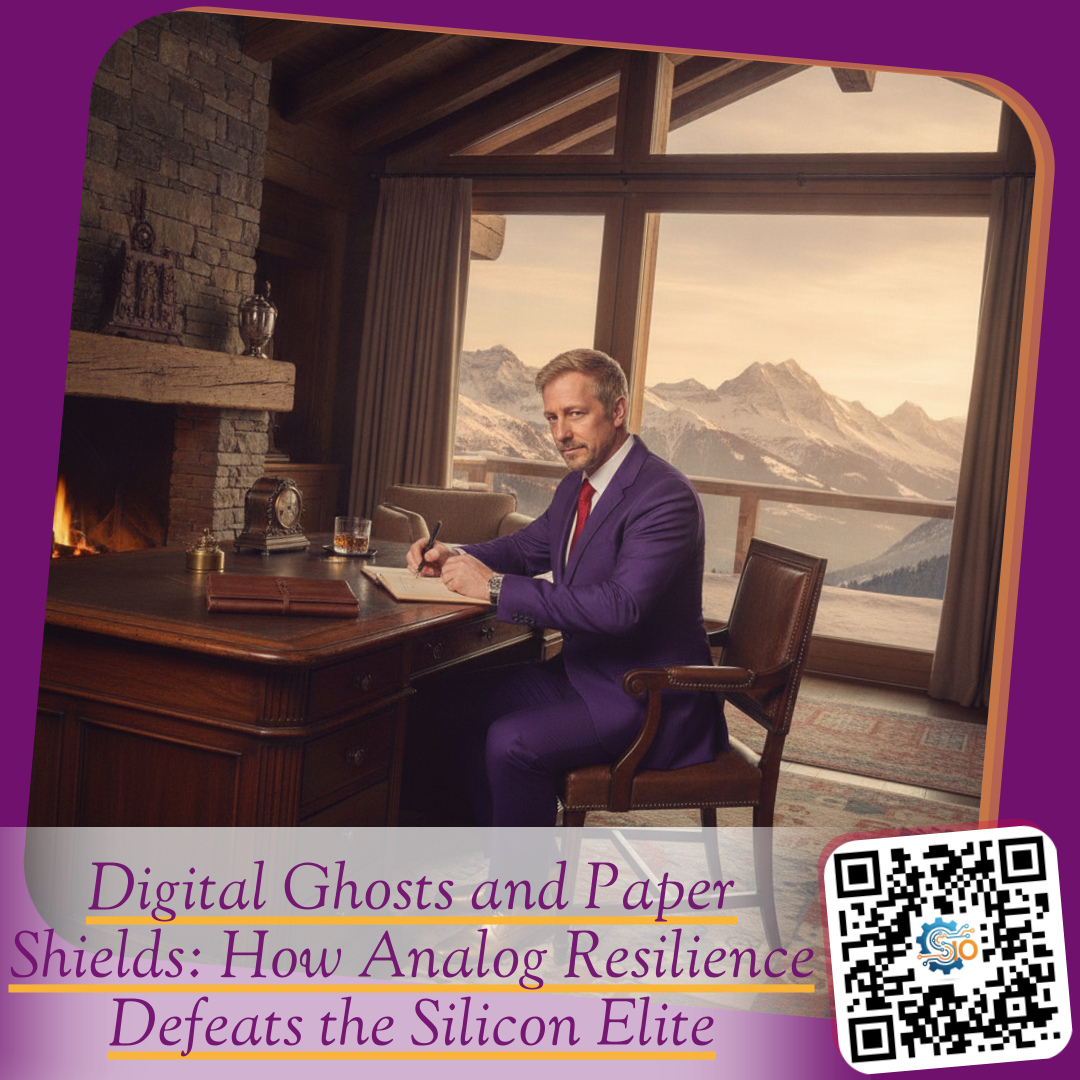
From the terrace of my Swiss chalet, looking out at the majestic peaks of the Alps as the evening sun paints the snow in shades of gold and violet, the world looks incredibly peaceful. I am sitting here in my favorite purple suit, a crisp white shirt, and my signature golden shoes, enjoying a vintage Swiss wine. But as I look down at my tablet, the news from the digital frontier tells a very different story. We are living through a bizarre, almost surreal era where the physical and digital worlds are colliding in ways we never could have imagined.
On one hand, we see the silicon elite liquidating human capital at an unprecedented rate. Giant corporations are cutting tens of thousands of real, living workers to fund the ultimate virtual vanity project: the digital resurrection of the deceased. On the other hand, the most robust survival architecture of 2026 is not coming from a high-tech laboratory or a silicon valley incubator. It is emerging from the quiet, ink-stained pages of hospitals that were forced to go back to pen and paper to survive a national cyber-attack. It is a wild time to be alive, and if you want to protect your personal sovereignty and build true financial freedom, you need to understand the rules of this new landscape.
The Ghost in the Machine: The Rise of Digital Resurrection
Let us talk about the cold reality of the tech sector today. Oracle recently cut 21,000 jobs. That is not just a statistic; those are 21,000 families whose lives have been disrupted. Why did this happen? Because the company, like so many other tech giants, is frantically shifting its focus and resources toward artificial intelligence. The silicon elite are obsessed with automation, algorithms, and virtual assets. They are sacrificing real human beings in the present to build a digital future that feels increasingly hollow.
Perhaps the most chilling manifestation of this trend is the rise of digital resurrection. In places like Ukraine, families are using advanced AI tools to recreate their fallen loved ones. By feeding old videos, voice notes, and text messages into neural networks, they create virtual avatars that can speak, reply, and interact. It is an attempt to cheat grief, but it comes at a massive cost. We are trading genuine human legacy for digital ghosts, creating a world where the living are sidelined to fund the memories of the dead.
This eerie dynamic is something I explored recently when discussing how the market is shifting. In my article, “Servers Over Pawns: The Ruthless Trade of Physical Sanctuary for Digital Ghosts”, I wrote about how our physical reality is being traded away for virtual illusions. When we prioritize the digital ghost over the physical sanctuary, we lose our grip on what actually keeps us safe, healthy, and free. We become dependent on a virtual matrix that can be shut down in an instant.
The Day the Screens Went Dark: Reclaiming the Analog Shield
If you want proof of how fragile this digital matrix really is, look no further than the recent massive cyber-attack that targeted healthcare infrastructure. Over 100 hospitals were suddenly locked out of their digital systems. Their databases, electronic health records, and communication networks vanished overnight. In a system entirely dependent on the cloud, this could have been a total disaster.
But instead of collapsing, these hospitals did something extraordinary. They went offline. Nurses, doctors, and administrators pulled out dusty boxes of physical notebooks, clipboards, and ballpoint pens. They bypassed the corrupted digital networks entirely by writing patient charts by hand and delivering prescriptions physically. By embracing analog resilience, they defeated the hackers and kept their patients alive.
This incredible story proves a point I have been making for years. Our absolute reliance on hyper-connected systems is our greatest vulnerability. As I detailed in “The Debris of a Dying Era: Why Legacy Systems and Empty Shelters Demand a New Path to Sovereignty”, our high-tech systems are highly brittle. When the digital empire experiences a systemic shock, it is the old, offline legacy systems that provide the ultimate safety net. True sovereignty means having a backup plan that does not require an internet connection or a power grid.
The High-Tech Bubble and the Market Reckoning
While the silicon elite are pushing for total digital integration, the financial markets are starting to ask some very uncomfortable questions. Tech stocks have recently taken a massive tumble, wiping out billions in market value. Why? Because investors are finally waking up to the fact that the massive spending on AI has not yet yielded real, sustainable profits. The hype is hitting the hard wall of economic reality.
Building massive data centers and training complex models requires an astronomical amount of energy, capital, and infrastructure. When the return on investment is just virtual avatars and customer service chatbots, the math simply does not add up. In my post, “Fighting Entropy in the Digital Age: Why Robots and Stock Frenzies Cannot Save Us”, I pointed out that speculative bubbles always burst when they lose touch with physical utility. You cannot eat code, and you cannot run a society solely on artificial promises.
The smartest minds in the world are realizing that we need a balanced approach. We must use digital tools to leverage our efficiency, but we cannot let them replace our physical security. We need a strategy that combines the best of modern technology with the unshakeable safety of the physical world.
How to Automate Your Business While Keeping Your Feet on the Ground
So, how do we apply this to our daily lives and our businesses? How do we enjoy the benefits of modern technology without becoming victims of its fragility? The key is smart automation. We should use elegant, simple tools to run our digital assets so that we can spend more of our actual time in the physical world, building real assets, writing in paper notebooks, and enjoying our lives.
This is precisely why I recommend Systeme.io for online entrepreneurs. Instead of trying to manage ten different complex, expensive platforms that can crash or lock you out at any moment, you can consolidate your entire online business into one clean, reliable space. With Systeme.io, your sales funnels, email marketing, and product delivery run seamlessly in the background. It is a highly efficient system that does the heavy lifting for you.
By automating the digital routine, you buy back your most valuable asset: your time. You can step away from the computer screen, enjoy a walk in the fresh mountain air, and focus on physical investments. This is how you build true financial freedom in 2026. You use technology as a servant, never as a master.
Embracing the Best of Both Worlds
The lesson of the 100 hospitals is not that we should abandon computers and go back to the middle ages. The lesson is that we must always maintain an analog backup. We must preserve our human agency. Do not let your entire life exist solely on a server controlled by a tech giant that might lay off its entire support staff tomorrow.
Write down your most important goals on a real piece of paper. Keep physical copies of your essential documents. Build real-world relationships with your neighbors and business partners. When you combine the physical power of analog resilience with the automated efficiency of smart platforms, you become truly unstoppable.
The silicon elite can keep chasing their digital ghosts and spending billions on virtual illusions. As for me, I will keep enjoying the fresh alpine air, writing my thoughts in my favorite leather journal, and using reliable tools to secure my independence.
Are we relying too much on digital platforms that could vanish during the next major cyber-attack? How can you introduce a little more analog resilience into your personal life and business today?
I wish you all the very best on your path to absolute sovereignty and peace. Let us connect on my social networks to share how you are balancing the digital and physical worlds in your own life!