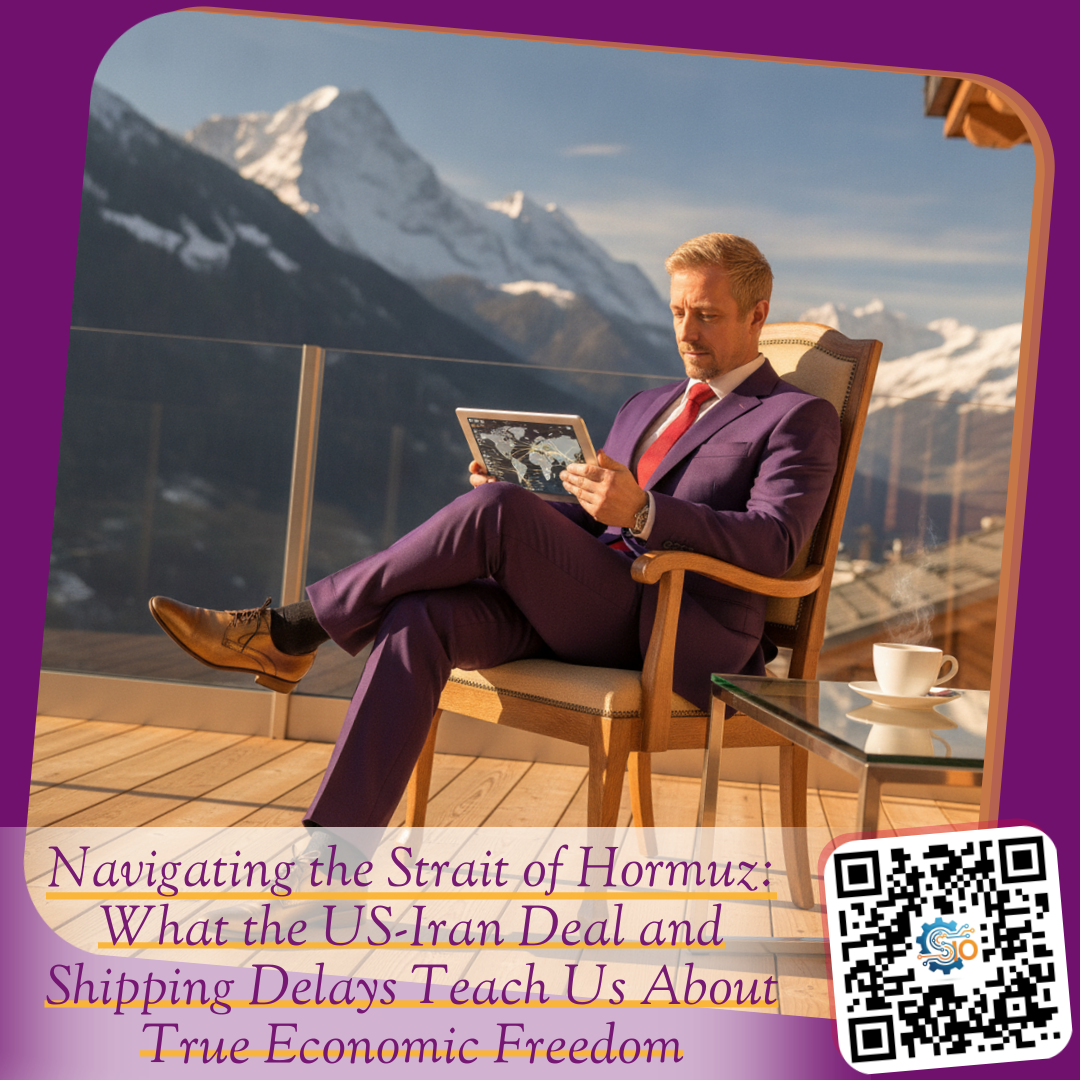
The morning sun reflects off the pristine snow of the Swiss Alps, casting a brilliant violet glow across my favorite chalet terrace. I sit here in my well-tailored purple suit, smoothing my red tie, with my golden shoes resting on the hand-crafted wooden railing. A perfect espresso is steaming on the table next to my notebook. While the world below is caught in an endless cycle of panic and sudden reaction, I prefer to look at the global landscape with calm, focused clarity.
Today, my friends, we must look toward the warm, turbulent waters of the Middle East. The global news cycle is buzzing with massive developments. The United States and Iran have agreed to a diplomatic deal, and there are loud declarations that the crucial shipping lanes of the region will reopen. Yet, if you look closer at the actual maritime data, the truth is far more complex than the headlines suggest. The gates may be declared open, but the vessels are not moving yet.
The Realities of the Strait of Hormuz Bottleneck
For months, the world watched in suspense as a blockade paralyzed one of the most vital maritime choke points on earth. Recently, we heard the announcement of a historic agreement. But as the ink dries on the treaties, shipping companies are hesitating. There are very real, practical reasons why massive cargo ships are not rushing back into the strait. Insurance rates remain sky-high, physical security guarantees are still unproven, and many ship captains are understandably cautious after enduring months of intense tension.
Think about the sailors who have been trapped in these waters, exhausted and stressed after months of isolation. Their plight shows us the stark reality of modern global commerce. When you rely entirely on physical supply chains, you are always at the mercy of geopolitical chess games. Your livelihood, your business, and your peace of mind can be frozen by a single administrative decision or a sudden military standoff. This is a fragile way to live, and it stands in direct opposition to the lifestyle of freedom we discuss here.
The Illusion of Centralized Reassurances
It is easy to get swept away by the optimism of mainstream news. We see headlines proclaiming a new era of peace and trade. However, history teaches us that top-down agreements are often temporary and fragile. In my previous writing, Geopolitical Pendulums: What US-Iran Nuclear Negotiations Teach Us About Personal Sovereignty, I discussed how quickly these diplomatic tides can turn and why relying on state agreements is a dangerous strategy for wealth preservation.
When governments negotiate, they protect their own interests, not yours. Tehran may sell this deal as a massive victory, while others view it as a matter of absolute necessity. But for the sovereign individual, the lesson remains unchanged. You cannot build a secure life if your primary economic engine is vulnerable to foreign blockades, regulatory shifts, or the whims of global superpowers. True stability is never granted by a government; it is built by your own hands.
Transitioning from Physical Vulnerability to Digital Assets
How do we escape this cycle of vulnerability? The answer lies in shifting your focus from fragile physical assets to resilient digital assets. This is a theme I explored deeply in my piece, The Great Geopolitical Reset: What the US-Iran Deal and Cape Verde World Cup Heroics Teach Us About Personal Sovereignty. True freedom means creating a lifestyle and an income stream that do not rely on cargo ships, physical borders, or centralized shipping lanes.
Imagine running a global enterprise from a laptop while sitting in a beautiful chalet, completely unaffected by maritime blockades. This is not a distant dream; it is a highly achievable reality. By leveraging modern digital tools, you can build automated businesses that deliver value instantly to customers worldwide. This allows you to bypass the physical bottlenecks of the world entirely.
When you run a traditional physical company, you have to worry about manufacturing, storage, logistics, and local regulations. A single delay at a port can ruin an entire quarter of progress. By contrast, a digital empire allows you to maintain absolute control over your distribution. You can create a masterclass, write an ebook, or design a software solution once, and sell it a million times without ever needing a physical warehouse.
To achieve this level of operational independence, you need a robust, all-in-one digital infrastructure. This is where Systeme.io becomes your ultimate ally. Instead of managing a dozen different expensive software subscriptions, you can use Systeme.io to build high-converting sales funnels, host your digital courses, manage your email marketing campaigns, and run your affiliate programs. It gives you the digital sovereignty to bypass physical trade routes entirely. When you automate your marketing with Systeme.io, your business keeps running and generating revenue, regardless of whether shipping lanes are open or closed.
The Power of Exclusivity and Digital Leverage
In another recent discussion, Exclusivity Beyond Shinnecock Hills: The Seiko Fullmetal Alchemist Watch and the Strait of Hormuz, we looked at how high-value, exclusive assets retain their power even during times of severe distribution crisis. But digital leverage is even more powerful because it has zero shipping costs and infinite scalability. When you create digital products, you have no inventory to store, no customs declarations to file, and no ships to insure.
Leverage is the key to multiplying your efforts. In the physical world, leverage is often expensive and highly risky. You have to take out loans, hire massive teams, and lease physical spaces. In the digital world, your leverage is practically free. A single automated email campaign can reach tens of thousands of potential buyers in an instant, generating sales while you sleep, travel, or enjoy a quiet afternoon in the Swiss Alps.
When you sell digital assets, online consulting, or automated memberships, your products travel at the speed of light through fiber-optic cables, completely avoiding naval blockades and high insurance premiums. You are no longer a passive observer waiting for news about global conflicts. You become the captain of your own economic vessel, navigating the global market on your own terms. This is the ultimate form of financial freedom.
Building Your Personal Port of Safety
Achieving financial freedom is a romantic journey of self-determination. It is about waking up every day knowing that your ability to provide for your loved ones is not dependent on a politician signing a treaty in a distant capital. The current delays in the shipping lanes are a wake-up call for anyone who still relies solely on traditional, physical business models. It is time to transition into the digital age and claim your sovereignty.
It is time to audit your life and your business. Ask yourself how much of your wealth is tied to systems you cannot control. By transitioning to digital products, automated systems, and global online communities, you insulate yourself from the turbulence of international relations. You create a life of true luxury, peace, and uninterrupted prosperity. The mountains here in Switzerland do not shake when shipping lanes close, and neither should your bank account.
The Path Forward
As the sun climbs higher over the Alps, illuminating my golden shoes, I am reminded of how beautiful life can be when you take full control of your destiny. Do not wait for global powers to clear the path for you. Build your own path, secure your own sovereignty, and design an economic engine that never sleeps. The digital ocean is always open, and the wind is in your sails.
How much of your current income is vulnerable to physical supply chain disruptions?
What steps are you taking today to build your own digital engine of freedom?
I wish you all absolute success and prosperity on your journey. Let us continue this exciting conversation on my social networks, and let us build a life of luxury and freedom together.