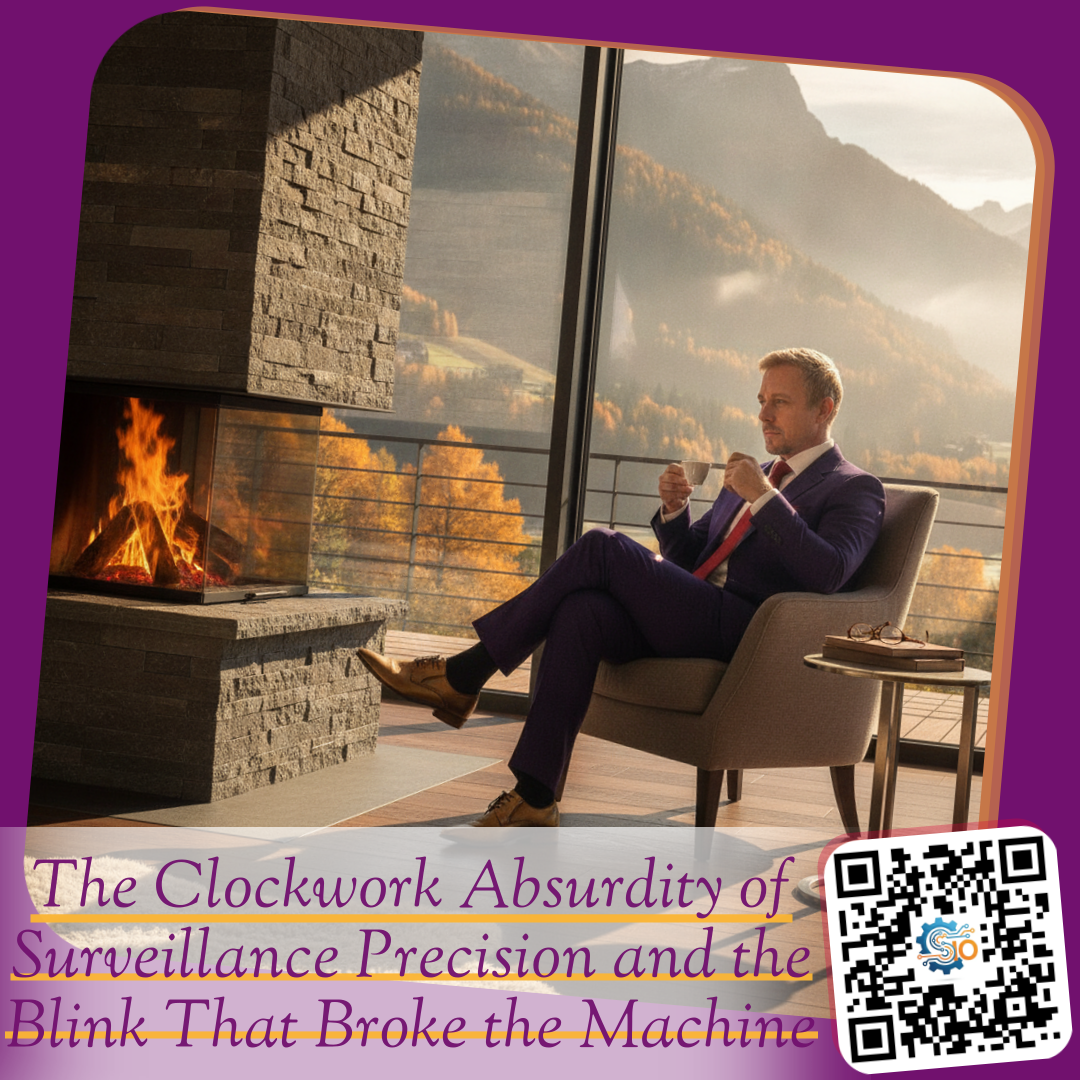
Good morning, my friends. Up here in the Swiss Alps, Tuesday dawn has painted the peaks in cold shades of rose and silver. I am sitting by the fire in my purple suit and red tie, fresh espresso in hand, with the golden shoes resting comfortably on the cedar floorboards. Looking out across the valley, everything seems orderly, balanced, and serene. Yet, looking down at the news feed this mid-October morning of 2026, the contrast between human technical capability and institutional stupidity has reached an astonishing peak.
Consider the strange paradox of the world we currently navigate. In a single news cycle, we learn that automated road cameras equipped with machine vision recently identified nearly 19,000 road offences in a single sweep, catching drivers holding phones, shifting seatbelts, or adjusting their steering grip with surgical precision. On the other side of British manufacturing, designers have managed to engrave microscopic ciphers and ultraviolet clues onto a commemorative Cluedo coin, turning loose pocket change into a high-precision puzzle. The institutional machinery possesses the computational power to monitor millions of involuntary micro-movements and the industrial finesse to carve microscopic riddles onto metal.
Yet, when a bright young student with severe physical disabilities asks to sit an exam by spelling out his answers through the conscious, mechanical precision of a blink, the entire institutional apparatus grinds to a dead halt. The exam board refuses him. The system cannot compute. The machine that claims to see everything suddenly claims it cannot accommodate an eyelid.
The Selective Blindness of the Modern Bureaucracy
It takes a special kind of institutional paralysis to track thousands of drivers across highway networks while claiming that an individual pupil blinking at a screen presents an insurmountable administrative challenge. We are living through what I previously described in When AI Feelings Trump Human Dignity: Navigating the Bizarre Moral Order of 2026, where systems are obsessed with superficial algorithmic perfection while failing real human souls at the exact point where empathy and adaptability are required.
Think about the sheer engineering invested in surveillance. Millions of dollars flow into cameras capable of peering through tinted windshields at highway speeds to detect a phone resting on a commuter lap. We celebrate the technical triumph of tracking nineteen thousand minor infractions without human intervention. We marvel at miniature collectible coins minted with hidden ciphers honoring detective games. We have solved the geometry of surveillance and the manufacturing of novelty.
However, when a human mind trapped inside a non-verbal body seeks to demonstrate knowledge through an eye-tracking assistive board, the rulebook freezes. The examiners panic about security protocols, standardized time limits, and invigilation forms. The gear-train that effortlessly tracks our every move cannot bend its rigid little spine to let a determined teenager prove his worth. This is pure, unadulterated institutional rigidity.
Algorithmic Muscle Versus Real Human Sovereignty
What does this reveal about the direction of our societies? It shows that modern administrative institutions do not value precision for the sake of human flourishing. They value precision strictly for the sake of compliance and extraction. When precision serves to issue a fine or market a collectible product, resources are infinite. When precision demands patience, human discretion, and personalized accommodation, the administrative budget instantly evaporates.
In our earlier discussion on The Rise of Analog Sovereignty and the New Human Premium, we explored how the most valuable qualities in an automated world will be human willpower, grit, and genuine cognitive effort. What could represent human dignity more powerfully than a young person fighting through physical limitations to spell out essays letter by letter, blink by blink? It is an act of pure triumph. It deserves applause, not a bureaucratic denial slip.
When institutions operate this way, they expose their own systemic decay. As we observed when examining The Clockwork Fragility of Modern Systems and the Case for a Three-Day Rhythm, rigid systems that refuse to adapt to human reality always become fragile. They rely on an illusion of total control, but that control shatters the moment life presents an organic scenario that does not fit neatly into an automated database template.
Building Systems That Serve Freedom Instead of Choking It
Whenever I see institutions behave with this cold incompetence, it reinforces why I spend my life preaching digital autonomy, entrepreneurship, and clean operational architecture. The traditional public bureaucracies are bloated dinosaurs. They adopt technology primarily to watch you, tax you, and restrict you. They rarely adopt it to liberate you.
If you run a modern business, your design philosophy must be the exact opposite. Technology exists to reduce friction for real people, not to build unscalable walls of red tape. When I organize digital operations, funnel architectures, and client systems, I demand tools that eliminate manual headaches while keeping human communication front and center. That is why so many independent entrepreneurs rely on agile platforms like Systeme.io to handle payments, memberships, and marketing pipelines in one seamless environment. You set up intelligent workflows so that you have the freedom to treat your customers, students, and collaborators like sovereign individuals rather than automated statistics.
True leverage does not mean building cold, indifferent funnels. It means building frictionless engines that free up your mental bandwidth so you can actually care about people. A well-designed workflow simplifies logistics so that human nuance can thrive.
The Courage in an Eyelid
The image of that student sitting in front of his board, ready to blink his way through hours of complex academic assessment, should humble every bureaucrat on earth. It takes ferocious discipline to construct language through micro-gestures. It takes endless hours of mental stamina to express thoughts when your only motor output is the movement of your eyes. That student demonstrated more courage and precision in one afternoon than an entire ministry of education exhibits in a decade.
The authorities claim that verifying his answers creates logistical complications. They wonder how to authenticate his intent, how to monitor his pace, and how to grade his output against standard metrics. The absurdity is staggering. We live in an age where high-resolution artificial intelligence can distinguish between a coffee cup and a smartphone at eighty miles per hour in the rain, yet institutional gatekeepers throw up their hands in helplessness because a boy wants to blink his answers on a monitor.
They do not lack the technical capability to accommodate him. They lack the institutional will. They have prioritized the standardization of the machine over the dignity of the human spirit.
Reclaiming Human Dignity in a Standardized Era
As we move deeper into the final months of 2026, stories like this serve as vital checkpoints. They force us to ask what kind of world we are actually engineering. Do we want a society that excels at automated penalties and novelty coins while slamming the door in the faces of those who fight hardest to learn?
I choose to place my bets on human tenacity every single time. Cameras can log their nineteen thousand fines, and mints can hide their clever ciphers in copper alloys, but neither compares to the quiet power of an individual refusing to surrender his mind to circumstances. As entrepreneurs, thinkers, and free individuals, our task is clear. We must reject cold institutional rigidity in our own ventures, create workflows that honor individual capability, and defend the human spirit wherever it chooses to shine.
How do we reconcile our society’s boundless capacity for automated surveillance with its shocking inability to accommodate basic human vulnerability? What does it say about our future when machines are trusted to issue penalties, yet forbidden from enabling someone to learn?
I wish you clarity, health, and unshakable determination this week. Keep your standards high and your compassion intact. While comments are turned off here on the journal to maintain peace and focus, come over to my social networks and share your perspectives on today’s story. Let us keep the conversation thriving.