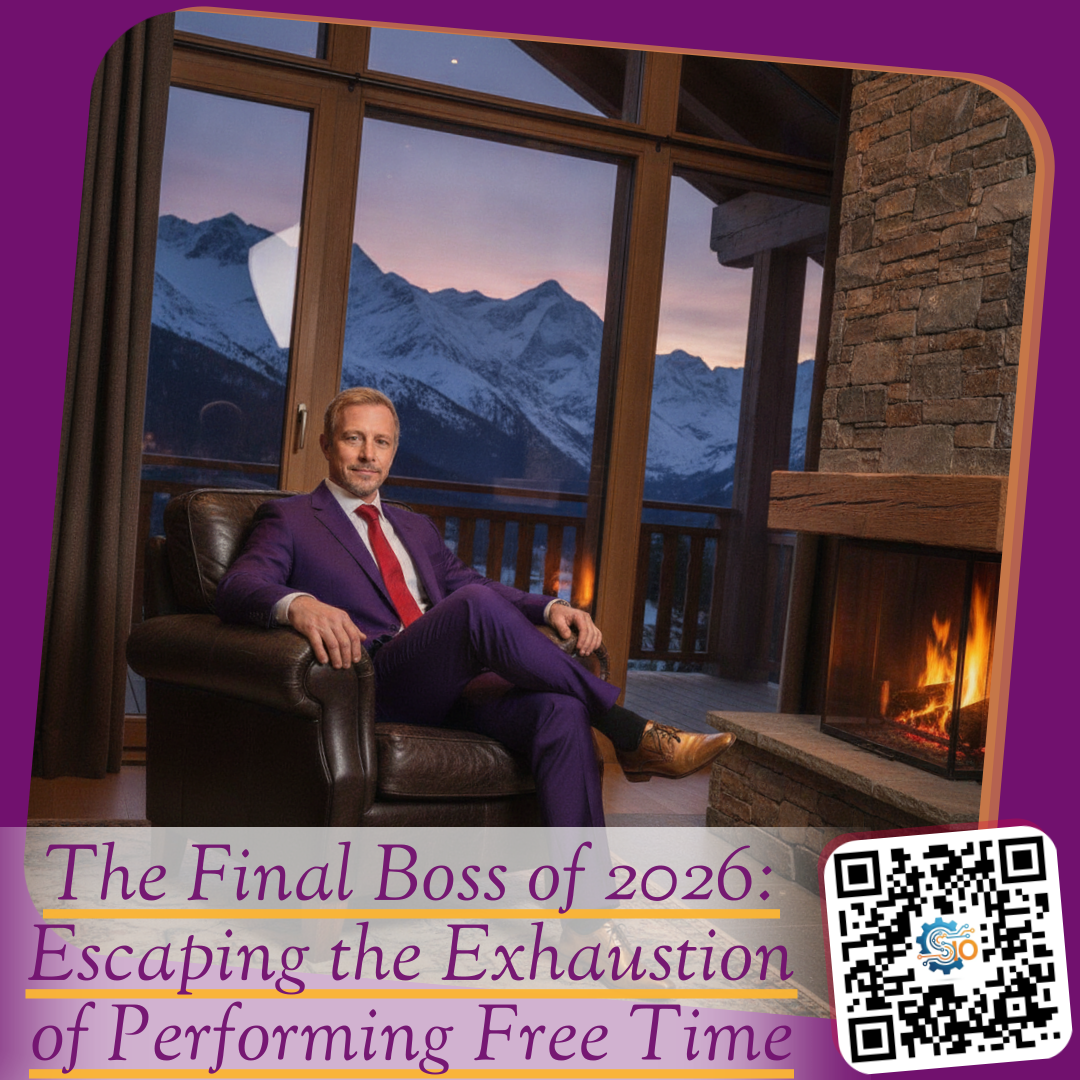
The October wind is whipping across the high peaks of the Swiss Alps tonight, dusting the pine trees just outside my chalet with a sharp layer of fresh powder. Looking out from my terrace, with a warm mug in hand and the glow of the fireplace reflecting off my golden shoes, the world seems quiet. Yet down in the digital lowlands, an entirely different spectacle is unfolding. We were promised liberation, but instead we find ourselves thrust into an arena where every moment of rest must be staged, packaged, and monetized.
For months, the tech world buzzed over Jeff Bezos outlining his vision of the three-day workweek. The narrative sounded like salvation. Advanced artificial intelligence and automated infrastructure would finally liberate humanity from the five-day grind, letting algorithms shoulder the operational weight while we reclaimed four whole days of pure, sovereign living. I even touched on this promise recently in my breakdown of The Clockwork Fragility of Modern Systems and the Case for a Three-Day Rhythm. But crossing that threshold has revealed a bitter irony. When you remove the traditional office schedule without fixing your relationship to hustle culture, leisure ceases to be an oasis. It turns into an exhausting performance.
The Illusion of the Three-Day Workweek
The dream sounded immaculate. If machines handle data entry, logistical dispatch, and algorithmic sorting, our hours belong to us again. Yet what happens when people actually receive that time? Rather than resting, society appears determined to drag the metrics of corporate output into personal life.
We see this tension everywhere. Take Nara Smith, whose hypnotic videos showcase her casually making chewing gum, marshmallows, or delicate pastries entirely from scratch while draped in pristine designer couture. It is visually gorgeous and deeply mesmerizing, but it represents a profound psychological shift: hyper-curated domestic labor reframed as leisure. What used to be mundane chores or quiet domestic downtime has become an aesthetic production. You are no longer allowed to simply toast a slice of bread. You must ferment the sourdough, churn the butter from raw cream, and film the morning light cutting across your marble countertop.
When rest requires cinematic execution, you have not actually left the office. You have merely relocated the supervisor into your own skull. In my earlier essay on Civilizational Atrophy and the High Price of Manual Overload, I warned that clinging to manual friction for its own sake creates artificial burnout. When performative perfection colonizes our weekends, the four-day weekend starts feeling heavier than forty hours under fluorescent bulbs.
From the Banana Bowl to the Royal Walkabout: Everything is Vaudeville
If Nara Smith represents the serene, hyper-manicured wing of leisure performance, the Savannah Bananas represent its chaotic opposite. The explosive popularity of the Banana Bowl tour proves that even America’s slowest pastime can no longer afford to simply exist. Baseball can no longer just be nine innings on a lazy Sunday afternoon. It must be backflips in the batter box, synchronized team dances, yellow tuxedos, and constant slapstick stimulus designed for short-form clips.
Do not get me wrong, I love showmanship. Anyone who knows my penchant for a bespoke purple suit and vibrant red tie knows I appreciate theatrical style. But there is a distinct difference between dressing up for the joy of life and feeling obligated to turn every second into a viral event. We have transformed play into an adrenaline-soaked circus because quiet recreation feels uncomfortable to an attention span trained on constant dopamine spikes.
Even the oldest institutions feel this crushing weight. Look at William, Prince of Wales, navigating the relentless digital demand for public vulnerability mixed with effortless poise. Modern royalty cannot merely cut a ribbon or attend a banquet. In our era, royal figures are expected to execute authentic relatability, manage multi-platform charitable brands, and demonstrate cinematic emotional resilience. When even a future monarch must master the choreography of modern content cycles, what hope does an ordinary professional have when trying to log off on a Friday?
Meeting the Final Boss in Street Fighter 2026 Style
Entering the autumn of 2026 feels like stepping into the climactic round of an arcade showdown. Remember the gritty pixel battles of classic gaming? With the hype around the latest Street Fighter 2026 updates reigniting our love for intense digital combat, the metaphor feels remarkably accurate. Every modern creator and entrepreneur is fighting their way through the bracket of burnout.
The early opponents were predictable: manual data entry, endless email chains, and operational bottlenecks. But the final boss of the modern hero journey is not a greedy employer or a broken computer system. The ultimate opponent is our internal compulsion to commodify our own peace. We conquer our work tasks only to face the final challenger: the urge to prove our free time is productive, beautiful, and envy-inducing.
Many of us fell into what I described in The Liquidation of Comfort Equity: From Frozen Pizza to Algorithmic Empires, trading genuine relaxation for digital validation. When you turn your hobbies into side hustles and your downtime into broadcast content, you lose the very sovereignty that financial independence was meant to purchase.
Building Genuine Freedom Instead of Stage Sets
True luxury is not about shooting forty takes of your morning coffee. True luxury is sipping an espresso in silence while the clouds drift over the Matterhorn, knowing your revenue engine runs smoothly without your frantic input.
Achieving that state requires ruthless discipline with your tech stack. If you spend your newfound free time managing fractured tools, duct-taping software subscriptions, and troubleshooting broken funnels, you remain trapped in operational quicksand. That is why I rely on streamlined, all-in-one architectures. Using Systeme.io allows digital entrepreneurs to manage sales funnels, email marketing, online courses, and affiliate management from a single dashboard. When your marketing runs on clean automation through Systeme.io, you do not have to perform your business all weekend. The infrastructure does the heavy lifting, giving you back actual sovereignty rather than scripted leisure.
Once your enterprise operates quietly in the background, you face the real test. Can you turn off the camera? Can you watch a ballgame without needing twenty viral highlights per inning? Can you bake a batch of cookies without wondering if the lighting matches your social grid?
Reclaiming the Sacred Art of Doing Nothing
The antidote to the exhaustion of performing free time is unapologetic simplicity. The three-day workweek is only a victory if the remaining four days belong to your spirit rather than your audience.
Give yourself permission to possess unrecorded moments. Walk through an autumn forest without composing a voiceover. Cook a simple dinner with flour on your apron and mismatched socks on your feet. Read a physical book without highlighting lines for a tweet thread. When your identity is tethered to internal peace rather than external approval, the performative circus loses its grip on your life.
As the stars emerge above the alpine ridges tonight, I am closing my laptop and leaving the stage behind. The show will always tempt you to perform another encore. True masters know exactly when to draw the curtain.
Are you using your automated freedom to genuinely rest, or have you simply turned your hobbies into unpaid theater? How many of your weekend rituals exist purely for you, without needing an audience to validate them?
I wish you peace, clarity, and true freedom from the noise. Connect with me across my social channels to share your thoughts on building quiet wealth, and let us celebrate the moments we keep entirely for ourselves.