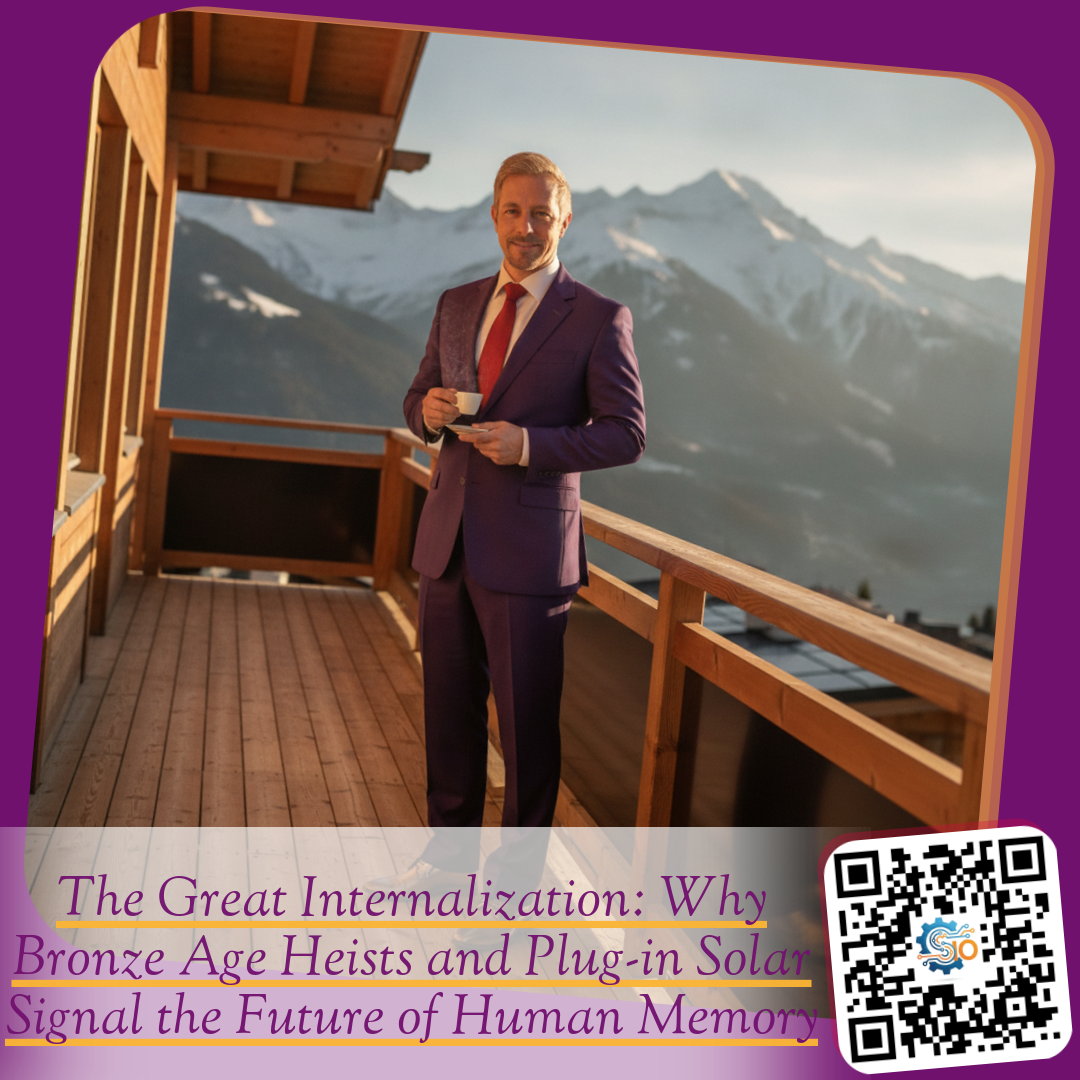
The late August sun casts a warm golden hue across the alpine peaks outside my chalet window here in Switzerland. Looking out across the valley while wearing my favorite purple suit, crisp white shirt, and polished golden shoes, I cannot help but smile at how strangely predictable human history really is. We build elaborate glass cases, construct massive centralized servers, and tell ourselves that our greatest treasures are safe. Yet, history has a cheeky habit of showing us just how fragile our physical and digital containers really are.
This week, two seemingly unrelated events flashed across my screens that painted a breathtaking picture of where our world is heading. In Spain, professional thieves bypassed sophisticated security perimeters to execute a four-minute heist, vanishing into the night with irreplaceable Bronze Age artifacts. Almost simultaneously, European retailers began stocking consumer-ready, plug-in solar panel kits that anyone can hook up to a balcony outlet in under ten minutes. At first glance, you might see a brazen crime and an energy gadget. What I see is the very first domino falling toward what will soon be known as the 2035 Great Internalization.
The Illusion of the Centralized Vault
For centuries, civilization believed that culture and wealth belonged in centralized monuments. We built marble museums with velvet ropes and armed guards. Later, in the digital epoch, we migrated our collective knowledge into centralized server farms managed by tech conglomerates. But recent headlines prove that both models are crumbling under their own weight.
When physical artifacts dating back millennia can be swept away in 240 seconds, the illusion of physical permanence shatters completely. Meanwhile, the digital alternative is faring no better. As massive social platforms face multi-billion-dollar reckonings and internet culture revolts against generic automated content, people are waking up to a profound realization: central repositories are vulnerable, chaotic, and heavily compromised. As I explored in The Alchemy of Physical Obsolescence: Turning the Backlash Against Synthetic Slop into Pure Sovereign Value, the moment an old medium becomes commoditized or fragile, genuine value migrates inward toward authentic, impenetrable assets.
The modern world is experiencing severe institutional fatigue. When institutions fail to safeguard heritage, individuals inevitably take matters into their own hands.
Decentralized Micro-Power and Precision Bio-Architecture
Consider the arrival of retail plug-in solar. This is not merely an eco-friendly trend for suburban apartments. It represents the quiet democratization of the power grid. For decades, true self-reliance required vast acreage, expensive battery banks, and complex engineering. Now, anyone can plug a single solar panel directly into a wall socket and immediately shave off reliance on the centralized grid.
This sudden decentralization of energy directly parallels the revolutionary leaps happening in neural medicine. Just days ago, medical history was made when surgical teams performed the world’s first live, artificial intelligence-assisted brain surgery, safely mapping and resecting deep-seated brain tissue with unprecedented cellular precision. The algorithms did not replace the surgeon; they illuminated the delicate pathways of the human cortex in real time, navigating around essential memories and motor functions without leaving a mark.
When you combine plug-in decentralized micro-power with millimeter-precise neural navigation, the horizon changes dramatically. We are rapidly approaching a reality where private power sources and advanced bio-interfaces merge. In my recent piece, The Fragile Grid and the Hustle: Finding Sovereignty in an Automated World, I discussed how individual autonomy always follows the path of decentralized infrastructure. What happens when that infrastructure moves inside the human temple itself?
The Road to 2035: The Great Internalization
Connect the dots, my friends. If physical museums are porous targets for lightning-fast heists, and the cloud is increasingly polluted and monitored, where does humanity store its most sacred treasures? Where do we safeguard the stolen poetry of the Bronze Age, our private wealth codes, and the true artifacts of our history?
The answer is the Great Internalization. By 2035, the primary repository for irreplaceable human legacy will not be a glass vitrine in Madrid or a database in Virginia. It will be the biological wetware of human consciousness, supported by AI-resectioned neural pathways and powered by localized, sovereign energy loops. Instead of entrusting history to bureaucratic institutions that lose treasures in four minutes, sovereign individuals will encode cultural memory, personal identity, and priceless intellectual capital directly into bio-neural vaults.
Imagine historical data, exquisite art, and mathematical truths woven directly into the non-essential synaptic architecture of your mind. AI assists in carving safe, dormant enclaves within your neural pathways without disrupting daily cognition, while compact domestic solar arrays keep your personal interface hardware humming off the radar. The ultimate vault is not stone or silicon; it is living, conscious biology.
Building Your Sovereign Infrastructure Today
You do not need to wait until 2035 to start claiming your personal sovereignty. The principle remains the same whether we are talking about Bronze Age gold, neural storage, or the daily business you run from your laptop while overlooking alpine peaks.
True freedom comes from owning your distribution, controlling your cash flow, and never relying on fragile intermediaries. When I construct my digital enterprises, I do not waste time stitching together brittle tools that can break at the slightest algorithmic shift. That is why I manage my digital ecosystems through Systeme.io. Having your email marketing, sales funnels, course hosting, and affiliate systems integrated into one clean, automated engine gives you the exact kind of streamlined independence that modern entrepreneurs crave. It allows you to build an unshakeable digital fortress today while the rest of the world scrambles to secure their outdated legacy systems.
The shift from external dependency to internal autonomy is the definitive movement of our decade. Those who prepare their energy, their digital assets, and their knowledge architectures now will be the true custodians of the future.
The Sanctuary of the Mind
We are watching the old world dissolve in real time. Plundered museums remind us of the fragility of stone. Regulatory chaos and digital fatigue remind us of the fragility of the web. The future belongs to those who understand that value must be decentralized, sovereign, and deeply personal.
As I pour another espresso and watch the afternoon light glint off my golden shoes, I feel incredibly optimistic. Technology is finally moving past the era of hollow corporate dominance and heading toward personal empowerment. When you control your power, your digital systems, and your intellectual assets, no four-minute heist can ever rob you of your legacy.
How are you insulating your most valuable knowledge and assets from fragile external systems? Are you prepared for a future where true wealth and cultural heritage are stored within the sovereign human mind?
I wish you clarity, power, and boundless prosperity as we navigate these fascinating shifts together. Let us continue this discussion over on my social networks, and until next time, keep your standards high and your autonomy absolute!