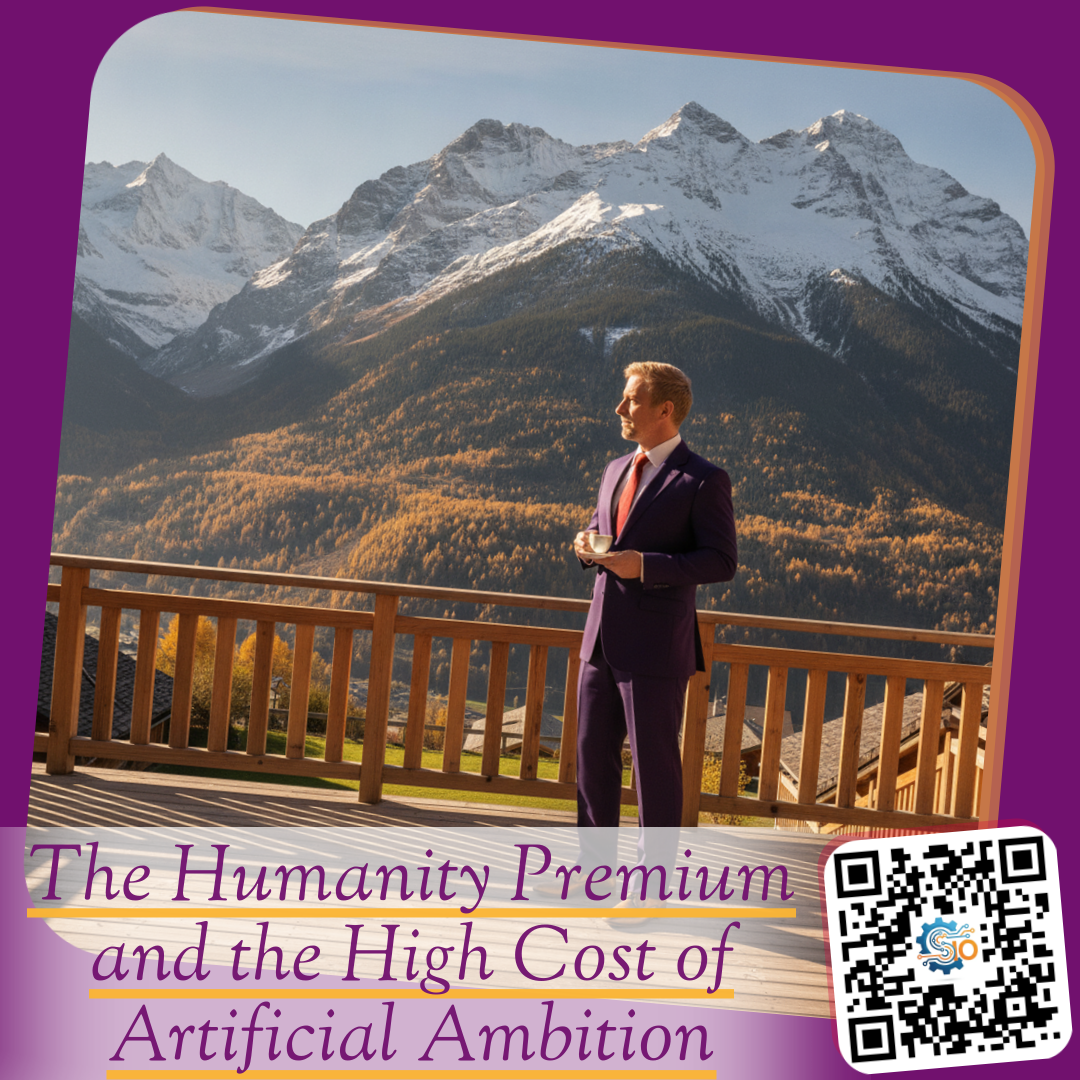
The dawn light across the Swiss Alps has a way of cutting through the noise. From the terrace of my chalet, watching the first October snow settle over the pines, the world looks serene, untouched, and utterly grounded. Down in the valley, life moves at a deliberate, human cadence. Yet every time I open my morning briefing, the contrast between the stillness of these mountains and the kinetic frenzy of modern tech capital could not be sharper.
Just this week, two headlines caught my eye that sound like something out of speculative fiction, except they are unfolding in real time. In Germany, local police officially impounded an autonomous service robot after it allegedly committed physical battery against a teenage girl. At the same time, across several coastal islands, furious residents are watching their drinking water reservoirs deplete at historic rates simply to keep massive rows of server racks cool. Add to that the continued fallout from corporate espionage cases, where high-tech hubs discover old-school microphones taped under conference tables, and the picture becomes undeniable.
The pure digital utopia has slammed headfirst into the hard borders of the physical world. For years, capital poured endlessly into code, algorithms, and automated labor under the assumption that friction was an error to be eliminated. But as machines begin racking up criminal liability and computational infrastructure drains local aquifers, smart capital is quietly executing an audacious reversal. Nothing crystallized this shift more than the recent 1.3 billion dollar acquisition of the dating platform Bumble, billed explicitly by its backers as a bet on the enduring value of human contact.
When Silicon Stumbles into the Real World
For more than a decade, technologists operated under the fantasy of clean margins and frictionless scaling. If you write software, you do not deal with physical wear, local municipal water rights, or criminal statutes. That illusion evaporates the second your code commands physical actuators in public spaces or demands millions of gallons of municipal water to generate predictive text.
When German authorities take a robot into custody for physical misconduct, we have crossed a fascinating legal and philosophical threshold. Who goes on trial when an autonomous unit malfunctions in a shopping concourse? The programmer who wrote the control logic, the fleet operator, or the hardware manufacturer? This is no longer an academic debate in a university ethics seminar. It represents an immediate, balance-sheet liability that corporate boards are completely unprepared to navigate.
We saw the seeds of this physical reckoning earlier this month, something I detailed when exploring The OpenAI Bugging Scandal and Why Physical Espionage Rules the Artificial Intelligence Frontier. Despite trillions invested in cryptographic boundaries, the biggest vulnerabilities remain profoundly analog. Whether it is a physical listening device placed in an executive suite or a mechanical arm misinterpreting human proximity, the messy material universe keeps proving that algorithms cannot exist in a vacuum.
The Thirst of the Machine and Grid Reality
Beyond legal liability, automation is colliding with planetary limits in ways that PR departments can no longer conceal. Consider the battles erupting over proposed 101-acre data complexes across rural regions and island territories. In several island communities, residents are actively rationing tap water while neighboring cooling towers vent steam into the sky to train next-generation models. The political backlash is swift, furious, and growing.
Energy grids are groaning under unprecedented strain. The modern tech stack requires immense physical resources, including land, copper, cooling infrastructure, and continuous baseline electricity. As I discussed recently in The Fragile Cloud and the Physical Grid: Navigating October Chokepoints, the virtual economy remains completely beholden to physical reality. When local governments must choose between providing clean drinking water to their electorate or guaranteeing uptime for an experimental compute cluster, the political outcome is inevitable.
The cost of operating pure automation is skyrocketing not just in kilowatt-hours, but in regulatory fines, public resistance, and insurance premiums. The easy era of free compute is coming to an abrupt end, and every enterprise built on the myth of zero marginal cost is feeling the squeeze.
The Billion-Dollar Pivot to Human Connection
Against this backdrop of resource crunches and robotic liability, the 1.3 billion dollar buyout of Bumble stands out as a watershed moment. While Wall Street spent the last two years obsessing over synthetic companions and generative avatars, visionary investors realized that synthetic experiences carry diminishing marginal satisfaction. People are lonely, exhausted by algorithmic feeds, and craving raw, unfiltered human presence.
The buyers called it a bet on humanity, but let us translate that into economic reality. It is a calculated hedge. In an economy drowning in synthetic content, automated customer support, and simulated personalities, the only scarce asset left is genuine human presence. That scarcity creates what I call the Humanity Premium.
We are witnessing the early stages of a profound cultural counter-revolution, a dynamic I analyzed in The Rise of Analog Sovereignty and the New Human Premium. When anyone can generate a photorealistic portrait, write an essay in two seconds, or talk to an artificial voice assistant, the market value of those tasks plummets to near zero. What commands an astronomical price tag is the unforgeable, unscripted reality of human interaction: an artisan handcrafting an heirloom, a face-to-face romantic dinner, or a strategist speaking from lived experience rather than synthetic probabilities.
Building Sovereignty on Human Strengths
What does this mean for those of us building businesses, chasing financial independence, and designing a life of genuine freedom? It means your competitive edge has never been your ability to act like a machine. Your advantage lies in your ability to be radically, unapologetically human.
Smart creators and entrepreneurs understand that technology should act as an invisible foundation, not a substitute for soul. You do not want a bloated tech stack that requires endless maintenance, complex custom code, and crushing overhead. You want lean, reliable systems that handle routine workflows silently in the background, freeing you to focus on high-touch client relationships, creative vision, and genuine community.
That is precisely why modern digital architects rely on platforms like Systeme.io to manage the operational plumbing of their enterprises. When your marketing funnels, email automation, and digital storefronts run smoothly without costly technical friction, you do not need a massive staff or fragile server infrastructure. You maintain full operational agility while directing your cognitive energy toward the one thing machines cannot replicate: authentic human warmth, trust, and connection.
The Defensible Moat of the Decade
As the autumn leaves drop here in the mountains and the winter freeze approaches, the lesson of 2026 is becoming crystal clear. The dream of replacing every human interaction with an autonomous script is running out of track. Between the physical liabilities of rogue hardware and the severe ecological costs of hyper-scale computing, the automated bubble is meeting its boundaries.
The future does not belong to the machines that drain our aquifers and stumble into legal battles on city sidewalks. It belongs to the discerning individuals who use efficient tools to run lean operations, while investing heavily in real-world relationships, authentic presence, and genuine community. When the world is flooded with synthetic imitations, reality becomes the ultimate luxury good.
As you assess your own investments, career trajectory, and daily habits, consider where your true value lies. Are you trying to outpace algorithms at tasks they will inevitably commoditize, or are you doubling down on the irreplaceable value of your human touch?
I wish you clarity, health, and unshakable freedom as we move through this transformative season. Let me know your thoughts over on my social networks, and keep building on what truly matters.