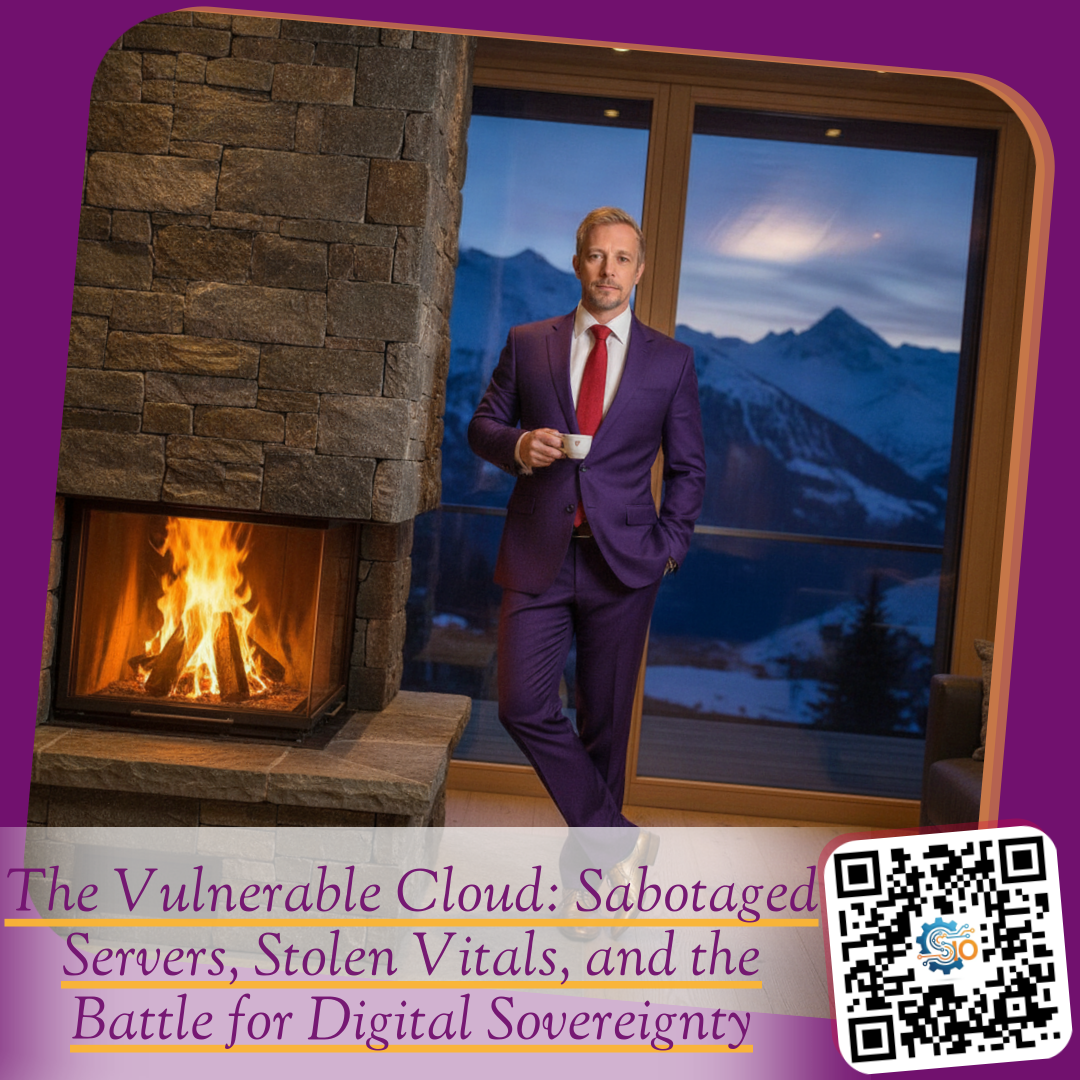
Good evening from the quiet heights of the Swiss Alps. Autumn has settled comfortably over the peaks tonight, bringing that crisp, crystal mountain air that makes a warm fireplace and a vintage red wine feel downright essential. Down in the valley, the lights are flickering like tiny circuit boards. Looking out my floor-to-ceiling windows tonight, wearing my favorite tailored purple suit and those lucky golden shoes that remind me why we work so hard for financial freedom, I found myself reading through the evening wire reports. To be completely honest with you, what is unfolding across our global networks right now ought to give every thinking entrepreneur pause.
Over the past forty-eight hours, headlines across the world have converged on a single chilling realization: our shared digital nervous system is under direct, physical, and virtual siege. In Eastern Europe, Ukrainian officials report that precision missile and drone strikes are deliberately targeting civil data centres, shifting the definition of warfare from front lines directly into the servers that store personal records, banking access, and municipal registers. Meanwhile in Poland, authorities confirmed an act of sabotage at a Starlink relay station, just as Denmark issued elevated security alerts regarding critical Baltic infrastructure.
If that feels far removed from daily commerce, glance across the Atlantic. A staggering breach compromised the internal databases of the Federal Bureau of Investigation, exposing the sensitive medical test records, including blood and urine screenings, of active special agents. Add to this the bombshell revelations out of Canberra regarding an orchestrated intrusion into private artificial intelligence servers, and a massive multi-hundred million euro fine slapped on Silicon Valley giants by European regulators for systemic data collection violations. The illusion of an untouchable, pristine cloud has vanished.
The Fragile Myth of Invulnerable Infrastructure
For more than a decade, tech evangelists sold the entire world on a seductive narrative: move everything off-site, trust massive remote facilities, and your business operations will become eternal. We were told that physical vulnerability belonged to the industrial age. Yet as the events of late September 2026 prove with brutal clarity, data centres are not ethereal clouds floating safely above the human fray. They are concrete, steel, diesel generators, and fragile glass fiber cables buried shallowly beneath public roads and seabeds.
When physical shells crack or saboteurs cut the power grid, whole sections of commerce go dark instantly. We touched upon this recurring illusion recently in The 186-Year Parchment and the 101-Acre Mirage: Why Real Digital Gold Is Built to Outlast Server Farms, examining how real endurance always outlasts speculative server real estate. When governments, rogue groups, or state actors decide that ordinary digital life is a legitimate military objective, the businesses relying solely on fragile centralized nodes wake up to find their core databases entirely inaccessible.
Consider the psychological shock when federal law enforcement discover their most intimate health biometrics have been dumped onto foreign black markets. If an agency with an eleven-figure security budget cannot prevent biological data leaks from its internal servers, what makes an independent business owner believe an unmonitored collection of disparate third-party plugins will protect customer trust?
Geopolitics, Red Carpets, and Centralized Chokepoints
This week also saw high-stakes political theater in Washington, where heads of state walked red carpets, shook hands under ornate bronze eagle statues, and traded diplomatic platitudes about artificial intelligence and trade dominance. Yet beneath all the pomp, as we explored in The Collapse of Legacy Trust, Ancient Instincts, and the Relentless Rise of China Speed, the underlying rivalry is no longer just about naval fleets or industrial tonnage. It is a sprint to control the physical compute power, silicon foundries, and raw data pipelines that govern human communication.
When global titans posture at international summits while regional conflicts systematically weaponize power lines and satellite arrays, the lesson for private operators is unmistakable: centralization is a massive vulnerability. When you house your company’s entire identity, operations, billing, and communication across fragmented, unmanaged third-party tools, you are essentially renting space in a glass house during a hailstorm.
True sovereignty requires intentional consolidation and self-reliant architectures. In my own businesses, I stopped playing Russian roulette with fragile multi-tool stacks years ago. That is precisely why having a cohesive engine like Systeme.io makes all the difference for modern creators and entrepreneurs. Instead of juggling twelve vulnerable subscriptions, brittle webhooks, and scattered data leaks, you bring your funnels, email marketing, client courses, and affiliate management under one seamless, hardened roof. It eliminates unnecessary friction, tightens security hygiene, and gives you total control over your business destiny.
Building Fortresses in an Era of Persistent Turbulence
So how do we navigate this evolving terrain without succumbing to digital paranoia? We take inspiration from classic principles of defense in depth, strategic redundancy, and personal independence. Just as an alpine chalet is engineered with thick granite foundations, reinforced timber beams, and dual heating systems to withstand severe mountain winters, your enterprise must possess distinct layers of resilience.
- First, own your customer relationships directly. If social platforms change their algorithms tomorrow or foreign data centers suffer kinetic damage, your direct subscriber list remains your lifeline. Keep it clean, keep it verified, and maintain consistent communication.
- Second, ruthlessly audit your operational dependencies. Eliminate superfluous integrations. Every unnecessary bridge between disparate software tools represents an unmonitored backdoor waiting to be exploited.
- Third, diversify your assets into real-world strength. Digital cash flows are magnificent, but financial sovereignty means converting digital gains into hard assets, land, precious metals, and tangible resources that no remote power outage can erase.
The quiet tragedy of our time is that millions of capable individuals have outsourced their critical faculties to central authorities who cannot even guarantee the safety of their own data vaults. From healthcare records leaked on dark forums to satellite ground stations burning in border provinces, the message of 2026 is ringing loud: self-reliance is no longer an eccentric philosophy. It is an operational necessity.
The Sovereign Path Forward
As the logs pop in my fireplace and the evening deepens here in Switzerland, I find myself thinking about the freedom we often take for granted. True wealth has never been about flaunting flashy gadgets or mindlessly worshiping new technologies. True wealth is waking up each morning knowing that no matter what geopolitical storm blows through the valley, your foundation is solid, your income systems are diversified, and your family’s future is firmly in your own hands.
The world may continue down its volatile path of cyber skirmishes, fractured infrastructure, and high-level political posturing. But you do not have to be a casualty of systems you cannot control. By simplifying your digital architecture, securing your customer relationships, and thinking with long-term clarity, you build something that endures long after the noise subsides.
How resilient is your current operational setup if external server hubs go dark tomorrow? Have you taken real steps this year to protect your data, your independence, and your primary revenue channels from external disruption?
I wish you clarity, strength, and unwavering confidence as you build your own sovereign future. I would love to hear your thoughts and perspectives, so connect with me on my social media channels and let us continue this important conversation together!