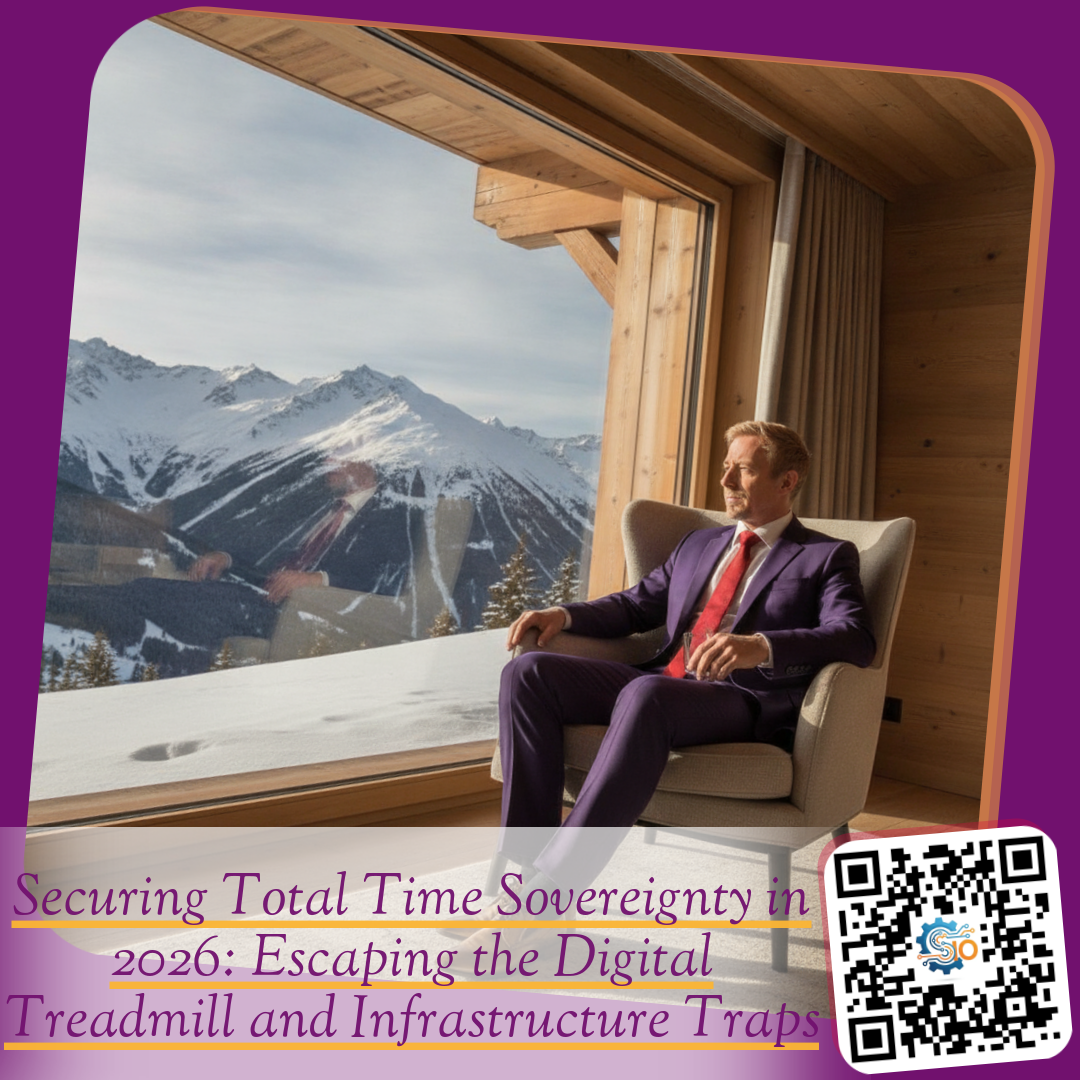
Good morning from the Swiss Alps, my friends. As I sit here on this crisp mid-October morning with a warm cup of espresso, the first dusting of winter snow is glittering across the peaks outside my window. There is something profoundly centering about watching mountain peaks catch the morning light while wearing a sharp purple suit and slipping into a favorite pair of golden shoes. It reminds me that true wealth is not merely measured in investment portfolios or luxury estates. Real luxury is the complete, uncompromising ownership of your calendar.
We are living through a peculiar shift here in late 2026. Across the globe, institutions, workers, and individuals are finally waking up to the reality that our attention and our hours are being ruthlessly strip-mined. If you do not actively defend your personal schedule, the modern world will gladly chop it into tiny commercial fragments and sell it back to you at a markup.
The Brazilian Workweek Shift and the Real Battle for Attention
Just recently, headlines captured a major milestone when Brazil’s Congress approved a historic reduction in the standard working week. Supported heavily by President Lula, the measure is designed to give millions of workers their lives back. It is a bold, admirable political achievement. Yet, when I read the news while reviewing financial reports in my study, a crucial realization struck me. What good is shaving four or eight hours off your formal employment if those recovered hours are immediately swallowed by frictionless digital noise?
A shorter official workweek does not automatically grant you sovereignty. If you leave the office early only to spend four hours trapped in an endless cycle of doomscrolling and commercial dopamine traps, you have not gained freedom. You have simply changed the identity of your overseer. The traditional industrial shift has been replaced by an insidious cognitive shift. As I explored in Systeme.io powered business setups and discussed in my piece on Turning Off the Algorithm: The New Frontier of Digital Sovereignty, real autonomy begins when you intentionally design your digital perimeter.
To truly claim the benefits of a shorter workweek, you must apply Brazil’s legislative philosophy to your personal screen time. You have to unilaterally declare an end to mandatory mental overtime. That means choosing deliberate silence over ambient distraction and treating your cognitive surplus as an irreplaceable sovereign asset.
Opting Out of the Engine: Lessons from Down Under
While South America tackles formal labor laws, Australia is testing the frontiers of digital consumer defense. Regulators in Canberra are advancing a pilot framework allowing citizens to legally opt out of algorithmic feed manipulation. Imagine having a simple toggle switch that strips away predictive engagement hooks, inflammatory viral posts, and machine-curated feeds, leaving only chronological updates from accounts you intentionally choose to follow.
For years, platforms have argued that complex recommendation engines serve consumer convenience. In reality, they are predatory retention machines engineered to keep your pupils glued to glass. Opting out of the algorithm is not an admission of weakness; it is a tactical retreat that protects your focus. It restores the internet to what it originally was: a high-utility research tool rather than an addictive psychological casino.
When you strip away the machine-learned bait, something fascinating occurs. You reclaim hours of deep mental clarity. You suddenly possess the creative energy required to build resilient ventures, write meaningful work, or simply enjoy a quiet dinner with someone you adore. Reclaiming cognitive clarity ties directly into the themes I highlighted in The Humanity Premium and the High Cost of Artificial Ambition. When artificial systems handle synthetic optimization, our irreplaceable human value flourishes only if we preserve our capacity for unhurried thought.
Ditching the Demoralising High Street Grind
Preserving your energy is not just a digital exercise; it applies equally to the physical environments you inhabit. I recently read a refreshingly candid account from a shopper in the United Kingdom who admitted why she abandoned physical retail entirely. She described entering modern department stores and shopping centers as an utterly demoralising experience. Between self-checkout errors, understaffed aisles, aggressive in-store marketing, and sensory exhaustion, brick-and-mortar retail has become an exercise in frustration.
Her solution was simple: migrate practical procurement online. She buys her staples with structured efficiency so she can preserve her peace of mind for things that actually matter. There is great wisdom in that approach. Friction for the sake of nostalgia is a terrible trade. Why waste three hours navigating bumper-to-bumper traffic and fluorescent-lit aisles when a well-curated digital purchase takes three minutes?
True lifestyle architecture is about systematically eliminating low-value friction. If an activity drains your emotional reserves without providing joy, streamline it immediately. By shifting mechanical errands into lean, automated processes, you free up the mental bandwith required to live expansively.
The Hidden Overhead of Modern Connectivity
However, as we embrace digital efficiency, we must avoid walking blindly into infrastructure traps. Consider the cautionary tale of a British farmer who leased a small corner of his land to host a major 4G mobile mast. On paper, it looked like effortless passive income. In practice, the arrangement became an absolute financial nightmare.
Changes in telecommunications legislation slashed his rental yield, while complex property rights and maintenance disputes saddled him with thousands of pounds in legal overhead. He thought he was leasing a tiny patch of dirt for guaranteed revenue; instead, he became an involuntary custodian of brittle corporate infrastructure. The operational friction eclipsed the financial reward.
There is a profound lesson here for entrepreneurs and sovereign creators in late 2026. Do not own heavy, litigious, high-friction systems when agile architectures exist. Whether you are managing real estate, physical servers, or complicated software stacks, unnecessary overhead is the enemy of agility. This is precisely why smart digital entrepreneurs lean on integrated, all-in-one platforms like Systeme.io. Instead of juggling dozens of brittle plugins, expensive server licenses, and technical headaches, using Systeme.io lets you run high-converting sales funnels, email marketing, and automated digital businesses from a single dashboard. You avoid the farmer’s dilemma entirely by keeping your operational footprint light, clean, and profitable.
Constructing Your Personal Sovereignty Matrix
How do we weave these disparate threads together into a cohesive way of living? It comes down to four fundamental operational rules that I practice daily here in the mountains:
- Cap your consumption hours ruthlessly: Take inspiration from Brazil’s labor reform. Establish a non-negotiable shutdown time for professional obligations and informational intake every single evening.
- Enforce manual digital curation: Follow the Australian model. Turn off recommendation algorithms, mute algorithmic alerts, and force your devices to serve your intentions rather than platform advertising metrics.
- Automate mundane replenishment: Eliminate demoralising physical retail errands through systematic digital procurement, preserving your physical and emotional reserves for deep creative labor and leisure.
- Reject brittle infrastructure overhead: Keep your business assets and personal lifestyle light. Avoid agreements and technical setups that require endless legal, financial, or mechanical maintenance for marginal returns.
When you align these principles, your daily existence changes dramatically. The feeling of constantly playing catch-up evaporates. You stop reacting to external alerts and start dictating the pace of your own life. You gain the luxury of unhurried mornings, deep conversations, and purposeful creative work that moves the needle.
The Path Forward in Late 2026
As the afternoon light softens across the snowfields outside my chalet, I am reminded that autonomy is never granted by decree alone. Parliaments can vote on shorter hours, and regulators can challenge Big Tech, but the final boundary must always be set by you.
If you fail to curate your attention, society will consume it without hesitation. But when you master the art of strategic subtraction, cutting out the algorithmic bait, the demoralising physical chores, and the heavy overhead traps, you discover an extraordinary reservoir of time. And time, my friends, remains the ultimate luxury.
How much of your daily schedule currently belongs entirely to you, and how much has been leased away to external algorithms? If you could reclaim eight focused hours each week starting tomorrow, what masterpiece would you build?
I wish you clarity, calm, and soaring success as you craft your own space. Connect with me on social media to share your thoughts and let me know how you are restructuring your digital boundaries this season.